Tapado Olanchano
*Tapado* means covered, for the blanket of plantain leaves sealing the pot. The tiers are not decorative: dense yuca and green plantain on the floor, meats above, ripe plantain across the top — so rendered fat and cured beef juices wash down while coconut and plantain sugars steam up.
- Prep
- 40 min
- Cook
- 2 hr
- Serves
- 8 hearty portions
- Difficulty
- Hard
Researched · Kitchen testing pending
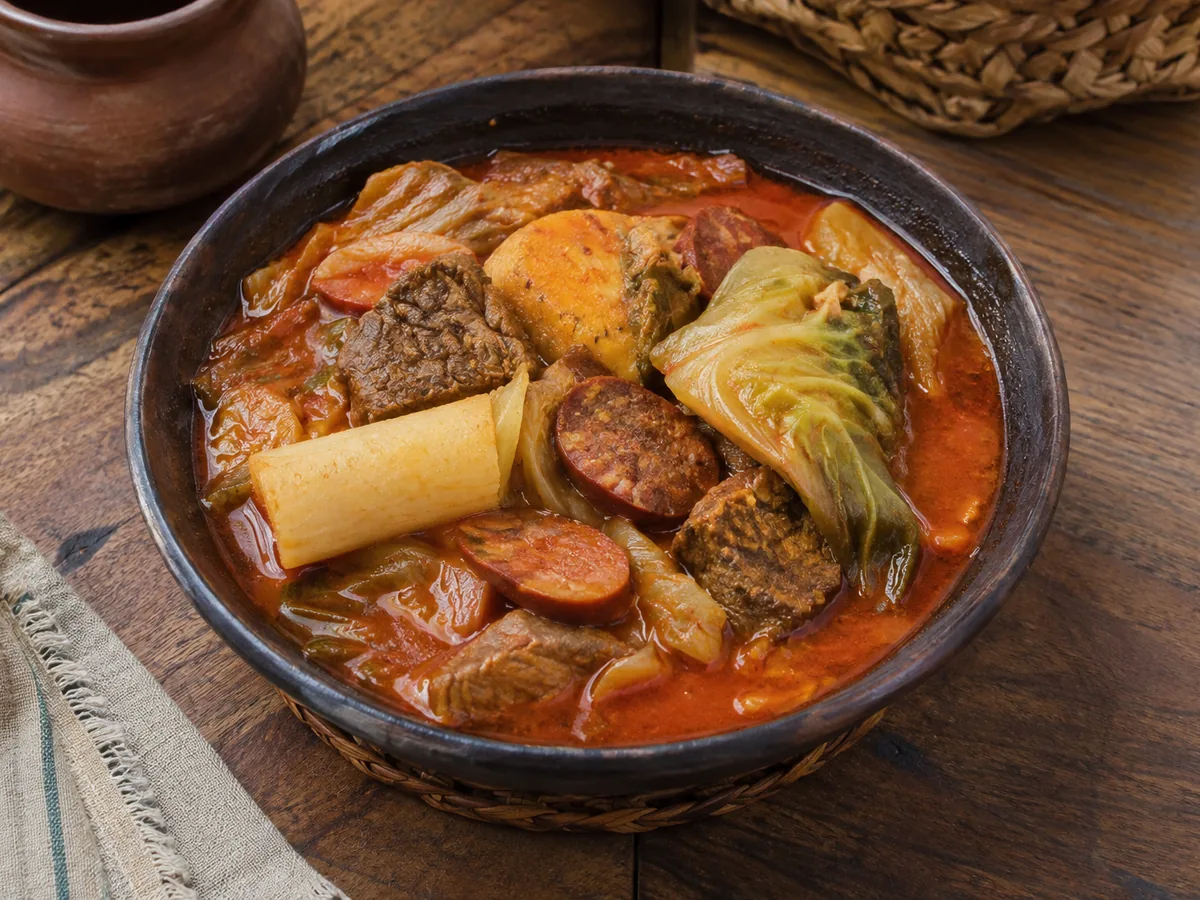
In the vast cattle-ranching department of Olancho, tapado olanchano is legendary. The word tapado means covered, and refers to the thick blanket of plantain leaves that seals the pot.
Sun-dried salted beef is soaked to strip the brine, then layered in tiers with bone-in pork ribs, longaniza and crisp chicharrones. Between the meats go sweet ripe plantains, starchy green plantains and tender yuca. Coconut milk and an achiote sofrito are poured over the tiers.
Sealed under the leaves and a heavy lid, the whole pot braises in its own steam — salty cured beef, rich pork fat and sweet caramelised plantain arriving together.
The meats
- 800 g1.76 lbSalted sun-dried beef (cecina salada), cut into 8 cm chunks
- 800 g1.76 lbBone-in pork ribs, cut into individual 5 cm riblets
- 400 g14 ozCrisp pork belly cracklings, chopped into bite-sized chunks
- 300 g10 ozHonduran longaniza, or fresh Spanish cooking chorizo, in 4 cm links
The liquid
- 600 ml2.5 cupsFresh unsweetened full-fat coconut milk
- 750 ml3.2 cupsBeef stock, or cold filtered water
The sofrito
- 45 ml3 TbspAchiote oil
- 2 large2 largeYellow onions, peeled and cut into thick 5 mm rings
- 8 cloves8 clovesFresh garlic, minced to a paste
- 2 large2 largeSweet red and green bell peppers, cored and sliced into strips
- 6 pieces6 piecesSweet ají dulce peppers, seeded and minced
- 8 leaves8 leavesFresh culantro, chopped fine
- 8 g2 tspCumin seeds, freshly toasted and ground
- 4 g1.5 TbspDried wild oregano, crushed
- 10 g2 tspFine sea saltlightly — the cecina keeps some of its cure
- 3 g1 tspCoarsely ground black pepper
The tiers
- 2 large2 largeGreen plantains, peeled and cut into 3 cm chunks
- 2 large2 largeVery ripe black-speckled plantains, peeled and cut into 3 cm chunks
- 600 g1.3 lbFresh yuca, peeled, woody core removed, cut into 4 cm chunks
To seal
- 6 large sheets6 large sheetsSmoked plantain leaves, washed and cleaned
Twelve hours, three water changes
Cured cecina has very low water activity. The long soak rehydrates the fibres while osmotic diffusion pulls the surface salt out. Skip it and the whole pot is inedible — and there is no fixing it afterwards.
Layer once, then never touch it
Stirring destroys the tiers and mashes the ripe plantain. The whole mechanism depends on the stack staying put while steam circulates through it.
Why the leaf seal matters
Sealed under overlapping leaves the pot holds slight positive steam pressure, and the volatile coconut and plantain aromas stay inside instead of leaving with the steam.
Both plantains, in different places
Green on the bottom to drink the savoury meat juices and hold a starchy bite; ripe across the top for the caramelised sweetness that answers the cured beef.
Do not lift the lid
An hour and three-quarters undisturbed. Every look releases the pressure that is doing the cooking.
Passive time, counted separately
The cecina soaks 12 hours in the refrigerator. That sits outside the times quoted above.
The five tastes on this plate
Salt is the cured beef and rib marrow, tempered by desalination. Fat is rendered pork, coconut lipids and achiote oil. Acid is quiet — lime or pickled onions supply it at the table. Heat is garlic, toasted cumin, black pepper and sweet ají dulce. Umami is cured beef glutamates, hydrolysed pork collagen and simmered plantain sugars.
Equipment
- Large bowl, for the soak
- Skillet, for the sofrito
- 10 to 12 qt enamelled cast-iron Dutch oven with a tight lid
- Large slotted spoon
- Wide serving platters
Traditionally a massive caldero over wood embers, sealed with fresh plantain leaves. A 10-to-12 quart enamelled Dutch oven works in a modern kitchen — tuck overlapping leaves down the inside walls to reproduce the seal.
Method
Desalinate the cecina10 min
Cut the salted beef into 8 cm chunks, cover with cold water, and soak refrigerated 12 hours, changing the water three times. Drain thoroughly.
Cut the salted beef into 8 cm chunks, cover with cold water, and soak refrigerated 12 hours, changing the water three times. Drain thoroughly.
Cook the achiote sofrito12 min
Sauté the onion rings, garlic, bell peppers and ají dulce in the achiote oil 8 minutes until soft.
Stir in the cumin, oregano, black pepper and culantro and cook 2 minutes. Off the heat.
Sauté the onion rings, garlic, bell peppers and ají dulce in the achiote oil 8 minutes until soft.
Stir in the cumin, oregano, black pepper and culantro and cook 2 minutes. Off the heat.
Build the tiers15 min
Lay the green plantain and yuca across the bottom of the pot in an even layer and pour over half the sofrito.
Arrange the soaked cecina, pork riblets and longaniza over the tubers, scatter the chicharrón across the meats, add the remaining sofrito, and finish with the ripe plantain across the top.
Layer green plantain and yuca evenly on the pot bottom; add half the sofrito. Arrange soaked cecina, ribs and longaniza above, then chicharrón and remaining sofrito. Finish with ripe plantain on top. Keep layers intact; do not stir.
Liquids and the leaf seal5 min
Pour the coconut milk and stock gently down the inside perimeter of the pot so the tiers are not disturbed, and season with 2 tsp salt.
Lay overlapping plantain leaves directly over the food, tucking them firmly down the interior walls, and clamp the heavy lid on.
Pour coconut milk and stock gently around the inside perimeter without disturbing layers; season with 2 tsp salt. Cover food with overlapping plantain leaves, tuck firmly along the inner walls and clamp on the heavy lid.
Steam-braise1 hr 55 min
Set over medium heat until you hear it boiling actively, about 10 minutes, then drop straight to the lowest setting.
Hold a gentle enclosed steam-braise 1 hour 45 minutes undisturbed. Do not lift the lid.
Set over medium heat until you hear it boiling actively, about 10 minutes, then drop straight to the lowest setting.
Hold a gentle enclosed steam-braise 1 hour 45 minutes undisturbed. Do not lift the lid.
Unveil
Peel back the fragrant leaves and check that the ribs and cecina are fork-tender at 90–93 °C and the yuca gives completely.
Lift the layers onto wide platters with a slotted spoon and ladle the coconut-scented juices over everything. White rice and lime alongside.
Open the leaf covering; check ribs and cecina are fork-tender at 90–93 °C and yuca yields completely. Lift intact layers onto platters with a slotted spoon; ladle over coconut juices. Serve with white rice and lime.
Sensory cues of doneness
- Visual: steam billowing off glistening mahogany cured beef, tender ribs, dark chicharrón, golden ripe plantain and soft yuca.
- Auditory: a quiet rhythmic bubbling under the leaf seal, with no violent splashing.
- Olfactory: wood smoke, cured beef, sweet coconut, caramelised plantain, garlic and wild culantro.
Look for glossy mahogany cecina, tender ribs, dark chicharrón, golden ripe plantain and soft yuca. Keep quiet rhythmic bubbling beneath the leaves; expect smoke, cured beef, coconut, caramelised plantain, garlic and culantro aromas.
Troubleshooting
- Unbearably salty.
The cecina was not soaked, or the water was not changed. Twelve hours, three changes.
- Mashed plantain and no distinct layers.
The pot was stirred. Layer once and leave it entirely alone.
- A dry stew with little aroma.
There was no leaf seal, so the volatiles escaped with the steam.
Substitutions
One-to-one global substitutions, with the technique adjustment each one requires.
Ingredient substitutions
| Ingredient | Replace with | Culinary impact and technique adjustment |
|---|---|---|
| Cecina salada | Brazilian carne seca, or salted beef brisket | One-to-one, soaked 12 to 16 hours before it goes near the pot |
| Plantain leaves | Parchment paper pressed down under foil | Traps the steam, though the leaves give an aroma foil cannot |
| Longaniza | Fresh Spanish cooking chorizo, or mild Italian sausage | One-to-one, sliced into 4 cm links |
Scaling
Half, for 4 portions
Halve everything in a 6-quart Dutch oven and steam-braise 1 hour 30 minutes.
Double, for 16 portions
Double everything in a 20-quart stockpot, with enough plantain leaves to form a proper airtight dome.
What to serve it with
- Steamed white rice, for the sweet-savoury coconut juices
- Encurtido hondureño with habanero and vinegar
- A crisp Port Royal, or cold chicha de maíz
Questions
What replaces Honduran cecina?
Mexican cecina salada, Brazilian carne seca, or well-soaked salt-cured brisket.
Why both green and ripe plantain?
Green absorbs the savoury meat juices and keeps a starchy bite; ripe brings the caramelised sweetness that balances the cured beef.
Can it be made without pork?
Tapado olanchano is defined by the beef-and-pork mixture, but the coastal tapado de pescado uses fresh fish with the same coconut milk.