Pastelitos de Carne Hondureños
Corn masa, not wheat, tinted sunset-orange with achiote — and one tablespoon of wheat flour stirred in, because that trace of gluten gives the tensile strength to roll a 3 mm disc that will not tear at the fold. Cooked rice and fine potato dice in the filling absorb the beef juices so nothing steams the shell open.
- Prep
- 35 min
- Cook
- 20 min
- Serves
- 12 large pastelitos
- Difficulty
- Medium
Researched · Kitchen testing pending
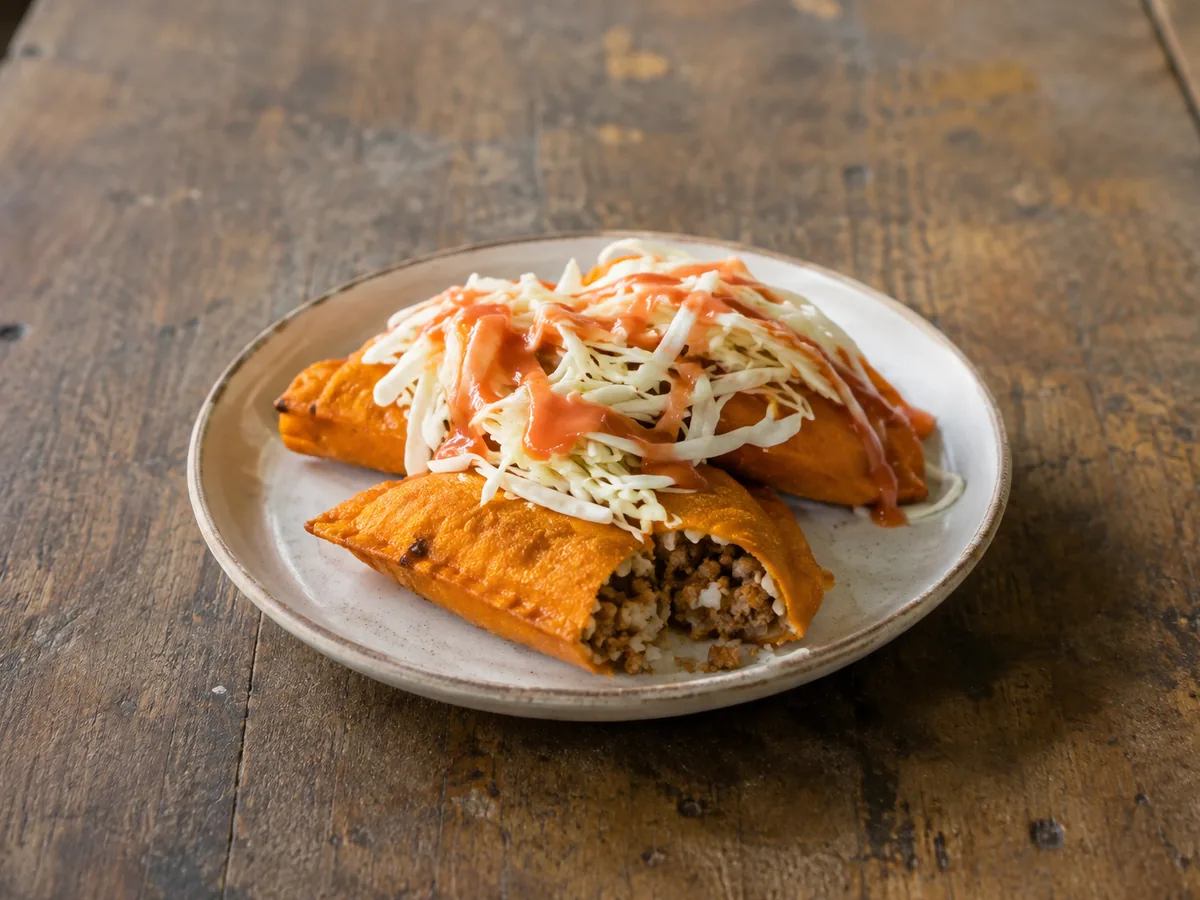
In afternoon markets from Tegucigalpa to Choluteca, street vendors fry golden batches of pastelitos de carne.
Unlike the wheat-dough empanadas further south, Honduran pastelitos are made from nixtamalised corn masa tinted a warm sunset orange with achiote oil. The filling is distinctive: lean ground beef cooked with onion, garlic and cumin, then tossed with cooked white rice and finely diced potato that binds the meat juices.
Folded into crimped half-moons and dropped into bubbling lard, they fry into a blistered crunchy shell — then arrive buried under shredded cabbage, drenched in warm tomato sauce and dusted with salty queso duro viejo.
The masa
- 500 g3.2 cupsPrecooked white cornmeal
- 600 ml2.5 cupsWarm filtered water, about 40 °C
- 30 ml2 TbspAchiote oil, for the colour
- 15 g1 TbspAll-purpose wheat flourfor elasticity — this is what stops it cracking
- 8 g1.5 tspFine sea salt
The filling
- 500 g1.1 lbLean ground beef chuck (85/15)
- 30 ml2 TbspRendered pork lard, or neutral oil
- 1 medium1 mediumYellow onion, minced into fine 3 mm brunoise
- 4 cloves4 clovesFresh garlic, minced to a paste
- 1 medium1 mediumSweet green bell pepper, cored and finely diced
- 200 g1.5 cupsRusset potatoes, peeled, cut into fine 5 mm dice and boiled tender-firm
- 150 g1 cupCooked long-grain white rice
- 6 g1.5 tspCumin seeds, freshly toasted and ground
- 3 g1 TbspDried wild oregano, crushed
- 8 g1.5 tspFine sea salt
- 2 g½ tspFreshly ground black pepper
To fry and serve
- 1 L4.2 cupsHigh-smoke-point frying oil or lard
- 400 g½ headGreen cabbage, shredded paper-thin
- 240 ml1 cupWarm cooked tomato and onion sauce
- 80 g¾ cupQueso duro viejo, finely grated
One tablespoon of wheat flour
Nixtamalised corn masa has no gluten and tears at the fold. That single spoon introduces just enough tensile strength to press a 3 mm disc and fold it without cracking.
Rice and potato bind the juices
Potato starch absorbs the free beef juices so the filling is moist but releases no steam inside the sealed turnover. That is what stops a blowout in the fryer.
The filling must be cold
Warm filling softens the raw masa from the inside and it tears in the oil. Cool it completely before assembly.
Press the air out
Trapped air expands violently at 180 °C and bursts the pastelito. Press the half-moon flat through the plastic before you crimp.
180 °C, steady
Below 175 °C the cornmeal drinks the oil and the shell goes greasy instead of blistering into rigidity.
Passive time, counted separately
The filling cools completely, the masa rests 15 minutes under a damp towel, and the fried pastelitos drain 2 minutes. None of that is active work.
The five tastes on this plate
Salt seasons the masa, the beef and the queso duro on top. Fat is the fried corn shell, lard in the filling and the frying oil. Acid is the cooked tomato sauce and the cabbage cutting the fried starch. Heat is toasted cumin, garlic, sweet pepper and black pepper. Umami is beef fond, toasted masa and aged dry cheese.
Equipment
- 12 in skillet, for the filling
- Large bowl
- Tortilla press or flat board, with heavy plastic sheets
- 5 to 6 qt Dutch oven with an oil thermometer
- Fork, for crimping
- Slotted spoon and a wire rack
Traditionally a heavy caldero over a high gas burner. A 5-to-6 quart Dutch oven with an oil thermometer works in a modern kitchen — holding a strict 180 °C is the difference between a crisp shell and an oily one.
Method
Cook the filling18 min
Sauté the onion, garlic and green pepper in the lard 5 minutes until soft, add the beef and brown 6 minutes broken into small morsels.
Stir in the cumin, oregano, black pepper and 8 g salt, then the cooked potato and rice, and cook on low 4 minutes. It should be moist with no pooling liquid. Cool completely.
Sauté onion, garlic and pepper in lard 5 minutes until soft. Crumble in beef; brown 6 minutes. Add cumin, oregano, pepper, 8 g salt, cooked potato and rice; cook on low 4 minutes until moist without pooled liquid. Cool completely.
Knead the achiote masa8 min
Whisk the cornmeal, wheat flour and 8 g salt, add the achiote oil, then work in the 600 ml warm water gradually, kneading 3 to 4 minutes into a smooth pliable dough that does not stick and shows no cracks when pressed.
Cover with a damp towel and rest 15 minutes.
Mix cornmeal, wheat flour and 8 g salt; add achiote oil, then gradually work in 600 ml water at about 40 °C. Knead 3–4 minutes until smooth, supple and nonsticky without cracks. Cover with a damp towel; rest 15 minutes.
Press the discs8 min
Divide into 12 balls of about 90 g. Between two plastic sheets on a tortilla press, flatten each into a 15 cm circle, 3 mm thick.
Divide into 12 balls of about 90 g. Between two plastic sheets on a tortilla press, flatten each into a 15 cm circle, 3 mm thick.
Fill and crimp12 min
Peel back the top sheet and place 2 generous tablespoons of cold filling in the centre.
Using the bottom sheet, fold into a half-moon, press the edges firmly through the plastic to expel all trapped air, then crimp the curved edge tightly with fork tines.
Place 2 generous tablespoons cold filling in each disc. Fold into a half-moon using the bottom plastic sheet; press through plastic to expel all air. Seal the curved edge tightly with fork tines.
Fry20 min
Heat the oil to 180 °C and lower in three at a time.
Fry 3 to 4 minutes, flipping once, until deep golden-orange, crisp and covered in tiny blisters, with the filling at 74 °C. Drain on a wire rack 2 minutes.
Heat the oil to 180 °C and lower in three at a time.
Fry 3 to 4 minutes, flipping once, until deep golden-orange, crisp and covered in tiny blisters, with the filling at 74 °C. Drain on a wire rack 2 minutes.
Garnish and serve
Two hot pastelitos per plate, mounded with shredded cabbage, spooned with warm tomato sauce and dusted heavily with grated queso duro.
Lime wedges and spicy encurtido alongside.
Two hot pastelitos per plate, mounded with shredded cabbage, spooned with warm tomato sauce and dusted heavily with grated queso duro.
Lime wedges and spicy encurtido alongside.
Sensory cues of doneness
- Visual: a deep sunset-orange crescent with blistered crisp edges, under pale cabbage, red salsa and white cheese.
- Auditory: a loud crunchy snap through the fried corn shell, and lively bubbling in the fat.
- Olfactory: fried corn masa, toasted cumin, sweet alliums, beef and warm tomato.
Look for deep golden-orange crescents with crisp blisters under pale cabbage, red sauce and white cheese. Expect a crunchy corn shell and lively frying bubbles, with aromas of cumin, sweet onion and garlic, beef and tomato.
Storing it
Freeze them raw on a parchment-lined tray until solid, then bag. Fry straight from frozen at 170 °C for 5 to 6 minutes.
Troubleshooting
- The pastelito bursts in the oil.
Air was trapped inside, or the filling went in warm. Press flat before crimping, and chill the filling.
- Cracked, tearing dough.
The wheat flour was left out, or the masa was under-hydrated. It should show no cracks when pressed.
- A greasy shell.
The oil was below 175 °C. Hold 180 °C.
Substitutions
One-to-one global substitutions, with the technique adjustment each one requires.
Ingredient substitutions
| Ingredient | Replace with | Culinary impact and technique adjustment |
|---|---|---|
| Precooked white cornmeal | Maseca, or white Harina P.A.N. | One-to-one, still with the tablespoon of wheat flour for elasticity |
| Ground beef | Shredded braised chicken, or ground pork | One-to-one in the filling |
| Queso duro | Cotija, or aged Parmigiano-Reggiano | One-to-one for the salty finish |
Scaling
Half, for 6 pastelitos
Halve everything. The fry stays 3 to 4 minutes at 180 °C.
Double, for 24 pastelitos
Double everything and fry in consecutive batches of three or four.
What to serve it with
- More warm cooked tomato and onion sauce over the cabbage
- Encurtido hondureño — pickled onion, carrot and jalapeño
- Cold horchata with morro seed, or an ice-cold SalvaVida
Questions
Why rice in a meat filling?
It absorbs the meat juices and fat as it cooks, giving a moist cohesive filling that does not leak when bitten. It is the signature Honduran touch.
Can they be baked?
Yes. Brush thoroughly with oil and bake at 200 °C for 18 to 20 minutes until crisp.
Can I freeze them raw?
Yes — freeze solid on a tray, then bag, and fry from frozen at 170 °C for 5 to 6 minutes.