Sopa de Caracol Garífuna
The Garífuna coast's greatest dish, and an exercise in timing. Queen conch is dense cross-linked collagen that seizes into rubber if simmered — so it is pounded flat with a mallet, and then dropped into broth already off the boil for strictly sixty to ninety seconds.
- Prep
- 30 min
- Cook
- 35 min
- Serves
- 6 soup bowls
- Difficulty
- Hard
Researched · Kitchen testing pending
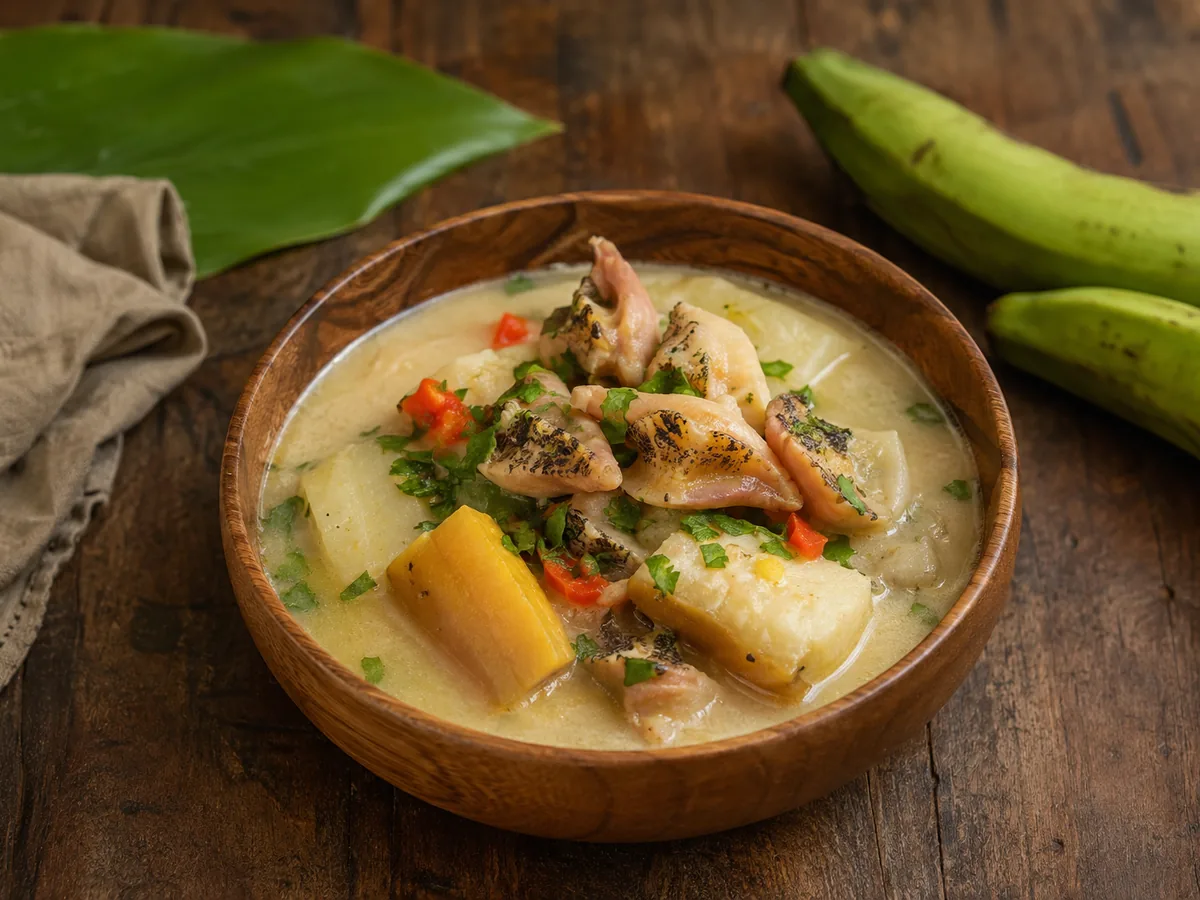
Along the Caribbean coastline of Honduras — from Tela and La Ceiba out to Roatán — the drumbeats of the Garífuna people carry across the sand. Sopa de caracol is their greatest culinary gift, immortalised by Banda Blanca in 1991.
The real soup is a matter of timing. Fresh queen conch is pounded with a heavy mallet to break down its dense muscle and sliced into ribbons. The broth is brewed from coconut milk, sweet and green plantains, yuca, sweet peppers and wild culantro, and cooked through completely.
The conch enters for the final sixty seconds. Overcooked it is rubber; timed properly it is tender, sweet and oceanic in a velvet golden broth.
The conch
- 800 g1.76 lbFresh queen conch meat, cleaned, dark skin and operculum trimmed
- 60 ml¼ cupFreshly squeezed lime juice, from about 3 limes1 Tbsp onto the conch, the rest to finish
- 2 g½ tspGround white pepper
The broth
- 1 L4.2 cupsFresh coconut milk pressed from 2 mature coconuts, or 2 tins unsweetened full-fat
- 750 ml3.2 cupsRich fish fumet or seafood stock
The sofrito
- 45 ml3 TbspAchiote oil
- 30 g2 TbspUnsalted butter
- 1 large1 largeYellow onion, peeled and cut into 4 mm brunoise
- 6 cloves6 clovesFresh garlic, crushed to a fine paste
- 1 large1 largeGreen bell pepper, cored and finely diced
- 6 pieces6 piecesSweet native ají dulce peppers, minced fine
- 8 leaves8 leavesFresh culantro, washed and chopped finehalf early, half to finish
- 8 g2 tspCumin seeds, freshly toasted and ground
- 15 g1 TbspFine sea salt5 g onto the conch, 10 g into the broth
The starches
- 1 large1 largeGreen plantain, peeled and sliced into 2 cm rounds
- 1 medium1 mediumSemi-ripe plantain, peeled and sliced into 2 cm rounds
- 500 g1 lbFresh yuca, peeled, woody core removed, cut into 3 cm chunks
Pound it, then barely cook it
Conch is dense cross-linked collagenous muscle. Two things make it edible: the mallet crushing the transverse connective sheaths, and a flash poach that sets the proteins at 55–58 °C. Neither works without the other.
Sixty to ninety seconds, off the boil
The broth must be at 85 °C, not bubbling, when the conch goes in. Past two minutes it is an inedible rubber band, and there is no recovering it.
Cook the broth completely first
Yuca and plantains are finished before the conch is even considered. The conch is the last thing to touch the pot and the pot comes straight off the heat after it.
Unsweetened coconut milk
Coconut cream made for cocktails will wreck the soup with sugar. Pure unsweetened milk only — and its lauric fats emulsify with the yuca starches into a broth that will not break.
Both plantains, on purpose
Green brings the savoury starchy bite; semi-ripe brings a delicate sweetness that answers the coconut. They are not interchangeable.
Passive time, counted separately
The seasoned conch ribbons stay cold in the fridge until the final minute. That sits outside the times quoted above.
The five tastes on this plate
Salt is the marine salinity of the conch, the fumet and sea salt. Fat is coconut lipids and golden achiote butter. Acid is lime squeezed in at the finish, cutting the coconut fat. Heat is garlic, toasted cumin, white pepper and culantro terpenes. Umami is fumet glutamates, conch ribonucleotides and stewed alliums.
Equipment
- Heavy meat mallet and plastic wrap
- 8 qt enamelled cast-iron Dutch oven
- Wooden spoon
- Wide bowls
Traditionally a heavy cast-aluminium caldero or clay pot over a wood fire. An 8-quart enamelled Dutch oven works in a modern kitchen — the enamel keeps lime and seafood off bare metal, and the thermal mass holds the sub-boil steady the moment the cold conch goes in.
Method
Tenderise the conch15 min
Lay the conch steaks flat under heavy plastic wrap and pound firmly and evenly with the textured face of a mallet until 5 mm thick and the dense fibres give.
Cut into 5 × 1 cm ribbons, toss with 1 Tbsp lime juice, the white pepper and 5 g salt, and keep cold until the last minute.
Pound conch evenly under heavy plastic with a textured mallet to 5 mm thickness, until fibres yield. Cut 5 × 1 cm ribbons; toss with 1 Tbsp lime juice, white pepper and 5 g salt. Refrigerate until the final cooking step.
Cook the sofrito10 min
Melt the butter with the achiote oil over medium and sauté the onion, garlic, bell pepper and ají dulce 6 to 8 minutes until soft and fragrant.
Stir in the toasted cumin and half the culantro and cook 2 minutes.
Melt the butter with the achiote oil over medium and sauté the onion, garlic, bell pepper and ají dulce 6 to 8 minutes until soft and fragrant.
Stir in the toasted cumin and half the culantro and cook 2 minutes.
Broth and tubers25 min
Pour in the 750 ml stock and 1 L coconut milk with 10 g salt and bring to a gentle boil.
Add the green plantain and yuca, cover partially, and simmer on medium-low 15 minutes. Add the semi-ripe plantain and simmer 10 minutes more until everything is fork-tender and the broth is velvety.
Bring 750 ml stock, 1 L coconut milk and 10 g salt to a gentle boil. Add green plantain and yuca; partially cover and simmer on medium-low 15 minutes. Add semi-ripe plantain; simmer 10 minutes until everything is tender and broth velvety.
Flash-poach the conch2 min
Drop the burner to its lowest setting — the broth must sit around 85 °C and must not boil.
Tip in the cold conch ribbons and stir gently strictly 60 to 90 seconds, until they turn opaque white and curl slightly. Pull the pot completely off the heat at once.
Lower heat to keep broth at about 85 °C, without boiling. Add cold conch ribbons; stir gently 60–90 seconds until opaque white and slightly curled. Remove the pot completely from heat immediately.
Finish and serve
Stir in the remaining lime juice and culantro and check the salt.
Ladle the soup, yuca, plantains and conch into wide bowls and serve immediately with white rice and lime wedges.
Stir in the remaining lime juice and culantro and check the salt.
Ladle the soup, yuca, plantains and conch into wide bowls and serve immediately with white rice and lime wedges.
Sensory cues of doneness
- Visual: a golden creamy broth full of tender white conch ribbons, pale yuca, plantain rounds and sweet pepper, flecked with green culantro.
- Auditory: a whispering sub-boil murmur, and no rolling boil at any point.
- Olfactory: sweet coconut, toasted cumin, sea conch, crushed garlic and wild culantro.
Look for creamy golden broth with white conch ribbons, tender yuca, plantain rounds, sweet pepper and green culantro. Keep cooking gentle; expect coconut, cumin, conch, garlic and culantro aromas.
Troubleshooting
- Rubbery, inedible conch.
It cooked past two minutes. Sixty to ninety seconds off the boil, and no reheating afterwards.
- Tough conch even when barely cooked.
It was not pounded. The mallet is not optional.
- A sweet, cloying broth.
Sweetened coconut cream was used. It must be pure unsweetened milk.
Substitutions
One-to-one global substitutions, with the technique adjustment each one requires.
Ingredient substitutions
| Ingredient | Replace with | Culinary impact and technique adjustment |
|---|---|---|
| Queen conch | Sea scallops, squid tubes, or chunks of grouper | Flash-poach scallops or squid 60 seconds; give fish 3 minutes |
| Culantro | Fresh cilantro leaves and tender stems | One-to-one, added in the final 2 minutes |
| Fresh coconut milk | Unsweetened tinned full-fat coconut milk | One-to-one. Never light or sweetened |
Scaling
Half, for 3 bowls
Halve everything in a 4-quart pot. The conch poach stays 60 to 90 seconds.
Double, for 12 portions
Double everything in a 16-quart stockpot, dropping the conch in two batches so the broth does not cool.
What to serve it with
- Arroz blanco con coco
- Crisp salted green plantain chips
- Pickled chile cabro, for anyone wanting real heat
- Guifiti, the Garífuna herbal rum tonic, or an ice-cold SalvaVida
Questions
What if I cannot get conch?
Large sea scallops, raw squid tubes cut into rings and flash-poached for a minute, or firm white fish like sea bass.
Can it be reheated?
Reheating overcooks the conch. Make the coconut broth ahead, reheat that, and drop fresh pounded conch in just before serving.
Why two kinds of plantain?
Green gives the savoury starch, semi-ripe a subtle sweetness that suits the coconut. Both, not either.