Pollo Chuco con Tajadas
"Dirty chicken", named affectionately for its messy street-stall glory. Yellow mustard does the binding no egg batter is needed for, and cutting the flour with cornstarch drops the gluten so the shell stays brittle even under warm tomato gravy and cold pink sauce.
- Prep
- 35 min
- Cook
- 25 min
- Serves
- 4 street-style platters
- Difficulty
- Medium
Researched · Kitchen testing pending
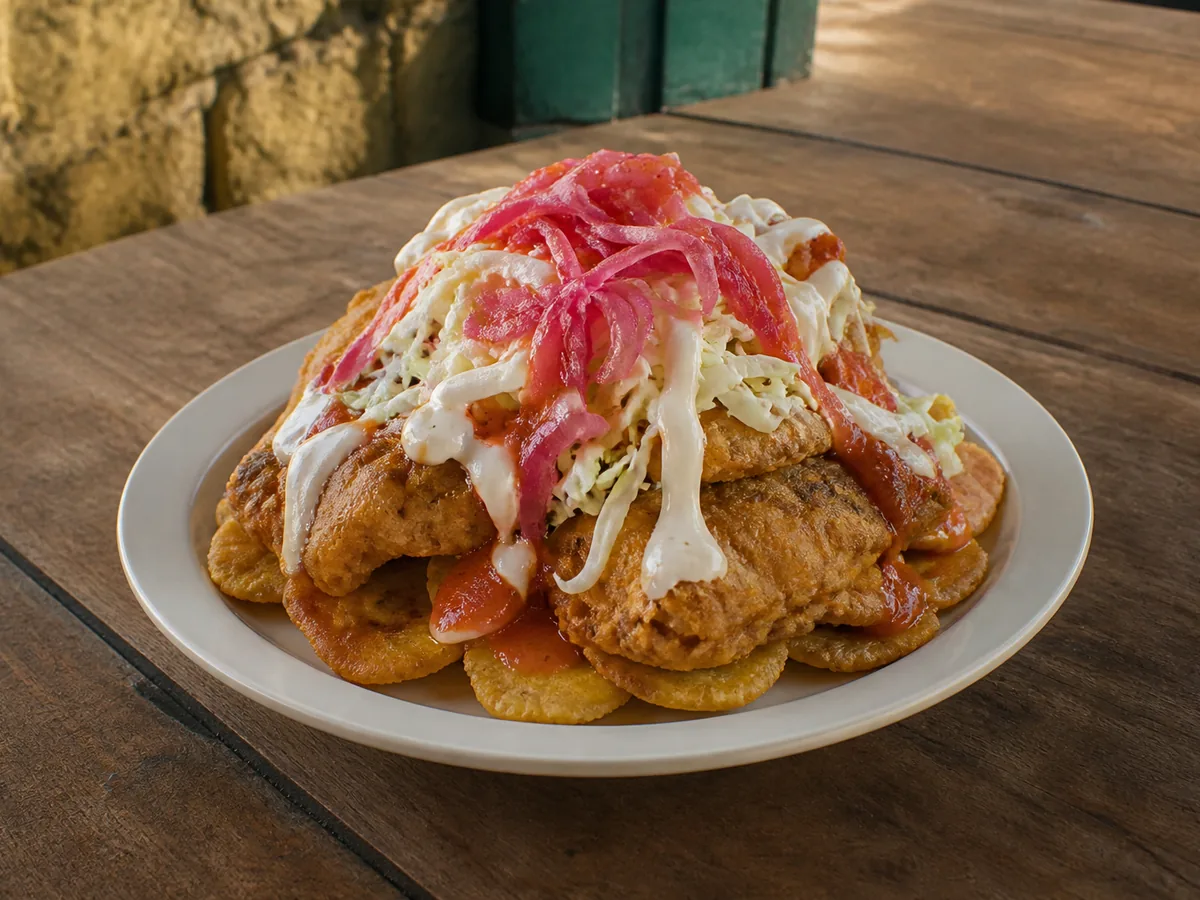
In San Pedro Sula, street corners under metal awnings sit in a haze of bubbling oil. The dish is pollo chuco — literally “dirty chicken”, named affectionately for its greasy, messy street-stall glory.
Leg quarters marinate in yellow mustard, crushed garlic, cumin, oregano and bitter orange, then get dredged in seasoned flour and fried in hot lard until the skin becomes blistered mahogany armour.
The plate is built over a bed of green plantains sliced paper-thin on a mandoline and fried crisp, then shredded cabbage, chismol, pink pickled onions, a ladle of warm spiced tomato sauce and a generous zigzag of salsa rosada.
The chicken
- 1.4 kg4 wholeChicken leg quarters, bone-in and skin-on, slashed twice to the bone
The marinade
- 45 ml3 TbspYellow prepared mustard
- 30 ml2 TbspBitter orange juice, or white vinegar
- 6 cloves6 clovesFresh garlic, crushed to a paste
- 10 g2 tspChicken bouillon powder
- 8 g2 tspCumin seeds, freshly toasted and ground
- 4 g1.5 TbspDried wild oregano, crushed
- 12 g2 tspFine sea salt8 g into the marinade, 4 g into the dredge
- 3 g1 tspCoarsely ground black pepper
The dredge
- 200 g1.5 cupsAll-purpose wheat flour
- 60 g½ cupCornstarchthis is what keeps the crust brittle
- 10 g1 TbspPaprika, or ají de color
The platter
- 4 large4 largeGreen plantains, peeled and sliced lengthwise into 2 mm ribbons on a mandoline
- 1 L4.2 cupsHigh-smoke-point frying oil, or rendered pork lard
- 400 g½ headGreen cabbage, shredded paper-thin, rinsed and drained dry
- 360 ml1.5 cupsChismol — diced tomato, onion, sweet pepper, cilantro, lime and salt
- 240 ml1 cupEncurtido, pickled red onions in spiced cane vinegar
- 120 ml½ cupSalsa rosada — mayonnaise, ketchup, lime juice and a splash of Worcestershire
- 240 ml1 cupWarm cooked tomato and onion gravy, seasoned with cumin and oregano
Mustard is the binder
Its acetic acid tenderises the surface and its ground-seed mucilage holds the seasoned flour on without any egg batter. That is why the crust stays thin rather than heavy.
Cornstarch, not just flour
Cutting 11%-protein flour with pure starch lowers the gluten. In 175 °C oil the starch granules dehydrate fast into a hard brittle shell that survives being drenched in two sauces.
2 mm on a mandoline
Knife-cut plantains are never even enough. Paper-thin ribbons expose broad surface area and drive out their moisture in about three minutes at 185 °C.
Two oil temperatures
185 °C for the plantains, 175 °C for the chicken. Frying the chicken hotter burns the crust before the bone is anywhere near done.
Assemble at the last moment
Sauces over plantains fifteen minutes early means soft chips. Build it as it goes to the table.
Passive time, counted separately
The chicken marinates at least 4 hours, and comes to cool room temperature before frying. Neither is active work.
The five tastes on this plate
Salt is the marinade, the salted chips and the briny onions. Fat is rendered chicken skin, fried tajadas and mayonnaise-based salsa rosada. Acid is cane vinegar from the encurtido and lime in the chismol. Heat is mustard, toasted cumin, garlic and black pepper. Umami is fried chicken fond, bouillon and cooked tomato gravy.
Equipment
- Mandoline
- 6 qt heavy Dutch oven with an oil thermometer
- Wide dredging dish
- Wire rack
- Instant-read thermometer
Traditionally a large steel caldero over a high-output burner. A 6-quart Dutch oven with an oil thermometer works in a modern kitchen — fry the plantains in batches so the oil never sags below temperature.
Method
Marinate the chicken10 min
Cut two diagonal slits to the bone in each quarter. Whisk the mustard, bitter orange juice, garlic, bouillon, cumin, oregano, black pepper and 8 g salt into a wet paste.
Rub it thoroughly into the slashes and under the skin, and refrigerate at least 4 hours.
Cut two diagonal slits to the bone in each chicken quarter. Whisk mustard, bitter orange juice, garlic, bouillon, cumin, oregano, black pepper and 8 g salt. Rub into cuts and under skin; refrigerate at least 4 hours.
Fry the tajadas10 min
Slice the peeled green plantains lengthwise into 2 mm ribbons on a mandoline.
Heat the oil to 185 °C and fry in batches 3 to 4 minutes, turning once, until rigid, pale golden and crisp. Drain and salt.
Slice the peeled green plantains lengthwise into 2 mm ribbons on a mandoline.
Heat the oil to 185 °C and fry in batches 3 to 4 minutes, turning once, until rigid, pale golden and crisp. Drain and salt.
Dredge and fry the chicken32 min
Whisk the flour, cornstarch, paprika and 4 g salt in a wide dish. Lift the chicken from the marinade, let it drip, and dredge firmly, pressing flour into the cuts. Shake off the loose flour.
Bring the oil to 175 °C and fry two quarters at a time 14 to 16 minutes, turning every 4, until deep mahogany and 77–80 °C at the thigh. Drain on a wire rack.
Mix flour, cornstarch, paprika and 4 g salt. Drain marinated chicken, press dredge firmly into cuts and shake off loose flour. Fry two quarters at a time in 175 °C oil 14–16 minutes, turning every 4 minutes, until mahogany and thigh reaches 77–80 °C. Drain on a rack.
Build the platter
Cover each wide plate with hot crisp tajadas, heap shredded cabbage over them, and spoon on the chismol and pickled onions.
Ladle 3 tablespoons of warm tomato sauce over the vegetables, set a hot chicken quarter on top, and zigzag the salsa rosada across everything. Serve immediately with lime.
Layer hot crisp tajadas, dry shredded cabbage, chismol and pickled onions on each plate. Add 3 tablespoons warm tomato sauce over vegetables, top with a hot chicken quarter and drizzle salsa rosada. Serve immediately with lime.
Sensory cues of doneness
- Visual: a mountain of golden plantain ribbons under crisp cabbage, topped with mahogany chicken and drizzled pink and red.
- Auditory: a deafening shatter as teeth break the skin and the chips.
- Olfactory: fried chicken skin, toasted cumin, yellow mustard, bubbling lard and sharp vinegar onions.
Look for crisp golden plantain ribbons and cabbage beneath mahogany chicken with pink and red sauces. Chicken skin and chips should shatter crisply; expect fried chicken, cumin, mustard, lard and vinegar-onion aromas.
Troubleshooting
- Soggy plantain chips.
They were cut too thick, or the oil was below temperature. Mandoline to 2 mm and hold 185 °C.
- Raw at the bone, burnt outside.
The chicken went in fridge-cold into oil that was too hot. Cool room temperature, slashed to the bone, steady 175 °C.
- A limp platter.
It was assembled early. Build it immediately before serving.
Substitutions
One-to-one global substitutions, with the technique adjustment each one requires.
Ingredient substitutions
| Ingredient | Replace with | Culinary impact and technique adjustment |
|---|---|---|
| Green plantains | No substitute | Yellow plantains go soft and sweet; only green fry into savoury chips |
| Bitter orange juice | Equal parts fresh orange and lime juice | One-to-one. The same tart citrus acidity |
| Queso seco | Cotija, or aged queso duro | One-to-one, for the optional cheese dusting |
Scaling
Half, for 2 platters
Halve everything. Frying times are identical.
Double, for 8 platters
Double everything, frying in consecutive batches and holding cooked chicken warm on a rack in a 95 °C oven.
What to serve it with
- Encurtido de cebolla roja with allspice and habanero
- Extra warm cooked tomato and sweet pepper sauce
- An ice-cold SalvaVida or Port Royal
Questions
Why "chuco"?
Street vendors in San Pedro Sula fried it on crowded pavements, and the messy layers of cabbage, sauce and grease made it deliciously "dirty" to eat.
Can I use breast?
Leg quarters are traditional because dark meat stays juicy over a fifteen-minute fry. Bone-in breast needs 12 to 14 minutes to 74 °C.
What is salsa rosada?
Mayonnaise, ketchup, lime juice and a dash of Worcestershire — the classic Central American street sauce.