Soup Joumou
The soup of freedom, eaten every 1 January since 1804. Puréed calabaza is the entire structure — its water-soluble pectins trap the water and suspended marrow lipids into an opaque golden potage — and the Scotch bonnet floats whole and unpunctured, perfuming the steam without ever releasing its capsaicin.
- Prep
- 45 min
- Cook
- 2 hr 15 min
- Serves
- 8 ceremonial bowls
- Difficulty
- Hard
Researched · Kitchen testing pending
January 1, 1804 marks the liberation of Haiti, the first free Black republic in the world. Under French colonial rule enslaved labourers grew calabaza squash for the plantation owners but were forbidden from eating it. On emancipation, Jean-Jacques Dessalines and Marie-Claire Félicité proclaimed that every Haitian should feast on the yellow soup of freedom.
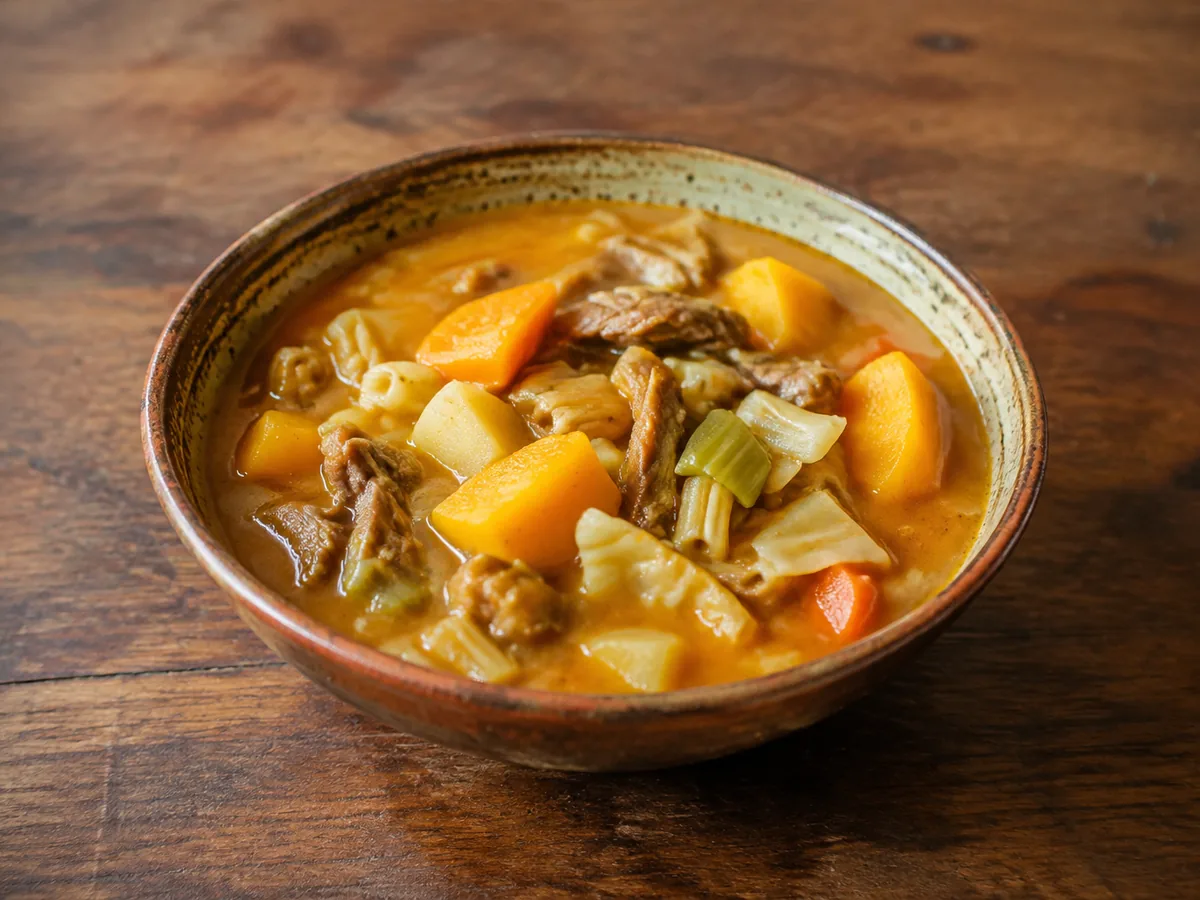
Soup joumou is that plate. It is built on slow-simmered beef shank and oxtail washed in sour orange, in a silky gold broth of puréed calabaza, simmered with malanga, green plantain, cabbage, carrot, rigatoni and a whole Scotch bonnet.
It is seasoned with citrus-garlic épice and finished with fresh lime, and it is eaten every New Year’s Day.
The meat
- 800 g1.76 lbBone-in beef shank, cut 4 cm thick with the marrow intact
- 600 g1.32 lbBeef oxtail, trimmed of outer fat, cut into 4 cm rounds
- 2 large2 largeFresh limes, halved, for scrubbing the raw meat
- 60 ml4 TbspBitter Seville orange juice, or 3 parts orange to 1 part lime
- 60 ml4 TbspHaitian épice — the wet paste of scallion, garlic, sweet pepper, parsley, thyme and shallot
The squash
- 1 kg2.2 lbCalabaza squash (West Indian pumpkin or kabocha), peeled, seeded, in 4 cm chunks
The pot
- 45 ml3 TbspUnsalted butter, or neutral oil
- 1 large1 largeYellow onion, peeled and finely diced
- 6 cloves6 clovesFresh garlic, minced to a fine paste
- 2.5 L10.5 cupsRich beef bone broth, or cold filtered water
- 4 whole4 wholeWhole cloves, pressed into half an onion
- 4 sprigs4 sprigsFresh thyme, tied with twine
- 20 g1.5 TbspFine sea saltdivided between the marinade and the pot
- 3 g1 tspFreshly ground black pepper
The vegetables
- 2 large2 largeCarrots, peeled and cut diagonally into 1.5 cm coins
- 2 stalks2 stalksCelery, sliced into 1 cm pieces
- 1 medium1 mediumMalanga (taro root), peeled and cut into 3 cm chunks
- 1 large1 largeGreen plantain, peeled and sliced into 2.5 cm rounds
- 400 g½ headGreen cabbage, cored and chopped into coarse 4 cm leaves
To finish
- 150 g1.5 cupsRigatoni or penne rigate
- 1 whole1 wholeScotch bonnet pepper (piman bouk), unpunctured, stem attached
- 30 ml2 TbspFreshly squeezed lime juice
The squash is the body
Calabaza carries high concentrations of water-soluble pectin and starch. Boiled and blended smooth before it meets the broth, those pectin molecules trap water and suspended marrow lipids into an emulsion — an opaque golden potage that coats the spoon. Under-measure the squash and the soup is thin.
The pepper must stay whole
Capsaicin sits in the internal placenta glands. Left unbroken with its stem on and floated on the surface, the pepper perfumes the steam with aromatic terpenes; punctured, it makes the pot unpalatable.
Wash the meat in citrus
Scrubbing with lime and coarse salt, then marinating in sour orange, denatures surface blood proteins and strips oxidation products. Skipping it leaves a gamey note nothing later removes.
Cloves in an onion
Studding the four cloves into half an onion keeps them together, so nobody bites down on a whole clove at the table.
90 °C for the collagen
Oxtail and shank both need about ninety minutes at a sub-boil to hydrolyse rigid type-I collagen into soluble gelatin.
Passive time, counted separately
The meat marinates at least 4 hours and ideally overnight, and the finished pot rests 10 minutes so the starches settle. Neither is active work.
The five tastes on this plate
Salt seasons the acid-washed beef and the root vegetables. Fat is marrow, oxtail tallow and butter enriching the purée. Acid is the sour orange wash and the lime squeezed in at the end to lift the dense squash sugars. Heat is Scotch bonnet steam, garlic-scallion épice, clove and black pepper. Umami is bone marrow, rendered oxtail gelatin and roasted calabaza.
Equipment
- 8 to 10 qt enamelled cast-iron Dutch oven
- Large pot, for the squash
- Blender
- Wooden paddle
- Instant-read thermometer
Traditionally a heavy cast-aluminium chaudron over charcoal. An 8-to-10 quart enamelled Dutch oven works in a modern kitchen — the enamel keeps the citrus off bare metal, and the thick floor is what stops the squash starch scorching.
Method
Clean and marinate the meat15 min
Scrub the shank and oxtail hard with lime halves and coarse salt, rinse in cold water and drain dry.
Toss with the 60 ml sour orange juice, the épice, 10 g salt, black pepper and thyme, and marinate refrigerated at least 4 hours, or overnight.
Scrub shank and oxtail with lime halves and coarse salt, rinse cold and drain dry. Toss with 60 ml sour orange juice, épice, 10 g salt, pepper and thyme. Refrigerate at least 4 hours or overnight.
Cook and purée the calabaza25 min
Simmer the squash chunks in 1 litre of water 20 minutes until fork-tender.
Blend squash and cooking water on high 60 seconds into a silky golden-orange cream and set aside.
Simmer squash in 1 L water for 20 minutes until fork-tender. Blend squash with its cooking water on high for 60 seconds until silky; set aside.
Sear and braise1 hr 30 min
Melt the butter in the Dutch oven over medium-high. Lift the meat from its marinade — keep the marinade — and sear 8 minutes to a deep brown crust. Add the onion and garlic and cook 3 minutes.
Pour in 1.5 L broth and the reserved marinade, drop in the clove-studded onion half and the tied thyme, boil, skim, then cover and simmer on low 1 hour 15 minutes.
Heat butter over medium-high. Remove beef, reserving marinade; sear 8 minutes, then cook onion and garlic 3 minutes. Add 1.5 L broth, marinade, clove-studded onion half and tied thyme. Boil, skim, cover and simmer low at about 90 °C for 1¼ hours.
Squash in, then the dense vegetables20 min
Whisk the calabaza purée into the pot — the liquid turns into a thick glowing yellow potage.
Add the carrots, celery, malanga and green plantain, season with the remaining 10 g salt, and simmer covered on low 20 minutes.
Whisk squash purée into the beef pot. Add carrots, celery, malanga and green plantain with the remaining 10 g salt; cover and simmer on low for 20 minutes.
Pasta, cabbage and the whole pepper15 min
Add the cabbage and the pasta, and rest the whole unbroken Scotch bonnet gently on the surface.
Simmer uncovered on low 12 to 15 minutes, stirring the floor of the pot occasionally, until the pasta is al dente and the beef core reads 93–96 °C.
Add cabbage and pasta; float the intact Scotch bonnet gently on top. Simmer uncovered on low 12–15 minutes, occasionally stirring the bottom without breaking the pepper, until pasta is al dente and beef reaches 93–96 °C.
Finish
Lift out and discard the Scotch bonnet and the clove-studded onion, and stir in the 30 ml lime juice.
Rest 10 minutes off the heat, then ladle into wide bowls, making sure every bowl gets shank, oxtail, vegetables and pasta. Warm crusty bread alongside.
Discard the Scotch bonnet and clove-studded onion; stir in 30 ml lime juice. Rest off heat 10 minutes. Serve each bowl with shank, oxtail, vegetables and pasta, with warm crusty bread alongside.
Sensory cues of doneness
- Visual: a radiant opaque golden-yellow broth packed with tender beef, green cabbage, orange carrot and pasta, the meat falling off the oxtail vertebrae.
- Auditory: steady thick bubbling, and a quiet sizzle as the finishing lime hits the hot broth.
- Olfactory: roasted calabaza, clove, wild thyme, beef marrow, sour orange and floral Scotch bonnet.
Look for opaque golden-yellow soup and tender beef falling from the oxtail bones, with intact vegetables and pasta. Expect thick, steady bubbling and aromas of squash, clove, thyme and sour orange.
Storing it
Better the next day, as the clove, thyme and squash marry. Reheat gently, adding a splash of stock if the pasta has drunk too much broth.
Troubleshooting
- A blisteringly hot soup.
The Scotch bonnet was punctured. Float it whole with the stem on and lift it out at the end.
- A gamey note in the broth.
The meat was not washed. Scrub with lime and salt and marinate in sour orange.
- Thin, watery broth.
Not enough calabaza. The purée is the foundational body — do not dilute it.
Substitutions
One-to-one global substitutions, with the technique adjustment each one requires.
Ingredient substitutions
| Ingredient | Replace with | Culinary impact and technique adjustment |
|---|---|---|
| Calabaza (joumou) | Kabocha, buttercup, or a dense butternut | One-to-one. Kabocha is the same species and gives identical body |
| Bitter Seville orange | 3 parts fresh orange juice to 1 part lime | One-to-one. It replicates the bitter-sour profile |
| Malanga | Yuca, russet potato, or white sweet potato | One-to-one, cut into sturdy 3 cm chunks |
Scaling
Half, for 4 portions
Halve everything in a 5-quart pot. The beef still needs its full 1 hour 15 minutes for the collagen.
Double, for 16 portions
Double everything in a 16-to-20 quart stockpot on a wide burner, stirring the floor diligently so nothing scorches.
What to serve it with
- Pain haïtien — crusty baguette or warm country rolls, for the golden broth
- Fried sweet ripe plantain slices
- Rhum Barbancourt 5 Étoiles, or an ice-cold Prestige
Questions
Can I use kabocha?
Yes — it is the identical species, with the same dense sweet dry orange flesh.
Can it be made ahead?
Yes, and it is better the next day. Reheat gently with a splash of stock.
Why stud the cloves into an onion?
So they stay together and nobody bites into a whole clove in their bowl.