Griot de Porc avec Pikliz
Braised, then fried — two phases, and the gap between them matters most. The pork must be patted bone-dry and air-dried fifteen minutes, because any surface water steams the crust soft instead of letting it shatter. The pikliz is the counterweight: 5% acetic acid against unctuous pork fat.
- Prep
- 30 min
- Cook
- 1 hr 30 min
- Serves
- 6 portions
- Difficulty
- Hard
Researched · Kitchen testing pending
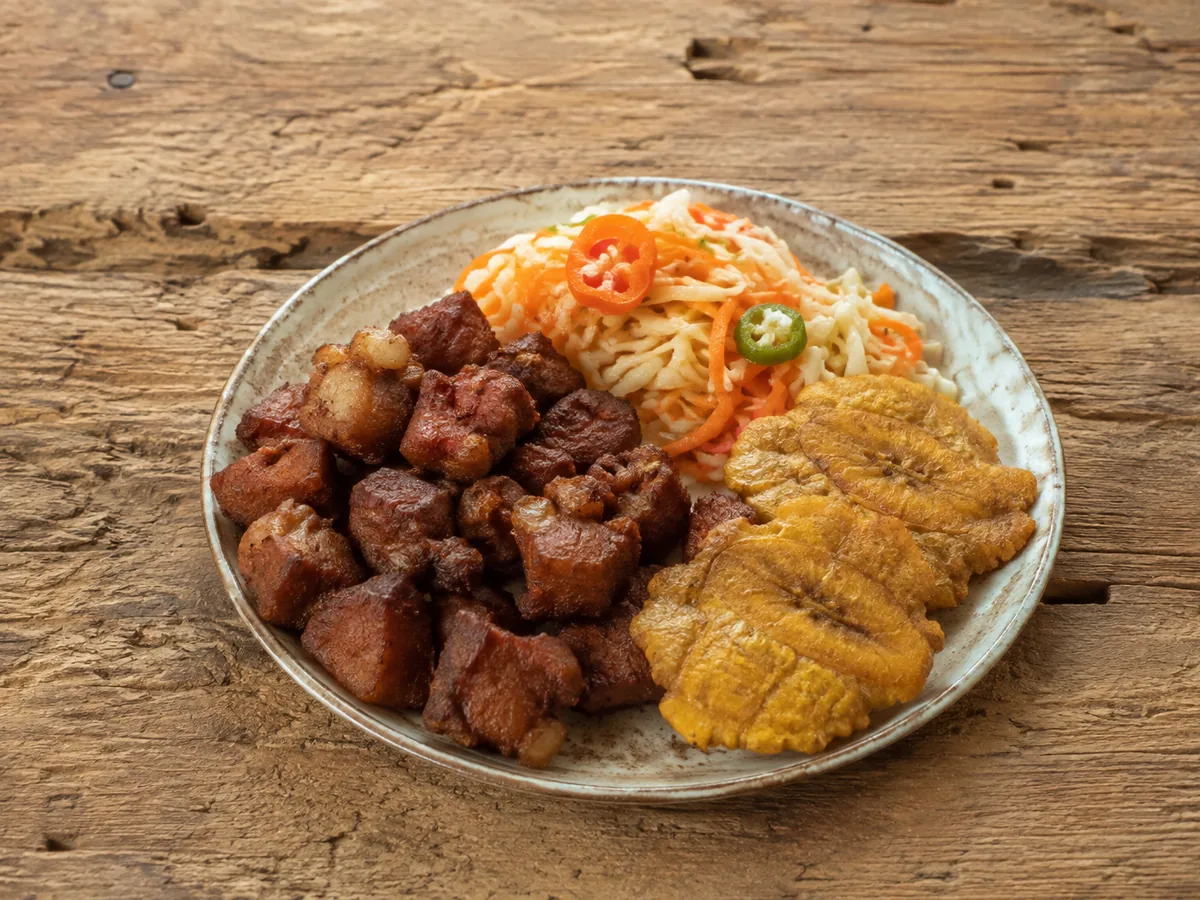
Griot is the heartbeat of Haitian street food and festive gatherings.
Chunks of pork shoulder are washed in cut sour oranges and limes, then steeped overnight in green épice packed with scallion, garlic, habanero, parsley and clove. The pork braises gently in its own juices until meltingly tender, and once cooled the morsels are deep-fried until the outside turns mahogany and shatters while the inside stays juicy.
It is always served with pikliz — the fiery crunchy slaw of cabbage, carrot and Scotch bonnet steeped in raw cane vinegar that cuts the pork fat with sharp electricity.
The pork
- 1.8 kg4 lbPork shoulder (Boston butt), trimmed of heavy gristle, cut into 5 cm cubes
- 3 large3 largeBitter Seville oranges, halved, or 2 sweet oranges with 2 limes
- 3 large3 largeFresh limes, halved, for washing the meat
- 120 ml½ cupHaitian green épice — scallion, garlic, shallot, parsley, sweet pepper and thyme blended with oil
- 6 cloves6 clovesFresh garlic, crushed to a paste
- 6 whole6 wholeWhole cloves, finely ground
- 5 g1.5 tspGround black pepper
- 15 g1 TbspFine sea salt
The braise
- 250 ml1 cupCold filtered water
- 4 sprigs4 sprigsFresh wild thyme
- 1 whole1 wholeScotch bonnet pepper, pierced once with a knife tip
To fry
- 1 L4.2 cupsHigh-smoke-point oil or lard
The pikliz
- 400 g4 cupsGreen cabbage, shredded into thin 2 mm ribbons
- 2 medium1.5 cupsCarrots, peeled and coarsely grated
- 1 small1 cupWhite or red onion, sliced into paper-thin half-moons
- 3 whole3 wholeFresh Scotch bonnet peppers, stemmed, seeded and julienned thin
- 350 ml1.5 cupsDistilled white cane vinegar
- 8 g1.5 tspFine sea salt
- 4 whole4 wholeWhole cloves, with 6 cracked black peppercorns
Dry pork, or no crust
After the braise the cubes are patted completely dry and left to air-dry 15 minutes. Surface water spatters violently in the oil and steams the crust soggy — this single step is the difference between griot and stewed pork.
Why the acid comes first
Citric and malic acids in bitter orange partially denature the exterior protein sheaths, which is what lets the épice penetrate over twelve hours rather than just sitting on the surface.
Braise gently
A rolling boil dries the muscle fibres before the collagen has had time to soften. Hold 90–93 °C with the lid slightly ajar.
185 °C, four to five minutes
Surface water flashes to steam and the Maillard reaction runs fast, so the exterior turns brittle mahogany while the interior stays at about 80 °C, juicy and gelatinous.
Pikliz needs 24 hours
The vinegar has to cure the cabbage and draw the floral heat out of the Scotch bonnets. Made and served the same day it is just wet salad.
Passive time, counted separately
The pork marinates 12 to 24 hours, the pikliz ferments 24 hours, and the braised pork air-dries 15 minutes. None of that is active work.
The five tastes on this plate
Salt penetrates the pork over the overnight marinade and seasons the pikliz. Fat is rendered pork shoulder and the frying oil. Acid is sour orange in the marinade and razor-sharp cane vinegar in the slaw. Heat is Scotch bonnet, garlic paste, crushed clove and black pepper. Umami is seared pork fond, collagen breakdown and the allium-heavy épice.
Equipment
- Large glass bowl or jar, for the pikliz
- 6 qt enamelled cast-iron Dutch oven
- 12 in cast-iron skillet or pot with a deep-fry thermometer
- Rimmed baking sheet and paper towel
- Wire rack, slotted spoon and tongs
Traditionally a heavy cast-aluminium chaudron over a charcoal brazier. A 6-quart Dutch oven for the braise and a thermometer-fitted cast-iron pan for the fry works in a modern kitchen — the two phases genuinely want two vessels.
Method
Clean and marinate the pork15 min
Rub the cubes with lime and bitter orange halves and coarse salt, rinse with hot water and drain thoroughly.
Toss with the épice, the juice of 2 sour oranges, the ground cloves, black pepper and 15 g salt. Massage well, cover, and refrigerate 12 to 24 hours.
Rub pork cubes with lime, bitter orange halves and coarse salt; rinse with hot water and drain thoroughly. Massage with épice, juice of 2 sour oranges, ground cloves, pepper and 15 g salt. Cover and refrigerate 12–24 hours.
Make the pikliz, a day ahead15 min
Pack the cabbage, carrot, onion and julienned Scotch bonnet tightly into a large glass jar.
Pour in the vinegar with the 8 g salt, cloves and cracked peppercorns — the vinegar must submerge everything — seal, and leave 24 hours at room temperature, or refrigerate up to a month.
Pack cabbage, carrot, onion and julienned Scotch bonnet into a glass jar. Add vinegar, 8 g salt, cloves and cracked peppercorns, fully submerging everything. Seal and leave 24 hours at room temperature, or refrigerate up to a month.
Braise1 hr 15 min
Tip the pork and all its juices into the Dutch oven with the 250 ml water, the thyme and the pierced Scotch bonnet.
Boil, then drop to medium-low, cover with the lid slightly ajar, and simmer 1 hour to 1 hour 15 minutes until fork-tender at 90–93 °C and the liquid is nearly gone.
Add pork and marinade to the pot with 250 ml water, thyme and the once-pierced Scotch bonnet. Bring to a boil, reduce to medium-low and simmer with lid ajar 1–1¼ hours at 90–93 °C, until fork-tender and almost dry.
Dry the pork5 min
Lift the cubes out with tongs, shaking off loose herbs, and spread them on a paper-towel-lined tray.
Pat every surface completely dry and leave to air-dry 15 minutes.
Lift pork onto a paper-towel-lined tray, shaking off loose herbs. Pat every surface completely dry, then air-dry 15 minutes before frying to limit spattering.
Fry15 min
Heat the oil to 185 °C and fry the pork in two batches, 4 to 5 minutes, turning occasionally, until deep mahogany and shatteringly crisp.
Drain on a wire rack 2 minutes.
Heat oil to 185 °C. Fry pork in two batches for 4–5 minutes each, turning occasionally, until deeply mahogany and crisp. Drain on a wire rack 2 minutes.
Plate
Mound the hot griot on platters and top with generous tongs of cold crunchy pikliz.
Serve immediately with banan peze and diri ak djon djon.
Pile hot griot onto platters and top generously with cold, crunchy pikliz. Serve immediately alongside banan peze and diri ak djon djon.
Sensory cues of doneness
- Visual: deep mahogany-bronze cubes with blistered edges, shredding to pale juicy fibre inside; pikliz vivid green, orange and purple.
- Auditory: a roaring sizzle as the pork enters the oil, and a loud brittle crunch when the crust breaks.
- Olfactory: fried pork fat, roasted garlic, pungent cane vinegar, citrus and toasted clove.
Look for blistered mahogany cubes with pale, juicy interiors and a brittle, audible crunch. Expect aromas of fried pork, garlic, citrus, toasted clove and sharp vinegar.
Storing it
The pikliz keeps refrigerated for up to a month in a sealed jar, and gets better as it goes.
Troubleshooting
- A soft, greasy crust.
The pork went into the oil wet. Pat dry and air-dry 15 minutes first.
- Dry, stringy meat.
It boiled hard. Keep the braise at a gentle simmer.
- Flat, harsh pikliz.
It had not fermented. Give it a full 24 hours.
Substitutions
One-to-one global substitutions, with the technique adjustment each one requires.
Ingredient substitutions
| Ingredient | Replace with | Culinary impact and technique adjustment |
|---|---|---|
| Bitter Seville orange | Equal parts fresh orange and lime juice | One-to-one. It matches the tart citrus profile |
| Pork shoulder | Pork belly, or pork collar | One-to-one. Both have the marbling for a crisp crust |
| Scotch bonnet | Habanero | One-to-one. The same apricot fruitiness and heat |
Scaling
Half, for 3 portions
Halve everything. The braise stays an hour, and one frying batch is enough.
Double, for 12 portions
Double everything in an 11-quart Dutch oven, frying in four batches so the oil holds 185 °C.
What to serve it with
- Banan peze — the non-negotiable partner
- More pikliz, cold from the jar
- Diri ak djon djon
- A cold Prestige, or krémas spiced with nutmeg and vanilla
Questions
Can it be baked or air-fried?
Yes. Brush the braised cubes with oil and bake on a rack at 220 °C for 15 to 20 minutes, or air-fry at 200 °C for 10.
Which cut of pork?
Shoulder, and it matters. Lean loin goes dry and chalky through the two phases.
What is Haitian épice?
The foundational wet seasoning paste — scallion, garlic, shallot, sweet pepper, parsley and thyme blended with oil.