Teaberry Smoko Scones
Smoko is the mid-morning break, and these are its scones. Cold butter rubbed into self-raising flour, sugar and small pink teaberries stirred through, milk folded in to a soft dough patted three centimetres thick and never kneaded. Cut straight down, set close together on a hot tray, brushed with egg and baked at 220 °C until tall and golden. Split warm, with jam.
- Prep
- 15 min
- Cook
- 15 min
- Serves
- 10 scones
- Difficulty
- Easy
Researched · Kitchen testing pending
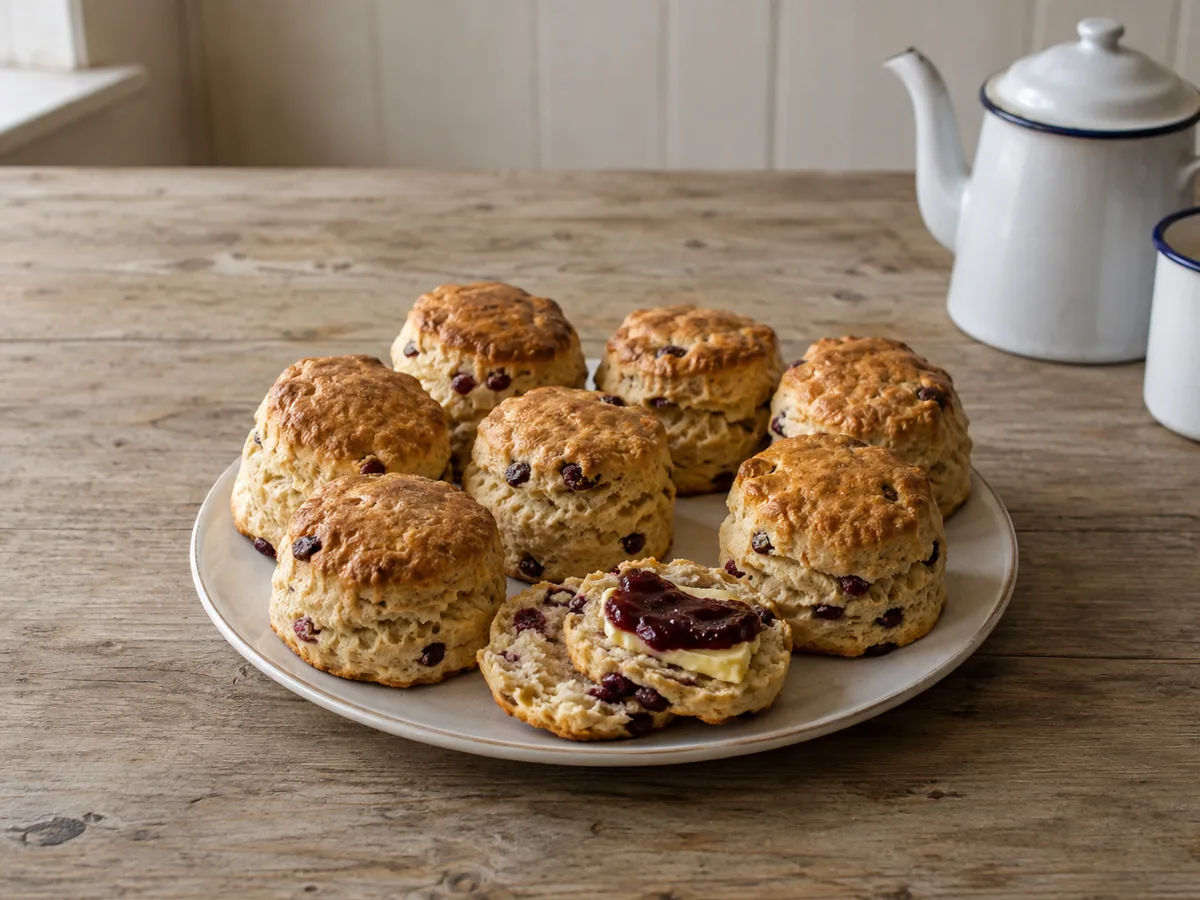
Smoko is the mid-morning halt on every Falklands farm, when the kettle goes on and something comes out of the tin. Scones are the most likely thing, and in late summer they carry teaberries, the small pink berries picked off the heath and kept in the freezer for the rest of the year.
They are made fast and handled little, cut close together so they rise tall, and eaten warm with butter and jam before anyone goes back out into the wind.
- 500 g4 cupsSelf-raising flour
- 3 g½ tspFine salt
- 100 g7 TbspButter, cold, in cubes
- 60 g⅓ cupSugar
- 150 g1 cupTeaberries, or dried cranberries
- 300 ml1¼ cupsMilk, cold
- 11Egg, beaten, for the tops
Teaberries
A tiny pale-pink berry from a creeping plant on the Falklands heath, with a faint wintergreen scent, picked in late summer and kept in the freezer. Dried cranberries are the honest stand-in anywhere else, and the scone does not mind.
Fold, do not knead
A scone rises on the steam of a soft, barely-handled dough. Bring it together with a knife, pat it out once, cut straight down without twisting the cutter, and the layers stay open.
The five tastes on this plate
Salt is a pinch in the dough. Fat is butter, in and on. Acid is the berries and the jam. There is no heat. Umami is the egg-glazed crust.
Equipment
- Large bowl
- Round knife or a pastry blender
- 6 cm round cutter
- Heavy baking tray, lined
- Pastry brush
Heat the tray in the oven and slide the scones onto it hot; the bottoms set at once and the rise goes up, not out.
Method
Heat the oven2 min
Heat the oven to 220 °C with the lined tray inside.
Heat the oven to 220 °C with the lined tray inside.
Rub in the butter4 min
Whisk the flour and salt in the bowl. Rub in the cold butter with your fingertips until sandy. Stir in the sugar and the berries.
Whisk the flour and salt in the bowl. Rub in the cold butter with your fingertips until sandy. Stir in the sugar and the berries.
Add the milk3 min
Pour in nearly all the milk and cut it through with the knife until a soft, slightly sticky dough gathers. Add the rest only if there is dry flour left.
Pour in nearly all the milk and cut it through with the knife until a soft, slightly sticky dough gathers. Add the rest only if there is dry flour left.
Pat and cut4 min
Turn onto a floured surface and pat, do not roll, to 3 cm thick. Cut straight down with the cutter, without twisting. Gather the trimmings once for the last scones.
Turn onto a floured surface and pat, do not roll, to 3 cm thick. Cut straight down with the cutter, without twisting. Gather the trimmings once for the last scones.
Glaze and bake15 min
Set the scones close together on the hot tray, brush the tops with egg, and bake 12 to 15 minutes until risen tall and deep gold on top.
Set the scones close together on the hot tray, brush the tops with egg, and bake 12 to 15 minutes until risen tall and deep gold on top.
Serve
Warm, split by hand, with butter and jam. Cream if there is any.
Warm, split by hand, with butter and jam. Cream if there is any.
Sensory cues of doneness
- Visual: tall, straight-sided scones with a golden top and pale, split sides; berries showing through.
- Auditory: a hollow tap on the base.
- Olfactory: butter and hot flour, with the berries' faint wintergreen.
Look for tall, straight-sided scones with a golden top, pale split sides and berries showing through. Listen for a hollow tap on the base; smell butter and hot flour with the berries' faint wintergreen.
Storing it
Best within hours. Keep a day in a tin and refresh 5 minutes in a hot oven; they freeze for 2 months and thaw in an hour.
Troubleshooting
- Flat and heavy.
Overworked, or rolled too thin. Pat to 3 cm and handle it as little as possible.
- Leaning scones.
The cutter was twisted. Straight down, straight up.
- Dry.
Too little milk or baked too long. A sticky dough, and out at deep gold.
Substitutions
One-to-one swaps, with the technique change each one needs.
Ingredient substitutions
| Ingredient | Replace with | Culinary impact and technique adjustment |
|---|---|---|
| Teaberries | Dried cranberries, currants or diddle-dee berries | Fresh berries make the dough wetter; use a spoon less milk |
| Self-raising flour | Plain flour with 20 g baking powder | Identical rise |
| Milk | Buttermilk, or milk with a squeeze of lemon | A more tender, slightly tangy scone |
Scaling
Half
Five scones from half the dough; the same oven.
Double
Two trays, baked one after the other; the dough waits happily 10 minutes.
What to serve it with
- Butter and diddle-dee jam
- Whipped cream, on a Sunday
- A pot of strong tea, which is what smoko is
Questions
What is smoko?
The mid-morning tea break, on the Falklands and in Australia and New Zealand, when work stops for tea, a smoke, and something baked.
Fresh or frozen berries?
Either. Frozen go in straight from the freezer so they do not bleed into the dough.
Why set the scones close together?
They support each other as they rise and come out taller with soft sides.