Diddle-Dee Berry Jam
The islands' own preserve, from the red crowberry that carpets the heath. Diddle-dee berries simmered with a little water until they burst, sugar and lemon juice stirred in until dissolved, then boiled hard to 105 °C, skimmed, and tested on a chilled plate until it wrinkles. Potted hot into sterilised jars. Sharp, dark, made for scones.
- Prep
- 20 min
- Cook
- 30 min
- Serves
- 5 small jars
- Difficulty
- Medium
Researched · Kitchen testing pending
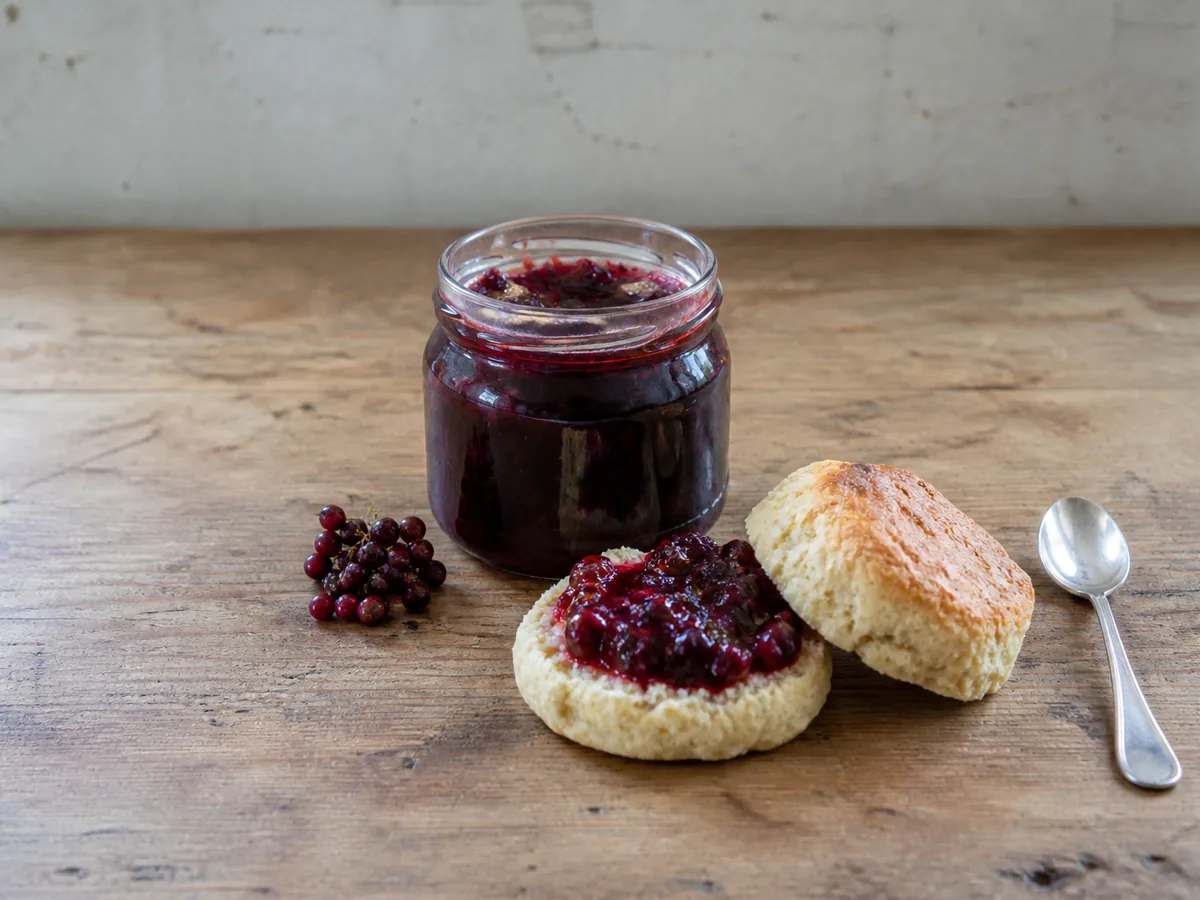
Diddle-dee is the red crowberry that covers the Falklands heath, and every autumn the islanders go out with buckets to pick it. It is too sharp to eat by the handful and perfect for jam: dark, tart, full of pectin, and made in kitchens that have a jar of it on the table year round.
It goes on smoko scones, on toast, and, in some houses, beside the Sunday lamb.
- 1 kg2¼ lbDiddle-dee berries, cleaned of stems and leavesor cranberries
- 120 ml½ cupWater
- 800 g4 cupsPreserving or granulated sugar
- 30 ml2 TbspLemon juice
Diddle-dee
Empetrum rubrum, a red crowberry on a low, wiry shrub that grows everywhere on the Falklands. The berries are sharp and a little resinous and full of pectin, so they set easily. Cranberries behave the same way in the pan.
105 degrees
Jam sets when enough water has boiled off for the sugar to reach 105 °C. A thermometer is quicker than guessing; the chilled plate confirms it.
The five tastes on this plate
There is no salt and no fat. Acid is the berry and the lemon. There is no heat. Sweetness is the sugar, and the faint bitterness of the berry skins is what keeps it from cloying.
Equipment
- Wide, heavy preserving pan or a 6-quart pot
- Sugar thermometer
- Five 200 ml jars with new lids, sterilised
- Two saucers, chilled in the freezer
- Ladle and a jam funnel
A wide pan boils the jam down faster, which keeps the colour bright. Do not fill it more than a third; jam climbs.
Method
Sterilise the jars15 min
Wash the jars and lids, and heat the jars in a 120 °C oven for 15 minutes; keep them hot. Simmer the lids in water. Put two saucers in the freezer.
Wash the jars and lids, and heat the jars in a 120 °C oven for 15 minutes; keep them hot. Simmer the lids in water. Put two saucers in the freezer.
Soften the berries10 min
Put the berries and water in the pan and simmer 8 to 10 minutes, stirring, until they burst and soften. Crush a few against the side for texture.
Put the berries and water in the pan and simmer 8 to 10 minutes, stirring, until they burst and soften. Crush a few against the side for texture.
Sugar and lemon3 min
Add the sugar and lemon juice and stir over low heat until every grain has dissolved; test by rubbing a drop between two fingers.
Add the sugar and lemon juice and stir over low heat until every grain has dissolved; test by rubbing a drop between two fingers.
Boil to a set10 min
Raise the heat and boil rapidly, stirring occasionally, 8 to 12 minutes until the thermometer reads 105 °C. Skim any foam. Drop a little on a cold saucer, wait 30 seconds, and push it: it should wrinkle. If not, boil 2 minutes more and test again.
Boil rapidly 8–12 minutes, stirring occasionally, to 105 °C; skim foam. Test a little on a cold saucer: wait 30 seconds and push; it should wrinkle. If not, boil 2 minutes more and retest.
Pot5 min
Off the heat, rest 2 minutes so the fruit does not float, then ladle into the hot jars leaving 5 mm of headspace. Wipe the rims and close.
Off the heat, rest 2 minutes so the fruit does not float, then ladle into the hot jars leaving 5 mm of headspace. Wipe the rims and close.
Process or chill10 min
For shelf storage, process the sealed jars in a boiling-water bath for 10 minutes, then leave undisturbed 12 hours and check that each lid has sealed. Otherwise, cool and keep in the fridge.
For shelf storage, process the sealed jars in a boiling-water bath for 10 minutes, then leave undisturbed 12 hours and check that each lid has sealed. Otherwise, cool and keep in the fridge.
Sensory cues of doneness
- Visual: a deep garnet jam that wrinkles on the cold saucer and sheets off the spoon.
- Auditory: the boil changing from a light bubbling to a heavier, slower plop as it thickens.
- Olfactory: sharp fruit, a little resin, hot sugar.
Check for deep garnet jam that wrinkles on a cold saucer and sheets off a spoon. Bubbling becomes slower and heavier as it thickens; expect sharp fruit, resin and hot sugar aromas.
Storing it
Processed and sealed jars keep a year in a cool cupboard; once opened, or unprocessed, refrigerate and use within 3 weeks. Any jar with a lifted lid, mould or fermentation smell is thrown away.
Troubleshooting
- Runny jam.
Under-boiled. Back into the pan and boil to 105 °C, testing on the saucer.
- Dark, caramelised jam.
Boiled too long or too slowly. A wide pan and a fast boil.
- Fruit floating at the top.
Potted too hot. Rest 2 minutes and stir before ladling.
Substitutions
One-to-one swaps, with the technique change each one needs.
Ingredient substitutions
| Ingredient | Replace with | Culinary impact and technique adjustment |
|---|---|---|
| Diddle-dee berries | Cranberries, redcurrants or lingonberries | All high in pectin and set the same; redcurrants are sharper |
| Granulated sugar | Jam sugar with added pectin | Sets faster; boil 4 to 5 minutes only |
| Lemon juice | Lime juice | The same job; a greener note |
Scaling
Half
A 3-quart pot; the boil to 105 °C is quicker, about 6 minutes.
Double
Not in one pan. Two batches set better and keep their colour.
What to serve it with
- Teaberry smoko scones, warm
- Toast at breakfast, or a spoon beside roast lamb
- Stirred into plain yoghurt
Questions
When are diddle-dee berries picked?
Late summer into autumn, February and March on the islands, by families out on the heath with buckets.
Do I have to process the jars?
Only for shelf storage. Jam kept in the fridge and eaten within three weeks needs no water bath.
Why the lemon?
Acid helps the pectin set and brightens the flavour. Diddle-dee is already sharp; the lemon is insurance.