Sopa de Pata
The Sunday restoration, simmered in aluminium cauldrons at the central market. Type-I and type-II collagen only becomes gelatin between 82 and 93 °C held for hours — boil it at 100 °C instead and the fat emulsifies into cloudy scum. Done right, the broth sticks your lips together.
- Prep
- 40 min
- Cook
- 3 hr 30 min
- Serves
- 8 hearty bowls
- Difficulty
- Hard
Researched · Kitchen testing pending
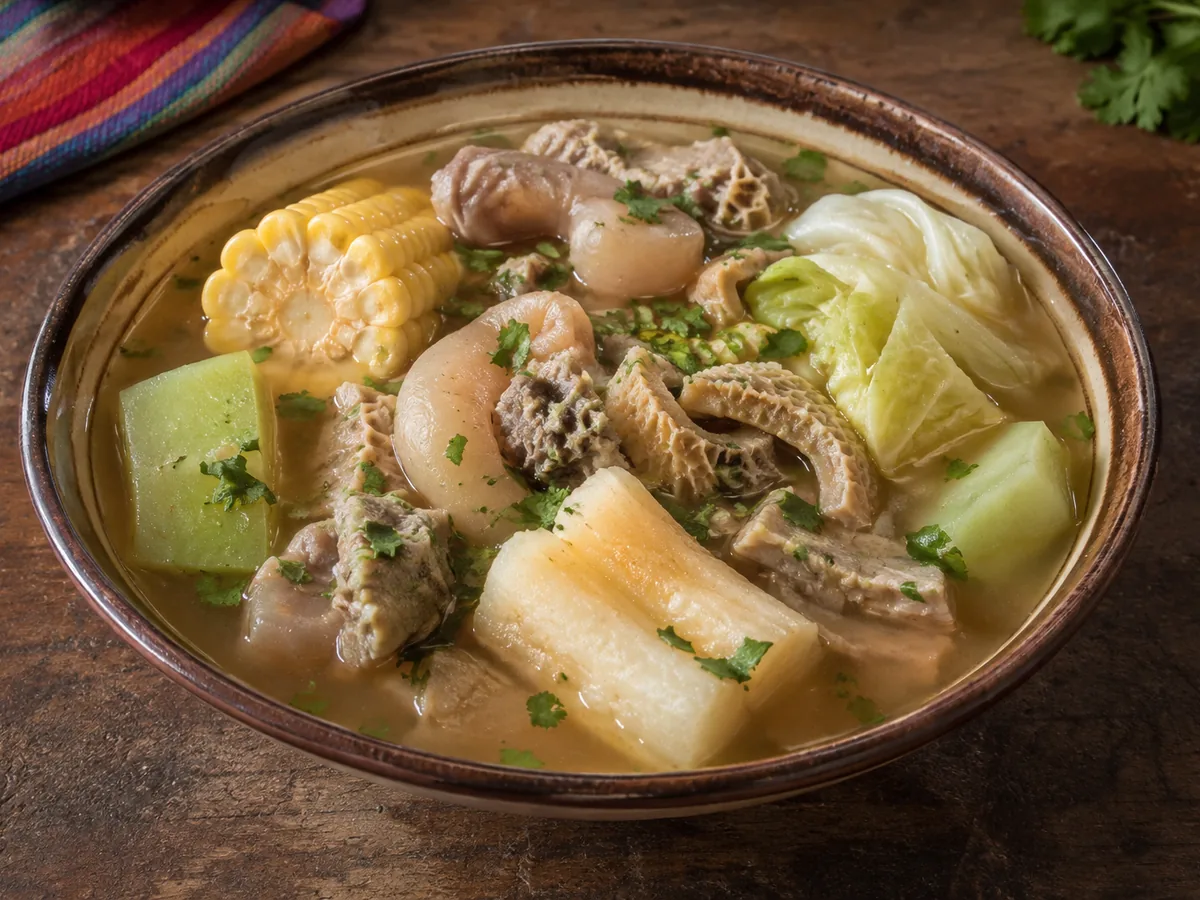
Sopa de pata is the Sunday restoration of El Salvador, simmered in large aluminium pots at crowded central market stalls.
It is built on cow’s trotters and honeycomb tripe, scrubbed with fresh limes and salt, then simmered low and slow for hours until the joints surrender pure silky gelatin. When the broth has turned amber and opaque, in go sweet corn on the cob, yuca, green plantain, güisquil, cabbage and achiote.
Finished with culantro and wild oregano, it is savoury and mineral-dense, and it leaves your lips sticking together with collagen.
The offal
- 1.8 kg4 lbCow's trotters, cross-cut into 5 cm rounds by the butcher and scrubbed clean
- 800 g1.76 lbHoneycomb beef tripe, cleaned and cut into 4 cm squares
- 4 whole4 wholeFresh limes, halved, for scouring
- 30 g2 TbspCoarse salt, for scouring
The broth
- 4 L17 cupsCold filtered water
- 1 large1 largeYellow onion, halved
- 10 cloves10 clovesFresh garlic, smashed flat
- 30 ml2 TbspAchiote oil
- 15 g1 TbspCumin seeds, freshly toasted and ground
- 5 g1.5 TbspDried wild oregano, hand-crushed
- 25 g1.5 Tbsp + 1 tspFine sea saltseasoned in stages
- 4 g1.5 tspBlack peppercorns, coarsely cracked
First in, at 40 minutes out
- 2 ears2 earsFresh sweet corn, husked and cut crosswise into 8 rounds
- 2 large2 largeGreen plantains, peeled and cut into 3 cm chunks
Second in, at 25 minutes out
- 600 g4 cupsFresh yuca, peeled, woody cord removed, cut into 5 cm chunks
Last in, at 10 minutes out
- 2 medium2 mediumGüisquil (chayote), peeled, cored and cut into thick wedges
- ½ head½ headGreen cabbage, cut into 6 large wedges
To finish
- 8 leaves8 leavesFresh culantro, or 1 cup of cilantro with its stems
Scrub the offal with lime and salt
Three minutes of aggressive rubbing, rinsed and repeated. The acid and abrasion together neutralise volatile amines and strip surface mucus, and without it an off-flavour runs through the whole pot.
Never let it roll
Collagen hydrolyses into gelatin between 82 and 93 °C. At a rolling boil the rendered fat emulsifies into the water and the soup turns cloudy and greasy instead of amber and clear.
Two and a half hours before any vegetable
Trotters need that long. Yuca needs twenty-five minutes. Put them in together and the cassava dissolves into glue while the tendons are still tough.
Stage by density
Corn and green plantain at forty minutes out, yuca at twenty-five, chayote and cabbage at ten. Otherwise the delicate things disintegrate.
Lime at the table, not in the pot
The broth is deliberately rich and unacidified. The balance arrives as a squeeze of lime in each bowl.
Passive time, counted separately
The offal is scoured twice before cooking, and the finished pot rests 10 minutes covered. Neither is active work.
The five tastes on this plate
Salt seasons the marrow, the ligaments and the dense yuca. Fat is marrow lipids and connective tissue in golden rings on the surface. Acid is entirely table-side lime. Heat is raw garlic, peppercorns, toasted cumin and chopped chilli on the side. Umami is three and a half hours of glutamates and nucleotides from bovine joints and tripe.
Equipment
- Wide bowl, for scouring
- 12 to 14 qt heavy stockpot
- Wide skimmer
- Deep wide ceramic bowls
Traditionally a 16-to-20 quart aluminium cauldron over wood embers. A 12-to-14 quart heavy stockpot works in a modern kitchen — or pressure-cook the trotters 50 minutes first and finish the vegetables in a pot on the stove.
Method
Scour the offal10 min
Squeeze the limes over the trotters and tripe and rub aggressively with the 30 g coarse salt for 3 minutes to strip the surface mucus.
Rinse thoroughly under cold water and repeat once, until everything smells clean.
Squeeze the limes over the trotters and tripe and rub aggressively with the 30 g coarse salt for 3 minutes to strip the surface mucus.
Rinse thoroughly under cold water and repeat once, until everything smells clean.
Draw the collagen25 min
Put the trotters and tripe in the stockpot with 4 L cold water, bring to a boil, and skim continuously for 20 minutes until the broth runs clear.
Add the halved onion, garlic, achiote oil, cumin, oregano, black pepper and 15 g salt.
Bring trotters, tripe and 4 L cold water to a boil; skim continuously 20 minutes until clear. Add halved onion, garlic, achiote oil, cumin, oregano, black pepper and 15 g salt.
The long sub-boil2 hr 30 min
Drop the heat until the broth barely trembles, 88–90 °C, and set the lid slightly ajar.
Simmer undisturbed 2 hours 30 minutes, until the trotters and tripe are fork-tender and the tendon gelatin gives completely.
Drop the heat until the broth barely trembles, 88–90 °C, and set the lid slightly ajar.
Simmer undisturbed 2 hours 30 minutes, until the trotters and tripe are fork-tender and the tendon gelatin gives completely.
Vegetables, in three stages40 min
Add the corn rounds and green plantain and simmer 15 minutes.
Add the yuca and simmer 15 minutes. Add the chayote and cabbage wedges and simmer a final 10 minutes, until everything is fork-tender.
Add the corn rounds and green plantain and simmer 15 minutes.
Add the yuca and simmer 15 minutes. Add the chayote and cabbage wedges and simmer a final 10 minutes, until everything is fork-tender.
Herbal finish5 min
Stir in the bruised culantro and the remaining 10 g salt and simmer 5 minutes on low so the herbal oils marry into the collagen broth.
Off the heat, rest covered 10 minutes.
Stir in the bruised culantro and the remaining 10 g salt and simmer 5 minutes on low so the herbal oils marry into the collagen broth.
Off the heat, rest covered 10 minutes.
Build the bowls
Into deep bowls: one gelatinous trotter piece and some tripe squares, surrounded by a corn round, yuca, plantain, chayote and cabbage.
Ladle the shimmering golden broth over and serve with warm tortillas and lime halves.
Into deep bowls: one gelatinous trotter piece and some tripe squares, surrounded by a corn round, yuca, plantain, chayote and cabbage.
Ladle the shimmering golden broth over and serve with warm tortillas and lime halves.
Sensory cues of doneness
- Visual: a steaming amber-gold broth with floating fat rings, tendons gone soft and translucent, and yuca cracking along its seams.
- Auditory: gentle bubbling breaking the surface every few seconds — never an aggressive boil.
- Olfactory: bovine marrow broth, sweet corn steam, earthy culantro, toasted cumin and roasted garlic.
Look for clear amber-gold broth with fat rings, soft translucent tendons and yuca splitting along its seams. Maintain gentle bubbles every few seconds, never a vigorous boil; expect marrow, corn, culantro, cumin and garlic aromas.
Storing it
It freezes into a solid block of gelatin, and thaws and reheats back into liquid gold.
Troubleshooting
- An off-flavour running through the soup.
The offal was not scoured. Lime and coarse salt, twice.
- Cloudy, greasy broth.
It boiled. Hold a lazy sub-boil the whole way through.
- Cassava dissolved into glue.
The yuca went in with the trotters. It needs 25 minutes; they need two and a half hours.
Substitutions
One-to-one global substitutions, with the technique adjustment each one requires.
Ingredient substitutions
| Ingredient | Replace with | Culinary impact and technique adjustment |
|---|---|---|
| Cow's trotters | Veal shanks (osobuco), or pig's trotters | One-to-one. Veal shanks bring excellent marrow and gelatin |
| Güisquil | Chayote, or zucchini | One-to-one, but add zucchini in the final 8 minutes only |
| Culantro | Fresh cilantro with its stems | One-to-one, for a clean herbal perfume |
Scaling
Half, for 4 bowls
Halve everything in an 8-quart Dutch oven. Simmer times are identical.
Double, for 16 bowls
Double everything in a 24-quart stockpot, so the vegetables submerge evenly.
What to serve it with
- Thick handmade corn tortillas, for dipping in the marrow broth
- Lime wedges and chopped chillies, to cut the collagen
- A cold Pilsener, or rich horchata de morro
Questions
Can I use a pressure cooker?
Yes. Pressure-cook the scrubbed trotters and tripe with the aromatics in 2.5 L water for 50 minutes, quick-release, then finish the vegetables on the stove for 25 minutes.
What does "pata" mean?
The lower leg and trotter of the cow — almost pure bone, marrow, tendon and skin, which is where all that gelatin comes from.
Does it freeze?
Yes, into a solid gelatin block. It returns to liquid on reheating.