Pupusas Revueltas
Not a tortilla with cheese on it — a sealed masa envelope around a molten core of three things. The fillings go in refrigerator-cold and paste-thick, because any free water in them flashes to steam on a 210 °C comal and blows the seams apart before the pupusa can puff.
- Prep
- 45 min
- Cook
- 25 min
- Serves
- 12 large pupusas, about 15 cm across
- Difficulty
- Hard
Researched · Kitchen testing pending
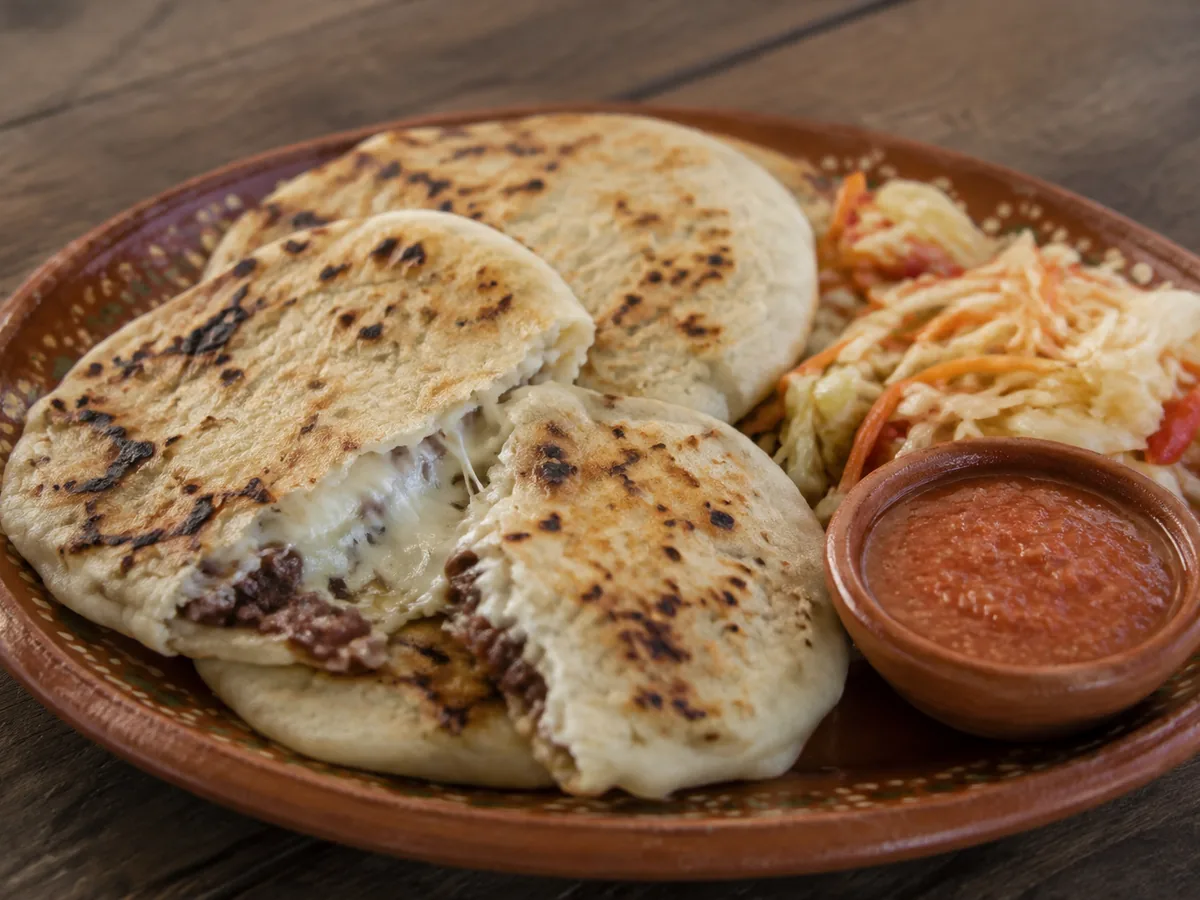
In every town from Olocuilta to San Salvador, the rhythmic clapping of pupuseras fills the afternoon air. Pupusas are the national culinary pulse of El Salvador.
A proper pupusa revuelta is not a tortilla with cheese on top — it is a sealed griddled corn disc housing a molten core of three things: savoury chicharrón ground into a smooth paste, velvety refried red beans, and stretchy Salvadoran quesillo.
Clapped thin between oiled palms and seared on a hot comal, the masa puffs with steam and blisters dark while cheese oozes through micro-fissures and crisps into lace at the rim. Eaten hot with your fingers, under crunchy curtido and warm tomato salsa.
The masa
- 600 g4 cupsPrecooked white corn flour for pupusas
- 750 ml3.2 cupsLukewarm filtered water at about 40 °C, adjusted for a smooth hydration
- 10 g1.5 tspFine sea salt
- 30 ml2 TbspVegetable oil, for the dough and the hand-dipping bowl
The chicharrón filling
- 400 g14 ozPork shoulder or belly, cut into 3 cm cubes
- 2 large2 largeRipe plum tomatoes, roughly chopped
- ½ medium½ mediumGreen bell pepper, cored and chopped
- ½ medium½ mediumYellow onion, chopped
- 3 cloves3 clovesFresh garlic, peeled
- 4 g1 tspCumin seeds, freshly toasted and ground
- 8 g1.5 tspFine sea salt
The other fillings
- 300 g1.5 cupsSalvadoran refried red silk beans, smooth, chilled and paste-thick
- 350 g3.5 cupsSalvadoran quesillo, or 50/50 low-moisture mozzarella and queso Oaxaca, shredded
The curtido
- 400 g4 cupsGreen cabbage, finely shredded into 2 mm ribbons
- 1 medium1 mediumCarrot, peeled and coarsely grated
- ½ medium½ mediumRed or white onion, sliced paper-thin
- 1 fresh1 freshJalapeño, sliced into thin rings
- 180 ml¾ cupDistilled white cane vinegar, or pineapple vinegar
- 120 ml½ cupWarm water
- 5 g1 TbspDried wild Mexican oregano, crushed between the palms
- 10 g2 tspFine sea salt
- 5 g1 tspGranulated cane sugar
The salsa
- 4 large4 largeRipe plum tomatoes, halved
- ½ medium½ mediumGreen bell pepper, chopped
- ¼ medium¼ mediumYellow onion
- 2 cloves2 clovesFresh garlic
- 5 g1 tspFine sea salt
Soft as an earlobe
Nixtamalisation cross-links the corn hemicellulose and gives the masa viscoelastic stretch, but only at the right hydration. If it cracks when pressed, knead in another two or three tablespoons of water before you stuff anything.
Cold, thick fillings
Watery beans or chicharrón liquefy while you are patting and flash to steam on the comal, splitting the seams. Both must be paste-thick and straight from the fridge.
The cup method
Press a thumb into a 70 g ball and rotate to make a hollow cup with 5 mm walls, fill it, then gather the top edges up and twist off the excess. An unbroken envelope is what lets it inflate.
Oil your hands, not the dough
A bowl of oil beside the board. Oiled palms are what stop the masa sticking and let you smooth over any micro-fissure at the edge.
The two-flip rule
Bottom set, flip, let it puff, flip once more to finish. Turning it back and forth dries the dough into leather.
Passive time, counted separately
The curtido ferments at least 2 hours and ideally 24, and the chicharrón paste chills completely. Neither is active work.
The five tastes on this plate
Salt is the seasoned masa, the chicharrón paste and the briny quesillo. Fat is rendered pork in the paste and melted whole-milk cheese. Acid is cane vinegar and fermented cabbage cutting the lard. Heat is toasted cumin, raw jalapeño and black pepper. Umami is browned pork fond, cooked tomato salsa and aged cheese curds.
Equipment
- Large glass jar, for the curtido
- Skillet and a food processor, for the chicharrón
- Saucepan and blender, for the salsa
- Wide bowl and a damp towel
- 12 to 14 in cast-iron skillet or flat griddle
- Small bowls of oil and water
Traditionally an unglazed comal de barro or a steel plancha over a wood fire. A 12-to-14 inch cast-iron skillet works in a modern kitchen — the thermal mass keeps the surface from dropping when cold stuffed masa lands on it.
Method
Cook the chicharrón paste30 min
Simmer the pork cubes with 250 ml water, 1 tsp salt and the cumin 20 minutes, until the water goes and the meat browns in its own fat.
Add the tomato, bell pepper, onion and garlic and cook 8 minutes, then pulse in a processor into a smooth thick spreadable paste. Chill completely.
Simmer pork with 250 ml water, 1 tsp salt and cumin 20 minutes until water evaporates and meat browns in its fat. Add tomato, pepper, onion and garlic; cook 8 minutes. Process to a smooth, thick paste; refrigerate until completely cold.
Ferment the curtido and simmer the salsa20 min
Pack the cabbage, carrot, onion, jalapeño, oregano, 10 g salt, sugar, vinegar and 120 ml warm water tightly into a jar and leave at room temperature at least 2 hours, ideally 24.
For the salsa, boil the tomato, pepper, onion and garlic in 250 ml water 10 minutes, blend smooth, then simmer with a teaspoon of oil, oregano and salt 10 minutes.
Pack curtido vegetables, oregano, 10 g salt, sugar, vinegar and 120 ml warm water tightly in a jar; leave at room temperature at least 2 hours, ideally 24. For salsa, boil tomato, pepper, onion and garlic in 250 ml water 10 minutes; blend, then simmer with 1 tsp oil, oregano and salt 10 minutes.
Knead the masa8 min
Whisk the corn flour and 10 g salt, drizzle in the 750 ml lukewarm water, and knead 4 to 5 minutes into a smooth supple dough.
It should feel like soft modelling clay — if it cracks when pressed, work in more water. Cover with a damp towel.
Mix corn flour and 10 g salt; gradually add 750 ml water at about 40 °C. Knead 4–5 minutes until smooth and supple. If it cracks, knead in another 2–3 tablespoons water. Cover with a damp towel.
Fill using the cup method15 min
Oil your hands and roll a 70 g ball. Press your thumb in and rotate to form a hollow cup with 5 mm walls.
Put in 1 Tbsp cold chicharrón, 1 Tbsp cold beans and 2 Tbsp quesillo, gather the edges up, twist off the excess and roll smooth.
Oil hands; shape a 70 g ball into a cup with 5 mm walls. Fill with 1 Tbsp cold chicharrón, 1 Tbsp cold paste-thick beans and 2 Tbsp quesillo. Gather edges, twist off excess and roll smooth.
Clap it thin10 min
With oiled fingers, pat the ball between your palms, rotating continuously, until it is an even disc 15 cm across and 6 mm thick.
Smooth any edge fissures closed with an oiled fingertip.
With oiled fingers, pat the ball between your palms, rotating continuously, until it is an even disc 15 cm across and 6 mm thick.
Smooth any edge fissures closed with an oiled fingertip.
Griddle25 min
Heat the comal to 210 °C and wipe it with an oiled towel.
Cook undisturbed 2.5 to 3 minutes until the base is set and toasted gold, flip and give it 2.5 minutes as it puffs with steam, then flip once more for a final minute. Onto a warm cloth.
Heat comal to 210 °C; wipe with an oiled towel. Cook undisturbed 2.5–3 minutes until base sets and browns. Flip, cook 2.5 minutes until puffed, then flip once more for 1 minute. Transfer to a warm cloth.
Serve
Serve piping hot and tear one open with your fingers so the quesillo stretches, then heap crisp curtido and warm tomato salsa over the centre.
Serve piping hot and tear one open with your fingers so the quesillo stretches, then heap crisp curtido and warm tomato salsa over the centre.
Sensory cues of doneness
- Visual: a golden corn cake speckled with dark comal blisters, with crisp cheese skirts browned along the rim.
- Auditory: a steady hiss as the oiled dough meets the iron, then a soft puffing sigh as the centre inflates.
- Olfactory: toasted corn masa, browned pork, stewed tomato, melted cheese and oregano curtido.
Look for golden corn cakes with dark comal blisters and crisp browned cheese at the rim. Expect a steady hiss followed by puffing, with aromas of toasted corn, pork, tomato, melted cheese and oregano curtido.
Storing it
Shape them raw, layer between parchment sheets and freeze solid. Cook straight from frozen on a medium comal, 4 to 5 minutes a side.
Troubleshooting
- The dough cracks as you flatten it.
The masa is dry. Knead in more water until it is soft and silky, before stuffing.
- Filling leaking and burning on the comal.
It was overfilled, or the filling was watery. Both fillings must be fridge-cold and paste-thick.
- A tough, leathery disc.
It was flipped too often. Bottom set, flip, puff, flip once to finish.
Substitutions
One-to-one global substitutions, with the technique adjustment each one requires.
Ingredient substitutions
| Ingredient | Replace with | Culinary impact and technique adjustment |
|---|---|---|
| Pupusa masa flour | Fine white masa harina, or rice flour | With rice flour, use boiling water to pre-gelatinise the starches |
| Salvadoran quesillo | 50/50 mozzarella with queso Oaxaca or Muenster | One-to-one. The same stretchy unctuous melt |
| Chicharrón para pupusas | Ground pork browned with tomato, or shredded braised chicken | Whatever it is, it must be puréed into a thick paste |
Scaling
Half, for 6 pupusas
Halve everything. The comal time stays about 3 minutes a side.
Double, for 24 pupusas
Double everything across two large griddles, so they all reach the table hot.
What to serve it with
- Curtido salvadoreño, crisp and oregano-scented
- Warm mild tomato and sweet pepper salsa poured over the curtido
- Horchata de morro with cinnamon and cacao, or an ice-cold Pilsener
Questions
Can I make them with rice flour?
Yes — pupusas de arroz, famous in Olocuilta, use fine rice flour kneaded with hot water and oil for a lighter, snow-white, crisper shell.
What cheese substitutes for quesillo?
A 50/50 blend of low-moisture mozzarella with queso Oaxaca or Muenster gives the same melt and salty tang.
Can uncooked pupusas be frozen?
Yes. Freeze them solid between parchment sheets and cook from frozen, 4 to 5 minutes a side on a medium comal.