Stewed Tamarind and Tamarind Balls
The twin tamarind sweets of every island childhood. Half the shelled pulp, seeds and all, kneaded by hand with raw cane sugar, rum and a pinch of salt and rolled in sparkling sugar into chewy balls with no cooking. The other half simmered in a stainless pan with dark brown sugar, ginger, cinnamon and clove to a glossy mahogany preserve at thread stage, finished with Cruzan rum.
- Prep
- 30 min
- Cook
- 25 min
- Serves
- About 500 g preserve and 20 balls
- Difficulty
- Easy
Researched · Kitchen testing pending
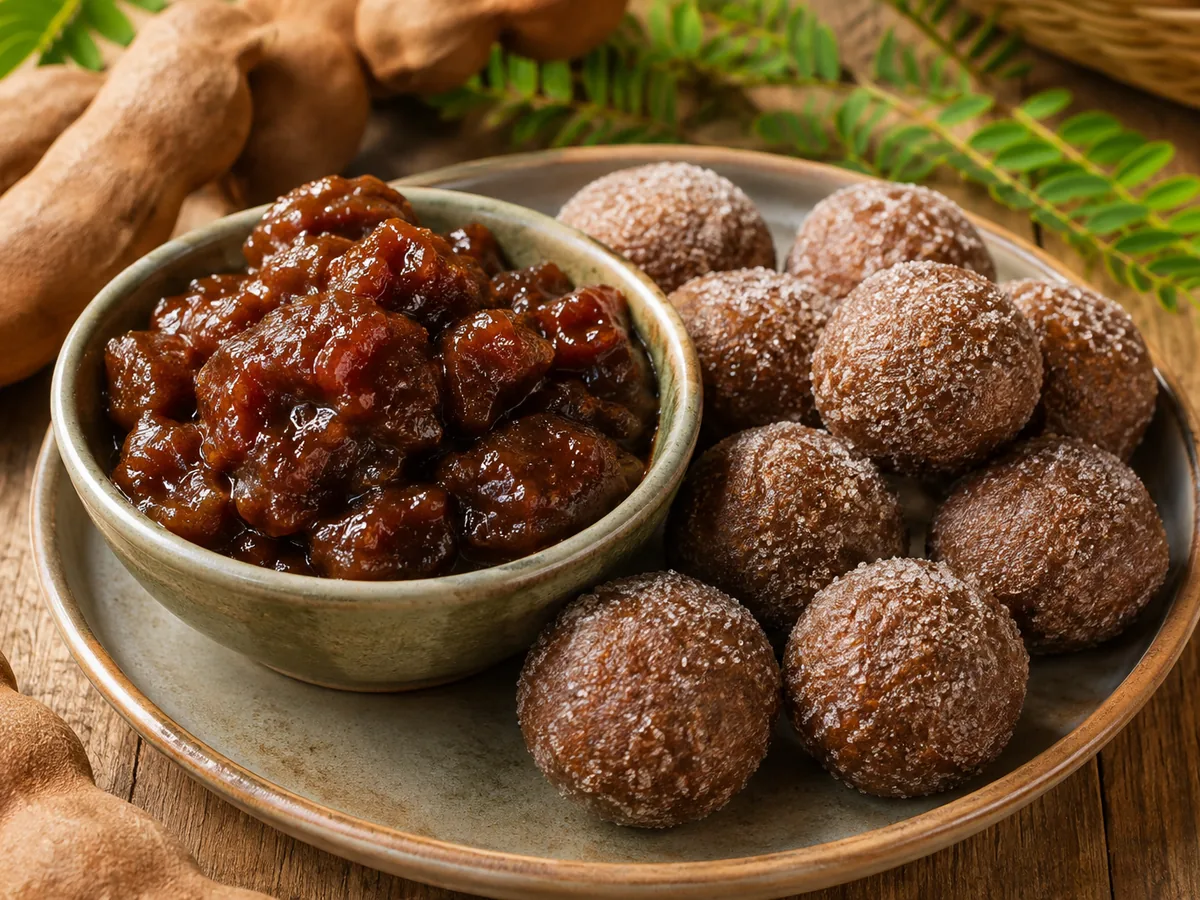
Every spring the big wild tamarind trees drop brittle brown pods across the islands, and children and market vendors crack them for the sticky, acid, mahogany pulp inside. From that pulp come the twin sweets of the Virgin Islands.
Stewed tamarind simmers the pulp, seeds and all, with dark brown sugar, cinnamon, clove, ginger and a splash of Cruzan rum into a glossy sweet-tart preserve. Tamarind balls need no heat: the raw pulp is kneaded with cane sugar and rum, rolled between the palms, and coated in sparkling sugar.
- 1 kg pods, or 600 g pulp2.2 lb podsFresh tamarind pods in the shell, or a seed-in pulp block
- 400 g2 cups packedDark brown sugar, for the stewed tamarind
- 200 g1 cupGranulated raw cane sugar, for the balls
- 60 ml¼ cupCruzan dark or amber rumdivided
- 300 ml1¼ cupsWater, for the stewed tamarind
- 15 g1 TbspFresh ginger, grated to a paste
- 4 g1½ tspGround cinnamondivided
- 2 g½ tspGround cloves
- 3 g½ tspFine sea saltdivided
- ¼ tsp¼ tspScotch bonnet, minced very fineoptional, for the Crucian spicy ball
Tartaric acid
Ripe tamarind is up to 12 percent tartaric acid, about pH 2. The acid survives heat, and boiled with brown sugar it inverts the sucrose so the preserve stays glossy instead of crystallising as it cools.
Stainless only
At that acidity, bare aluminium or cast iron leaches metal into the pan and pits it. Stainless steel or enamel.
The five tastes on this plate
Salt is a pinch that lifts both tartness and sweetness. There is no fat. Acid is the tamarind's mouth-puckering tartaric punch. Heat is ginger, clove, rum and the optional chili. There is no umami.
Equipment
- 3-quart stainless or enamelled saucepan
- Wooden spoon
- Parchment paper
- Sterilised glass jars
Tradition stews in a cast-iron dutchy; chemistry says stainless. Use a non-reactive pan.
Method
Shell the pods20 min
Crack the brittle shells with your fingers, peel them off and pull away the stringy fibres. Keep the seeds in the pulp. You should have about 600 g of sticky pulp.
Crack the brittle shells with your fingers, peel them off and pull away the stringy fibres. Keep the seeds in the pulp. You should have about 600 g of sticky pulp.
Knead the tamarind balls8 min
Put 300 g of pulp in a bowl with 150 g cane sugar, 30 ml rum, half a teaspoon of cinnamon, a pinch of salt, and the chili if using. Knead with clean hands 3 to 4 minutes, pressing the sugar into the pulp, until a stiff pliable dough forms.
Combine 300 g pulp, 150 g cane sugar, 30 ml rum, ½ teaspoon cinnamon, a pinch of salt and optional chili. Knead with clean hands 3–4 minutes, pressing sugar into pulp, until stiff and pliable.
Roll and coat8 min
Roll teaspoon-sized portions into 2.5 cm balls and roll each in the remaining 50 g sugar until fully coated. Set on parchment to dry 1 hour.
Roll teaspoon-sized portions into 2.5 cm balls and roll each in the remaining 50 g sugar until fully coated. Set on parchment to dry 1 hour.
Start the stewed tamarind5 min
Put the other 300 g of pulp in the saucepan with the water, brown sugar, ginger, a teaspoon of cinnamon, the cloves and the remaining salt. Stir over medium heat until the sugar dissolves and it boils.
Use stainless steel or enamel, not bare aluminium or cast iron. Combine remaining 300 g pulp, water, brown sugar, ginger, 1 teaspoon cinnamon, cloves and remaining salt. Stir over medium until sugar dissolves and mixture boils.
Reduce25 min
Lower to medium-low and simmer 20 to 25 minutes, stirring along the bottom often, until the pulp swells and the syrup thickens to a glossy mahogany glaze at 105 to 108 °C that coats a spoon heavily.
Lower to medium-low and simmer 20 to 25 minutes, stirring along the bottom often, until the pulp swells and the syrup thickens to a glossy mahogany glaze at 105 to 108 °C that coats a spoon heavily.
Finish and jar30 min
Off the heat, stir in the remaining 30 ml rum. Cool 30 minutes; it thickens further. Spoon into sterilised jars and seal.
Off the heat, stir in the remaining 30 ml rum. Cool 30 minutes; it thickens further. Spoon into sterilised jars and seal.
Sensory cues of doneness
- Visual: the preserve glossy dark mahogany, coating the spoon; the balls dark spheres glittering with white sugar.
- Auditory: a syrupy bubble in the pan; a soft squelch as the dough is kneaded.
- Olfactory: sharp sweet-sour fruit, caramelised brown sugar, rum, ginger, cinnamon.
Check for glossy dark-mahogany preserve that heavily coats a spoon and dark balls coated with sparkling sugar. Expect syrupy bubbling and sweet-tart fruit, caramelised sugar, rum, ginger and cinnamon aromas.
Storing it
The balls keep 6 months in an airtight jar at room temperature. The preserve keeps months sealed and refrigerated once opened.
Troubleshooting
- A metallic taste.
Aluminium or bare iron. Stainless or enamel only.
- Balls that will not hold together.
Seeds removed. The seeds give the volume and structure; leave them in.
- Rock candy in the jar.
Boiled past 110 °C. Stop while the syrup is still fluid and spoonable.
Substitutions
One-to-one swaps, with the technique change each one needs.
Ingredient substitutions
| Ingredient | Replace with | Culinary impact and technique adjustment |
|---|---|---|
| Fresh tamarind pods | A compressed wet pulp block, seed-in or seedless | Break it apart with your fingers |
| Cruzan dark rum | Spiced rum, gold rum, or water | Rum adds the island aroma |
| Dark brown sugar | Turbinado, jaggery or piloncillo | Jaggery gives a deep earthy sweetness |
Scaling
Half
Ten balls and a small jar; simmer 18 minutes.
Double
Forty balls and two jars, simmered in a 6-quart stainless pot.
What to serve it with
- Warm stewed tamarind over vanilla ice cream or pound cake
- The balls in tins as holiday sweets
- A sipping rum, or chilled coconut water
Questions
Prepared tamarind paste?
Yes; the one-pound wet blocks from Latin or Asian markets stand in one-to-one for fresh pods.
How long do the balls keep?
Up to 6 months airtight at room temperature.
Why rum?
For the molasses aroma, and because it helps preserve the confection.