Crucian Johnny Cakes
The food-fair bread of St. Croix. Flour, double-acting baking powder, a generous quarter cup of sugar and salt, cold butter rubbed in, cold milk stirred to a soft dough, kneaded a minute, rested thirty, flattened into discs, pricked three times with a fork so they puff evenly, and fried at 175 °C into golden pillows with a crisp shell and steamy layered crumb.
- Prep
- 20 min
- Cook
- 15 min
- Serves
- 12 johnny cakes
- Difficulty
- Easy
Researched · Kitchen testing pending
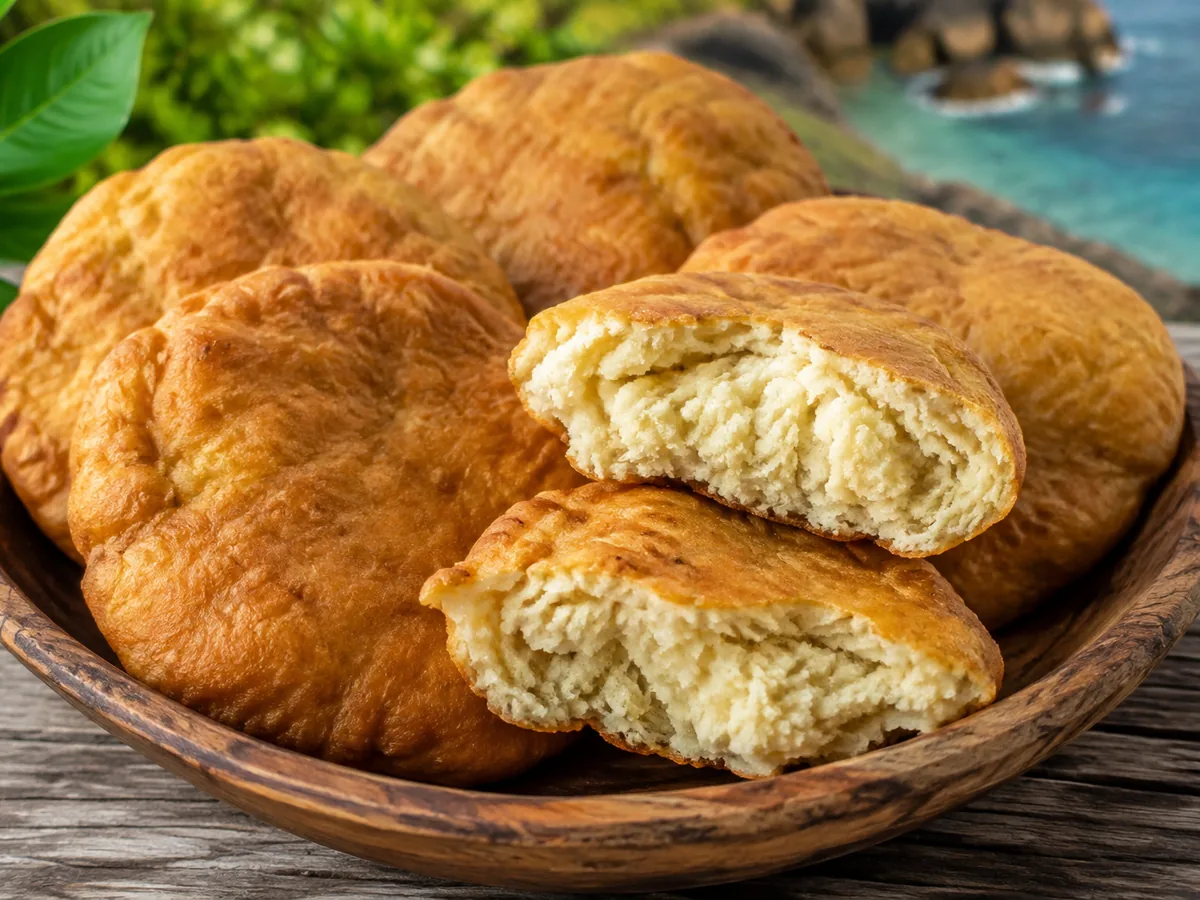
Journey cake became johnny cake: a provision bread that field labourers and sailors carried because it kept for days. The Crucian version is its own thing, made with wheat flour rather than cornmeal, a generous hand of sugar, butter or shortening and baking powder, and fried rather than griddled.
Flattened into discs and pricked with a fork, the cakes swell in hot oil into golden pillows with a thin, faintly sweet crust and a steamy, layered inside. They are the morning smell of every food fair on St. Croix.
- 500 g4 cupsPlain flour, sifted
- 15 g1 Tbsp plus 1 tspBaking powder, double-acting and fresh
- 50 g¼ cupGranulated cane sugar
- 8 g1½ tspFine sea salt
- 60 g4 TbspUnsalted butter or shortening, cold, in small cubes
- 240 ml1 cupCold whole milk or water, plus a spoonful if needed
- 1 L4 cupsVegetable oil, peanut oil or lard, for frying
Two rises and three pricks
Double-acting powder releases gas once when the cold milk goes in and again when the dough passes 60 °C in the oil. The fork pricks are vents: without them the steam blows the cake into a hollow ball; with them it lifts into an even, layered crumb.
Knead almost not at all
Cold butter rubbed into the flour coats the gluten. One or two minutes of kneading and a thirty-minute rest keep the cakes tender and let the discs hold their shape.
The five tastes on this plate
Salt tempers the sugar. Fat is butter in the dough and hot oil on the crust. There is no acid or heat in the bread; saltfish or conch supply them at the table. Umami is toasted flour and caramelised milk sugar.
Equipment
- Large bowl and a fork
- 5 to 6-quart Dutch oven with a deep-fry thermometer
- Slotted skimmer
- Wire rack lined with paper
A cast-iron dutchy over a coal pot at the fair; at home a heavy Dutch oven held at 175 °C.
Method
Dry ingredients1 min
Whisk the flour, baking powder, sugar and salt.
Whisk the flour, baking powder, sugar and salt.
Rub in the butter3 min
Rub the cold butter into the flour with fingertips or a pastry blender until it looks like coarse cornmeal with a few pea-sized flecks. Work fast so it does not melt.
Rub the cold butter into the flour with fingertips or a pastry blender until it looks like coarse cornmeal with a few pea-sized flecks. Work fast so it does not melt.
Hydrate and knead3 min
Make a well, pour in the cold milk and stir with a fork to a soft, slightly sticky dough. Knead on a lightly floured board 1 to 2 minutes until smooth, no more.
Make a well, pour in the cold milk and stir with a fork to a soft, slightly sticky dough. Knead on a lightly floured board 1 to 2 minutes until smooth, no more.
Portion and rest30 min
Divide into 12 pieces of about 70 g and roll into smooth balls. Cover with a damp towel and rest 30 minutes.
Divide into 12 pieces of about 70 g and roll into smooth balls. Cover with a damp towel and rest 30 minutes.
Shape and prick5 min
Flatten each ball with the palm or a pin into a 10 to 12 cm disc, 1 cm thick. Prick the top three times across the centre with a fork.
Flatten each ball with the palm or a pin into a 10 to 12 cm disc, 1 cm thick. Prick the top three times across the centre with a fork.
Fry15 min
Heat the oil to 175 °C. Lower in 3 or 4 discs and fry 2½ to 3 minutes until swollen and deep gold underneath, flip, and fry 2 to 3 minutes more until puffed and evenly browned, 95 °C inside. Drain on the rack.
Heat oil to 175 °C. Fry 3–4 discs at a time, 2½–3 minutes until puffed and deep gold underneath. Flip; fry 2–3 minutes until evenly browned and 95 °C inside. Drain on a rack.
Serve
Hot from the fryer, split and buttered, or beside stewed saltfish or conch in butter sauce.
Serve hot, split and buttered, or alongside stewed saltfish or conch in butter sauce.
Sensory cues of doneness
- Visual: evenly puffed golden-amber discs with three rows of fork pricks; split, the crumb is pale, fluffy and steaming.
- Auditory: a lively whisper as the dough slips into the oil; a light snap when torn.
- Olfactory: frying dough, toasted butter, caramelised cane sugar.
Look for evenly puffed golden-amber discs with fork marks and pale, fluffy, steaming crumb. Expect gentle frying sounds and a light snap when split, with dough, toasted butter and caramelised-sugar aromas.
Storing it
Shaped dough balls can be refrigerated overnight, covered. Bring to room temperature 20 minutes before flattening and frying.
Troubleshooting
- Tough, heavy biscuits.
Kneaded like pizza dough. One to two minutes, until it just holds.
- Dark outside, raw inside.
Oil above 190 °C. Hold 175.
- Thick lumps that cook unevenly.
The rest was skipped, so the discs shrank back. Thirty minutes under a damp towel.
Substitutions
One-to-one swaps, with the technique change each one needs.
Ingredient substitutions
| Ingredient | Replace with | Culinary impact and technique adjustment |
|---|---|---|
| Butter | Vegetable shortening or rendered leaf lard | Shortening gives the crisp, flaky carnival texture |
| Whole milk | Cold water, or evaporated milk cut half with water | Water is the old journey-cake way; evaporated milk is richer |
| Cane sugar | Turbinado or brown sugar | A deeper caramel note |
Scaling
Half
Six cakes in two batches of three.
Double
Twenty-four in steady batches of four so the oil holds 175 °C.
What to serve it with
- Stewed saltfish with onion, peppers, garlic and tomato
- Conch in butter sauce
- Hot bush tea, or cocoa tea with nutmeg and bay leaf
Questions
Baked instead of fried?
On a greased sheet at 200 °C for 15 to 18 minutes until golden, though frying is the island standard.
Dough ahead?
Yes, shaped and refrigerated overnight. Rest at room temperature 20 minutes before frying.
Water or milk?
Water is traditional and kept longer on a journey; milk gives a softer, richer crumb.