Bullfoot Soup
The Saturday cauldron outside every roadside cookshop. Lime-scrubbed cow heel simmered with yellow split peas for nearly two hours until the tendons are translucent and the peas have dissolved into a golden broth, then pumpkin, cassava, yam and corn rounds, a whole Scotch bonnet, and hand-rolled flour spinners dropped in for the last twelve minutes.
- Prep
- 35 min
- Cook
- 2 hr 30 min
- Serves
- 8
- Difficulty
- Medium
Researched · Kitchen testing pending
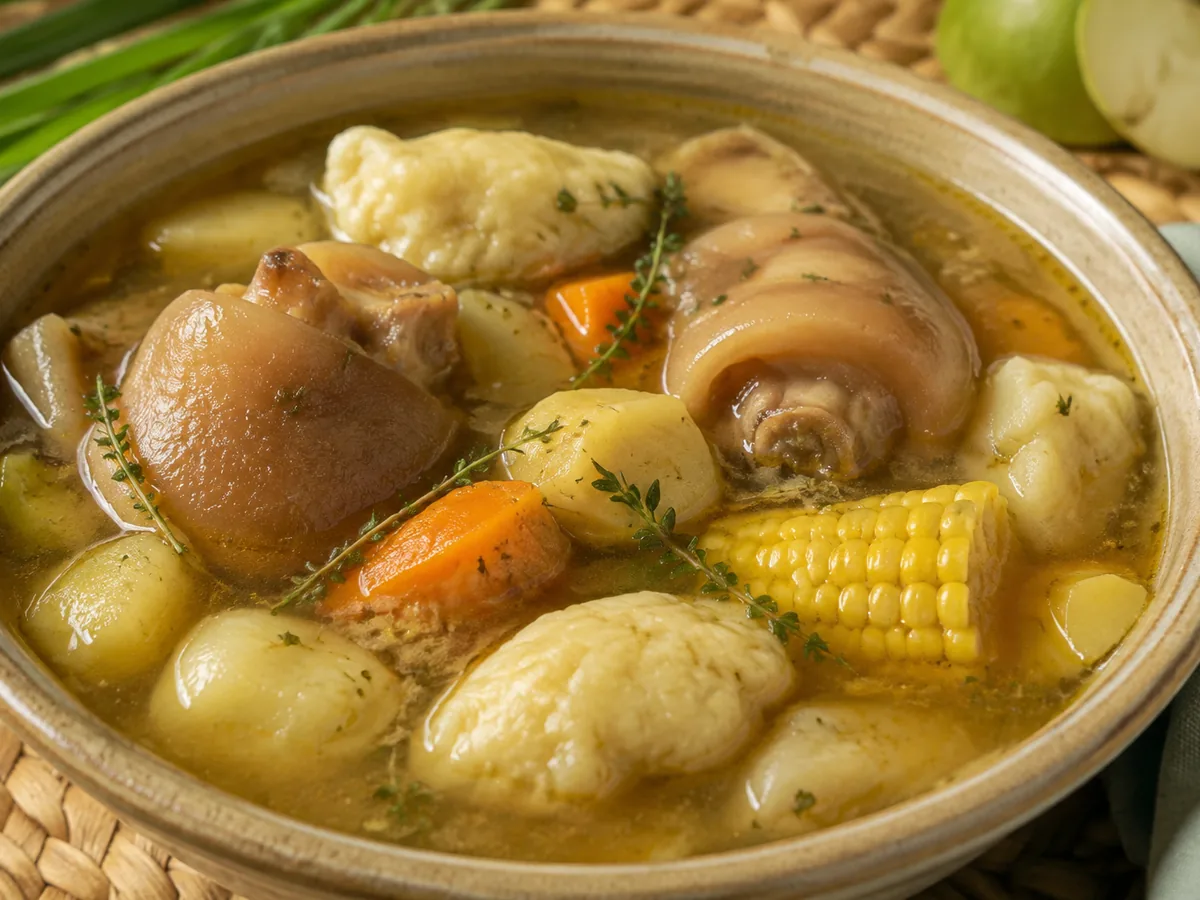
On Saturday afternoons steam rises from the cauldrons outside cookshops on St. Thomas and St. Croix. Bullfoot soup, cow heel soup, is the islands’ restorative: cross-cut trotters simmered until their tendons and skin are liquid gelatin, with yellow split peas that break down into a thick golden base.
The pot fills with ground provisions, pumpkin, yam, cassava and corn, and in the last minutes the spinners go in, hand-rolled flour dumplings that float up chewy and soaked in the sticky broth.
Soup
- 1.8 kg4 lbCow heels, cleaned, hair singed, in 5 cm rounds
- 3 large3 largeLimes, halved, for scouring
- 200 g1 cupDried yellow split peas, rinsed
- 3.5 L15 cupsCold water
- 200 g1 largeYellow onion, in fine dice
- 8 cloves8 clovesGarlic, crushed to a paste
- 4 whole4 wholeSweet seasoning peppers, seeded and minced
- 4 sprigs4 sprigsFresh thyme
- 4 whole4 wholeAllspice berries, lightly crushed
- 1 whole1 wholeScotch bonnet, unpunctured, stem on
- 300 g2 cupsCalabaza or kabocha, peeled, in 3 cm cubes
- 300 g2 cupsCassava, peeled, core removed, in 3 cm chunks
- 300 g2 cupsYellow yam or sweet potato, peeled, in 3 cm chunks
- 2 ears2 earsSweet corn, in 3 cm rounds
- 20 g1½ TbspFine sea saltdivided
- 4 g1 tspBlack pepper
Spinners
- 200 g1½ cupsPlain flour
- 3 g½ tspFine sea salt
- 100 mlscant ½ cupCold water
Feet are almost all collagen
Cow heel is tendon, skin and cartilage with little muscle. Held between 88 and 93 °C for two hours the collagen unwinds into liquid gelatin that gives the broth its lip-coating body. Cooled, it sets solid.
Peas as the thickener
Husk-free split peas burst quickly and disperse their starch into the broth, turning it opaque amber without any roux.
The five tastes on this plate
Salt seasons the tendons and roots. Fat is the melted collagen. Acid is added at the table, lime wedges or pepper vinegar. Heat is the whole pepper's aroma, allspice, garlic and pepper. Umami is trotter collagen, dissolved split pea and sweet roots.
Equipment
- 8 to 10-quart enamelled Dutch oven, or an 8-quart pressure cooker
- Large basin, for scrubbing
- Spoon, for skimming
- Bowl and fork, for the spinners
A blackened cauldron over a coal fire outside the cookshop. Indoors, a big Dutch oven, or a pressure cooker that tenderises the heels in 50 minutes before the vegetables go in.
Method
Clean the heels10 min
Check the hair is fully singed. Scrub the rounds with the cut limes and cold water in a basin, rinse and drain.
Check the hair is fully singed. Scrub the rounds with the cut limes and cold water in a basin, rinse and drain.
Extract the gelatin1 hr 55 min
Put the heels and split peas in the pot with the cold water and bring to a rolling boil. Skim the grey foam for 10 minutes. Add the onion, garlic, seasoning peppers, allspice and 10 g salt. Lower to medium-low, cover with the lid ajar, and simmer 1 hour 45 minutes, or 50 minutes under pressure, until the tendons are translucent and pulling from the bone and the peas have dissolved.
Bring heels, split peas and cold water to a rolling boil; skim 10 minutes. Add onion, garlic, seasoning peppers, allspice and 10 g salt. Simmer medium-low with lid ajar 1 hour 45 minutes, or pressure-cook 50 minutes, until tendons turn translucent and release from bones and peas dissolve.
Provisions and corn20 min
Add the corn, pumpkin, cassava and yam with the thyme and black pepper. Rest the whole Scotch bonnet on top. Simmer over medium-low 20 minutes until the roots are nearly tender.
Add corn, pumpkin, peeled and cored cassava, yam, thyme and black pepper. Lay the unpunctured Scotch bonnet on top; simmer medium-low 20 minutes until roots are nearly tender.
Roll the spinners8 min
Mix the flour and salt, add the cold water gradually with a fork to a stiff smooth dough, and knead one minute. Pinch off 15 g pieces and roll between the palms into tapered 8 cm fingers.
Mix the flour and salt, add the cold water gradually with a fork to a stiff smooth dough, and knead one minute. Pinch off 15 g pieces and roll between the palms into tapered 8 cm fingers.
Poach the spinners12 min
Drop the spinners into the simmering soup one by one. Simmer uncovered 10 to 12 minutes, stirring gently so they do not stick, until they swell and float. The pumpkin will half-melt and turn the broth golden. Lift out the pepper and thyme stems.
Add spinners one by one; simmer uncovered 10–12 minutes, stirring gently to prevent sticking, until swollen and floating. Pumpkin should partly dissolve and colour the broth golden. Remove pepper and thyme stems.
Season and serve
Taste and add the remaining salt as needed. Ladle into deep bowls so each has heel, corn, roots and spinners, with lime wedges.
Taste and add the remaining salt as needed. Ladle into deep bowls so each has heel, corn, roots and spinners, with lime wedges.
Sensory cues of doneness
- Visual: a thick golden-amber potage of translucent cow heel, yellow corn rounds, orange pumpkin, white cassava and floating ivory spinners.
- Auditory: heavy, viscous bubbling as the soup thickens.
- Olfactory: rich marrow, sweet corn, allspice, thyme, stewed pumpkin.
Check for thick golden-amber broth, translucent heel, corn, pumpkin, cassava and floating ivory spinners. Expect heavy thick bubbles and aromas of marrow, sweet corn, allspice, thyme and stewed pumpkin.
Storing it
Leftovers set into a firm jelly in the fridge and melt back into broth on gentle reheating.
Troubleshooting
- Rubbery heels.
Under two hours. Cook until the tendons are fork-tender and jelly-like.
- Spinners dissolved into starch.
Dropped in early. The last 12 minutes only.
- Cloudy, off-tasting broth.
The first foam was not skimmed. Skim hard for the first 10 minutes.
Substitutions
One-to-one swaps, with the technique change each one needs.
Ingredient substitutions
| Ingredient | Replace with | Culinary impact and technique adjustment |
|---|---|---|
| Cow heels | Veal trotters, pig feet or smoked pork hocks | Hocks add smoke to the gelatin |
| Calabaza | Kabocha, butternut or sweet potato | The same dense sweetness |
| Yellow yam | Sweet potato, russet or taro | Starchy tubers that drink the broth |
Scaling
Half
900 g heels and 2 litres water in a 5-quart pot; still 2 to 2½ hours.
Double
A 16 to 20-quart stockpot at a gentle sub-boil for the community pot.
What to serve it with
- Crucian yellow Scotch bonnet and mustard pepper sauce
- Warm johnny cakes or hard dough bread
- Cold ginger beer, or hot bush tea
Questions
Ox feet or pig feet?
Pig trotters or veal feet work the same way; cow heel is traditional for its gelatin.
Why bullfoot if it is cow heel?
Old Caribbean usage: trotters from working oxen and bulls were bullfoot.
Why does it set in the fridge?
The gelatin. It turns back into broth on gentle heating.