Cedar-Planked Wild Salmon
The Columbia River method of the Coast Salish and Chinook peoples, on a grill. Wild sockeye or king salmon roasts on a soaked, charred western red cedar plank that shields it from the flame and steams cedar oil into the flesh, under a simmered lacquer of bourbon, brown sugar and grainy mustard, pulled at 52 °C.
- Prep
- 20 min
- Cook
- 18 min
- Serves
- 6
- Difficulty
- Medium
Researched · Kitchen testing pending
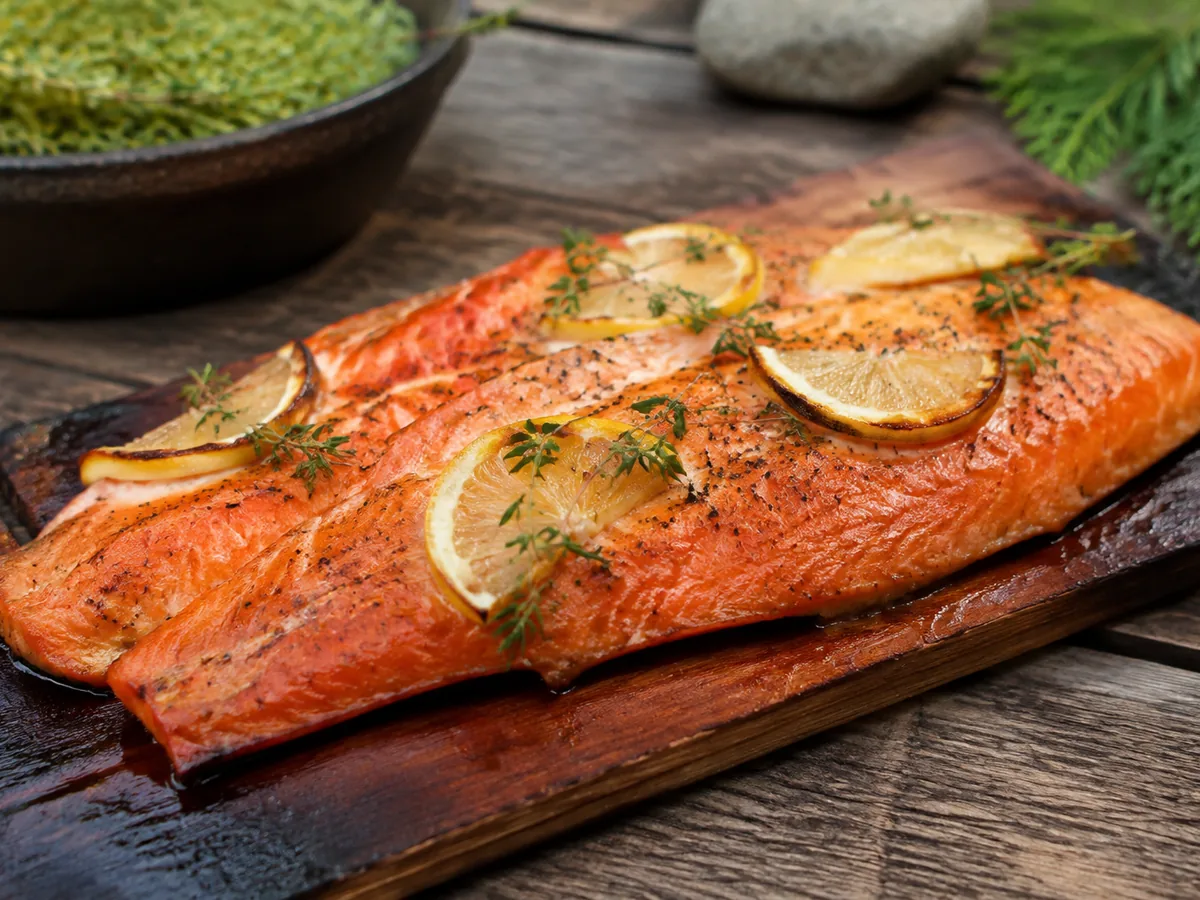
In the river basins and rainforests of the Pacific Northwest, from the Columbia to Puget Sound, the Coast Salish and Chinook roasted wild salmon on split cedar stakes around beach fires. Plank cooking is the region’s native gift to open-wood cookery.
A soaked slab of untreated western red cedar is laid over the coals until it crackles, and a side of wild sockeye or king goes on top. The wood buffers the flame and releases cedar oils into the fish. Lacquered with bourbon, brown sugar, grainy mustard and cider vinegar, the salmon roasts to a moist, pearlescent flake with caramelised edges.
- 1 side, about 1 kg1.8 to 2.2 lbWild sockeye or king salmon fillet, skin on, pin bones removed
- 1 or 21 or 2Untreated western red cedar grilling planks, about 38 by 18 cm, soaked 2 hours
- 60 ml¼ cupKentucky straight bourbon
- 50 g¼ cup packedDark brown sugar
- 30 g2 TbspCoarse whole-grain mustard
- 15 ml1 TbspApple cider vinegar
- 15 ml1 TbspMelted butter or olive oil
- 2 cloves2 clovesGarlic, minced to a paste
- 5 g1 tspSmoked paprika
- 8 g1½ tspFine sea salt
- 2 g½ tspFreshly ground black pepper
- 1 medium1 mediumLemon, sliced paper-thin
- 15 g2 TbspFresh dill or chives, chopped, to finish
Fifty-two degrees
Wild Pacific salmon is lean. Past 55 °C its fibres contract and squeeze white albumin onto the surface. Pulled at 50 to 52 °C it carries over to medium-rare and flakes in ruby petals with none of it.
The plank is a buffer
Two hours of soaking saturates the wood. Over 200 °C grill heat, water vaporises out of it as a cool steam layer under the skin while the charring underside gives off cedrol and thujaplicin into the steam.
Simmer the glaze first
Three or four minutes over medium-low boils off the bourbon's ethanol and concentrates the sugar and oak lactones into a lacquer that holds moisture in and caramelises under the lid.
The five tastes on this plate
Salt is sea salt on the flesh and the brined wood. Fat is the salmon's oils and the butter in the glaze. Acid is cider vinegar and lemon. Heat is grainy mustard, black pepper and the bourbon's bite. Umami is wild salmon, caramelised brown sugar and cedar smoke.
Equipment
- Charcoal or gas grill with a lid, set for medium indirect heat
- Fish pliers
- Small saucepan
- Heatproof gloves and a heatproof platter
- Instant-read thermometer
The original was split cedar stakes planted over beach embers. In a home oven, set the soaked plank and salmon on a foil-lined tray at 200 °C for the aroma without the smoke.
Method
Soak the planks2 hr
Submerge the planks in warm salted water under a heavy pot for a full 2 hours.
Submerge the planks in warm salted water under a heavy pot for a full 2 hours.
Prepare the salmon5 min
Feel along the fillet for pin bones and pull them out with the grain using fish pliers. Pat dry and season the flesh with the salt and pepper.
Feel along the fillet for pin bones and pull them out with the grain using fish pliers. Pat dry and season the flesh with the salt and pepper.
Simmer the bourbon glaze4 min
Combine the bourbon, brown sugar, mustard, vinegar, butter, garlic and paprika in a small saucepan and simmer over medium-low 3 to 4 minutes until the sugar dissolves and the alcohol fumes fade into a glossy syrup.
Combine the bourbon, brown sugar, mustard, vinegar, butter, garlic and paprika in a small saucepan and simmer over medium-low 3 to 4 minutes until the sugar dissolves and the alcohol fumes fade into a glossy syrup.
Char the plank3 min
Heat the grill to about 200 °C. Set the drained plank on the grate under the lid for 3 minutes until it dries, crackles and smokes. Flip it so the charred side faces up.
Heat the grill to about 200 °C. Set the drained plank on the grate under the lid for 3 minutes until it dries, crackles and smokes. Flip it so the charred side faces up.
Glaze and plank-roast12 to 15 min
Lay the salmon skin side down on the charred face, brush on half the glaze, and lay the lemon slices down the spine. Close the lid. Roast 12 to 15 minutes, brushing with the rest of the glaze at 10, and pull the plank when the thickest part reads 50 to 52 °C.
Lay salmon skin-down on the charred plank; brush with half the glaze and arrange lemon slices along the centre. Cover; roast 12–15 minutes, adding remaining glaze at 10 minutes. Remove when thickest flesh reaches 50–52 °C.
Serve from the plank
Lift the whole smouldering plank onto a heatproof platter with gloves. Scatter with dill and chives and serve family-style from the wood.
Lift the whole smouldering plank onto a heatproof platter with gloves. Scatter with dill and chives and serve family-style from the wood.
Sensory cues of doneness
- Visual: coral-ruby flesh under a glossy amber lacquer with no white curd, and plank edges charred black.
- Auditory: quiet crackle and pop from the wet wood, and a gentle sizzle of fat rendering onto it.
- Olfactory: cedar smoke, bourbon caramel, whole-grain mustard, embers and dill.
Look for coral-ruby flesh, glossy amber glaze without white curd and blackened plank edges. Expect gentle wood crackling and sizzling fat, with cedar, bourbon caramel, mustard, ember and dill aromas.
Troubleshooting
- Chalky flesh and white curd.
Past 55 °C. Pull it at 50 to 52.
- The plank ignited.
Under-soaked. Two hours minimum.
- A chemical taste.
Lumber cedar. Use only untreated, food-grade grilling planks.
Substitutions
One-to-one swaps, with the technique change each one needs.
Ingredient substitutions
| Ingredient | Replace with | Culinary impact and technique adjustment |
|---|---|---|
| Wild sockeye | Wild king, coho or steelhead trout | One-to-one. Steelhead has a similar texture and fat |
| Bourbon | Rye whiskey, dark rum, or apple cider for no alcohol | One-to-one. Cider caramelises beautifully |
| Whole-grain mustard | Dijon or stone-ground mustard | One-to-one. Supplies the tang |
Scaling
Half, for 3
A 450 g fillet on a small plank. Time stays at 12 to 14 minutes.
Double, for 12
Two sides on two large planks side by side.
What to serve it with
- Wild rice pilaf with dried cranberries and toasted pecans
- Grilled zucchini, sweet corn and asparagus
- A Willamette Valley Pinot Noir, or a Washington Syrah
Questions
Can I reuse a plank?
If it is not badly charred, scrub with hot water and no soap and use it once more. Most cooks use planks once.
Oven method?
Soaked plank and salmon on a foil-lined tray at 200 °C for 15 to 18 minutes.
What is the white stuff?
Albumin, forced out when the fibres contract from too much heat. Gentle plank roasting keeps it in.