Barbecue Baby Back Ribs
Memphis dry rub meets Kansas City glaze. Loin ribs stripped of their membrane, mustard-bound and rubbed with brown sugar and smoked paprika, smoked over hickory for the bark, wrapped in foil with butter and cider to braise tender, then unwrapped and lacquered with molasses-cider sauce until they pass the bend test.
- Prep
- 30 min
- Cook
- 5 hr
- Serves
- 4
- Difficulty
- Medium
Researched · Kitchen testing pending
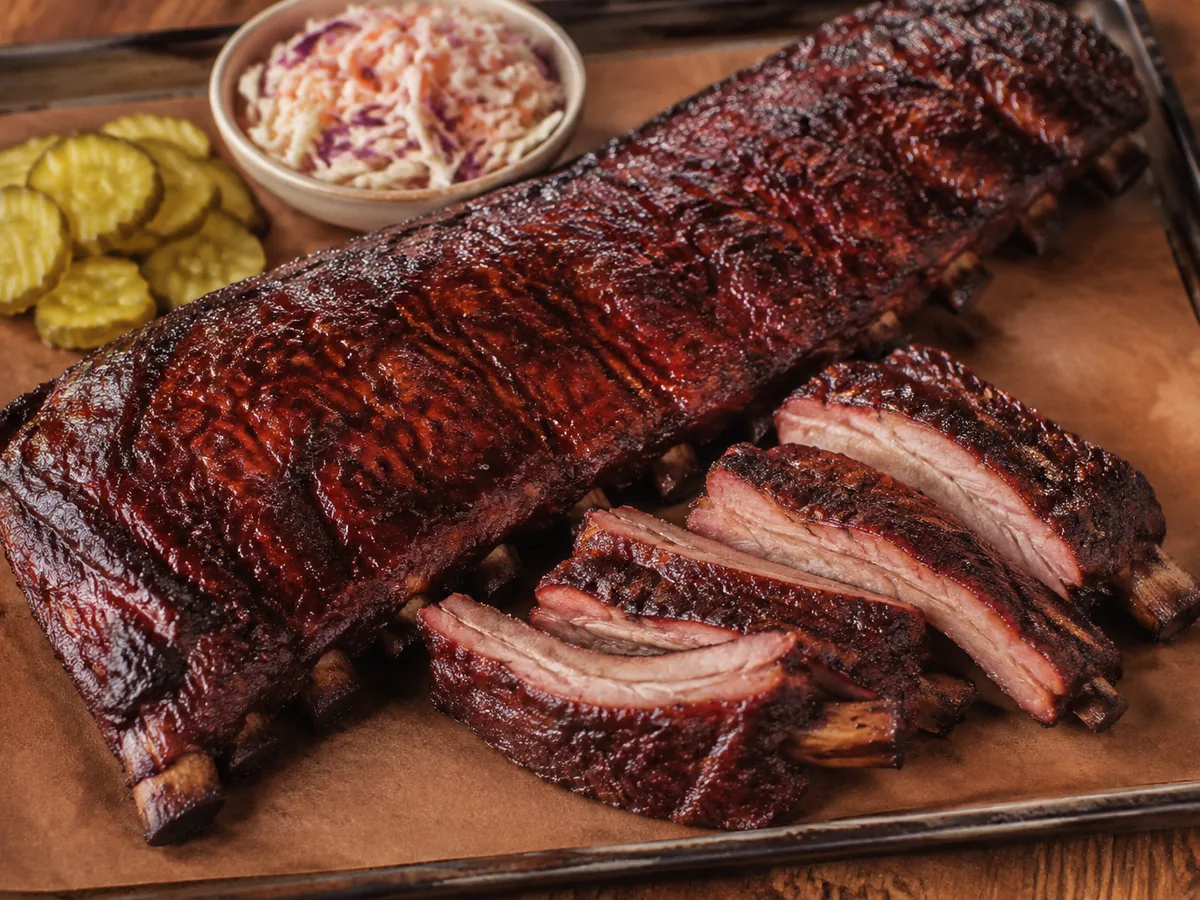
Across the barbecue shrines of Kansas City, Arthur Bryant’s, Gates and Joe’s, and of Memphis, Rendezvous and Central, pork ribs are the test of a pitmaster. This version bridges the two: the dry-rub spice of Memphis with the glossy, caramelised glaze of Kansas City.
Baby back ribs lose their tough rear membrane, take a mustard binder and a rub of brown sugar, smoked paprika, garlic, onion, black pepper and cayenne, and smoke over hickory and fruitwood until they wear a mahogany bark. Foil with butter, brown sugar and cider braises them tender, and a final unwrapped hour under molasses-cider sauce sets a sticky lacquer that gives a clean bite to the bone.
Ribs and rub
- 2 full racks, about 2 kg4 to 5 lbPork baby back ribs, trimmed, membrane removed
- 45 ml3 TbspYellow mustard, as a binder
- 60 g¼ cup packedDark brown sugar
- 25 g2 TbspSweet smoked paprika
- 15 g1 TbspCoarse kosher salt
- 15 g1 TbspGarlic powder
- 10 g1 TbspOnion powder
- 8 g1 TbspCoarsely cracked black pepper
- 4 g1½ tspPure ancho chilli powder
- 2 g½ tspCayenne
Wrap and glaze
- 60 g4 TbspUnsalted butter, in pats
- 60 ml¼ cupApple cider, for the wrap and the spritz
- 30 g2 TbspDark brown sugar, for the wrap
- 4 to 6 chunks4 to 6 chunksHickory and apple wood, for smoking
- 250 ml1 cupKansas City barbecue sauce, tomato, molasses, cider vinegar, brown sugar and Worcestershire
The membrane never softens
The peritoneum on the bone side is elastin, which heat does not break down. Left on, it is a rubbery barrier that blocks salt and smoke from one whole side. Peel it off in one sheet with a paper towel for grip.
Bark, then foil, then lacquer
Two to three hours uncovered lets the smoke bind the myoglobin into a pink ring while the rub dries into a mahogany crust. Foil with butter, sugar and cider traps steam at 100 °C and hydrolyses the collagen in under two hours. Unwrapped again, the surface dries so the sauce can caramelise into a tacky glaze.
The bend test
Lift a rack from one end. It should arch and the surface should crack gently without the meat falling off the bone. Fall-off-the-bone is overcooked.
The five tastes on this plate
Salt is kosher salt in the rub and the marrow. Fat is rib marbling and the butter in the wrap. Acid is cider vinegar in the sauce and the spritz. Heat is black pepper, cayenne, ancho and mustard. Umami is hickory phenols, caramelised pork fond, tomato and molasses.
Equipment
- Charcoal smoker, pellet grill, or a kettle grill set for two-zone indirect heat at 110 °C
- Extra-wide heavy-duty foil
- Spray bottle
- Butter knife and paper towels, for the membrane
- Tongs and a basting brush
The pits are offset steel smokers burning hickory logs. A kettle grill with the coals banked to one side and hickory chunks holds 110 °C well enough for a five-hour cook.
Method
Skin the membrane and season40 min
Ribs bone side up, slide a butter knife under the thin membrane over the centre bone, grip it with a paper towel and pull it off in one sheet. Brush both sides thinly with mustard. Whisk the brown sugar, paprika, salt, garlic, onion, pepper, ancho and cayenne and coat the ribs on both sides, pressing the rub in. Rest 30 minutes at room temperature.
Lift the bone-side membrane with a butter knife; grip with paper towel and peel off. Brush both sides with mustard. Mix sugar, paprika, salt, garlic, onion, pepper, ancho and cayenne; press onto both sides. Rest 30 minutes at room temperature.
Smoke for the bark2½ to 3 hr
Bring the smoker to 110 to 115 °C with hickory and apple chunks. Set the ribs meat side up and smoke undisturbed 2 hours, then spritz with cider every 45 minutes. Continue until the rub has set into a dark mahogany crust that does not rub off under a finger.
Heat smoker to 110–115 °C with hickory and apple. Smoke ribs meat-up undisturbed 2 hours, then spritz cider every 45 minutes until the dark mahogany bark stays set when touched.
The foil braise1½ to 2 hr
Tear two long sheets of heavy foil. In the centre of each lay four pats of butter, 2 tablespoons brown sugar and 2 tablespoons cider. Set a rack meat side down on top, wrap tightly with a double fold and crimped edges, and return meat side down to the smoker at 115 °C for 1½ to 2 hours, until the meat has pulled back 6 mm from the bone tips.
On each long foil sheet, place four butter pats, 2 tablespoons brown sugar and 2 tablespoons cider. Lay a rack meat-down; double-fold and crimp tightly. Smoke meat-down at 115 °C for 1½–2 hours until bones show 6 mm.
Unwrap and glaze45 min
Open the foil carefully away from the steam and move the ribs meat side up back onto the grate. Brush generously with sauce and smoke 30 minutes under the lid. Brush a second coat and smoke 15 minutes more until the glaze is caramelised, glossy and tacky.
Open foil carefully away from steam; return ribs meat-up to grate. Brush generously with sauce; smoke covered 30 minutes. Add a second coat; smoke 15 minutes until glaze is caramelised, glossy and tacky.
Bend test, rest and carve12 min
Lift a rack from one end with tongs. It should arch and crack gently on the surface without tearing apart. Rest 10 minutes on a board, flip bone side up to see the lines, and slice between the bones. Serve with extra warm sauce.
Lift one rack end with tongs: it should bend and crack gently without falling apart. Rest 10 minutes, turn bone-side up and slice between bones. Serve with extra warm sauce.
Sensory cues of doneness
- Visual: a glistening mahogany rack with a sticky caramel lacquer, bones pulled back 6 mm from the meat, bending into a gentle arch.
- Auditory: a gentle sizzle as the sauce bubbles on the grate, and the quiet crackle of hickory coals.
- Olfactory: sweet hickory smoke, caramelised molasses, roasted brown sugar, cider vinegar and seared pork.
Check for glossy mahogany ribs with tacky glaze, 6 mm exposed bone tips and a gentle bend. Expect quiet sizzling and coal crackling, with hickory, molasses, sugar, vinegar and pork aromas.
Troubleshooting
- A rubbery skin on the bone side.
The membrane was left on. It never breaks down; strip it before seasoning.
- Mushy ribs collapsing off the bone.
Overcooked. A finished rib takes a clean bite with a little resistance and pulls cleanly from the bone.
- Blackened, bitter sauce.
Sauced too early. Sugar-heavy sauce burns in the smoke; glaze only in the last 45 minutes.
Substitutions
One-to-one swaps, with the technique change each one needs.
Ingredient substitutions
| Ingredient | Replace with | Culinary impact and technique adjustment |
|---|---|---|
| Baby back ribs | St. Louis cut spare ribs | One-to-one. Add 30 minutes to both the smoke and the wrap |
| Dark brown sugar | Turbinado or maple sugar | One-to-one. Caramelises well |
| Hickory | Pecan, apple or cherry wood | One-to-one. Fruitwoods give a sweeter, gentler smoke |
Scaling
Half
One rack. Times do not change at 110 °C.
Double
Four racks across upper and lower grates, rotated halfway.
What to serve it with
- Creamy coleslaw with cider vinegar mayonnaise
- Slow-cooked baked beans with molasses and bacon
- A Boulevard wheat beer, or bourbon on the rocks
Questions
Baby back or St. Louis?
Baby backs come from the upper cage by the spine: leaner, curved, and done in about five hours. St. Louis ribs are trimmed spare ribs from the belly: flatter, fattier, and about six hours.
What is 3-2-1?
Three hours of smoke, two hours wrapped, one hour glazed. For baby backs, 2½, 1½ and 1 avoids mush.
Can I do them in the oven?
Wrapped in foil at 120 °C for 3 hours, then unwrapped, sauced and grilled 5 minutes to caramelise.