Maryland Crab Cakes
Chesapeake purism. Jumbo lump blue crab folded four or five times into a binder of one egg, a little mayonnaise, mustard, Worcestershire, lemon, Old Bay and coarsely crushed saltines, shaped into tall mounds, chilled to set, and seared in foaming clarified butter until golden with the lumps still whole.
- Prep
- 20 min
- Cook
- 8 min
- Serves
- 4 large cakes, about 160 g each
- Difficulty
- Medium
Researched · Kitchen testing pending
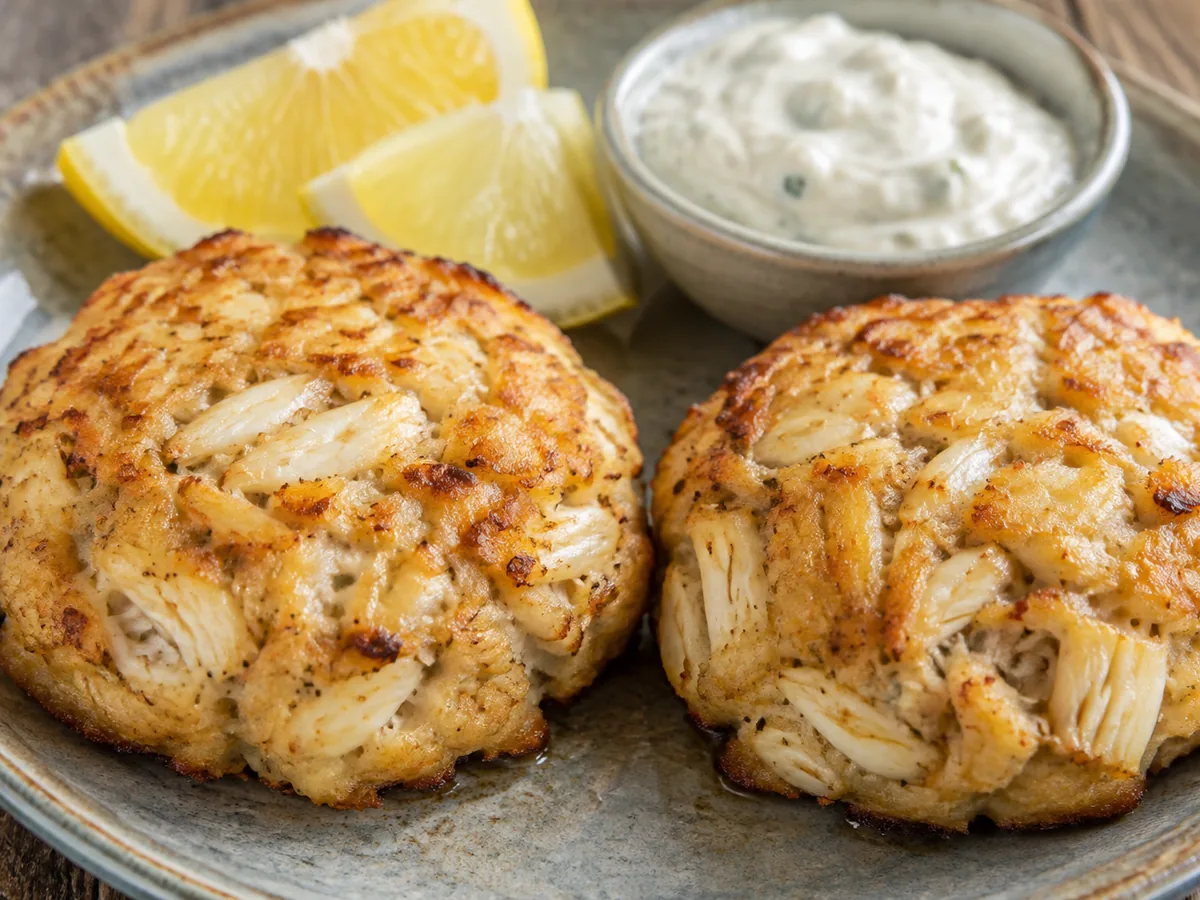
Along the Chesapeake Bay, from Annapolis and Baltimore to the Eastern Shore, the blue crab, Callinectes sapidus, the beautiful savoury swimmer, is culinary royalty. The Maryland crab cake is famous for what it leaves out: no bell pepper, no celery, no heavy breadcrumbs, no thick binder.
Jumbo lump meat is picked gently so the big white muscle cylinders stay whole. The binder is minimal, crushed saltines, a little mayonnaise, mustard, Worcestershire and Old Bay, and the cakes are shaped tall, chilled to set, and seared in foaming clarified butter until golden with the sweet lumps intact.
- 450 g1 lbFresh jumbo lump blue crab meat, picked for cartilage without breaking the lumps
- 1 large1 largeEgg, lightly beaten
- 45 g3 TbspWhole-egg mayonnaise
- 10 ml2 tspDijon or yellow mustard
- 5 ml1 tspWorcestershire sauce
- 5 ml1 tspFresh lemon juice
- 6 g1½ tspOld Bay seasoning
- 35 g½ cupSaltine crackers, about 10 to 12, crushed into coarse pea-sized flakesnever fine dust
- 15 g2 TbspFlat-leaf parsley, finely chopped
- 45 g3 TbspClarified butter, or butter plus 1 Tbsp neutral oil, for searing
- 4 wedges4 wedgesLemon, to serve
- 60 ml¼ cupTartar sauce or remoulade
Why saltines
Baked flour, shortening and salt in coarse flakes absorb the moisture from the egg and mayonnaise without turning to gum, and they melt into the background instead of adding dry, gritty bread. Breadcrumbs make a meatball.
Four folds
Jumbo lump is the big swimming-paddle muscle. Stirring shears it into stringy mush. A silicone spatula, four or five folds from the bottom, rotating the bowl, and stop.
Cold, then hot
Thirty minutes in the fridge firms the mayonnaise and butterfat so the cake holds together when it meets 180 °C butter. The egg sets at 65 °C and cements the lumps at serving temperature.
The five tastes on this plate
Salt is the crab's own brine, the saltines and Old Bay's celery salt. Fat is clarified butter and mayonnaise. Acid is lemon in the binder and the tartar sauce. Heat is Old Bay's peppers, dry mustard and Worcestershire. Umami is sweet blue crab, egg yolk and tamarind in the Worcestershire.
Equipment
- 10 to 12-inch cast-iron or non-stick skillet
- Wide, flexible fish spatula
- Silicone spatula
- Small parchment-lined tray
- Tweezers, for shell
The fish spatula is the tool that matters. Crab cakes have almost no binder and must be flipped with a wide, flexible blade and a supporting hand.
Method
Pick the crab8 min
Spread the crab on a paper-lined tray and lift out any shell or transparent cartilage with tweezers, keeping the lumps as large as possible. Chill.
Spread the crab on a paper-lined tray and lift out any shell or transparent cartilage with tweezers, keeping the lumps as large as possible. Chill.
Whisk the binder3 min
Whisk the egg, mayonnaise, mustard, Worcestershire, lemon juice, Old Bay and parsley until smooth.
Whisk the egg, mayonnaise, mustard, Worcestershire, lemon juice, Old Bay and parsley until smooth.
Fold in the crab and saltines2 min
Add the crushed saltines and the cold crab. With a silicone spatula, fold from the bottom up, rotating the bowl, four or five times only, until the lumps are coated. It will look loose and moist.
Add cold crab and saltines crushed into coarse pea-sized flakes, not powder. Fold gently from the bottom with a silicone spatula, rotating the bowl, only 4–5 times until coated; keep lumps intact.
Shape and chill35 min
Divide into four portions of about 160 g. With cupped hands, form each into a tall, compact mound about 7 cm wide and 4 cm high; never a flat puck. Cover loosely and refrigerate 30 minutes.
Divide into four portions of about 160 g. With cupped hands, form each into a tall, compact mound about 7 cm wide and 4 cm high; never a flat puck. Cover loosely and refrigerate 30 minutes.
Sear in foaming butter4 min
Heat the clarified butter over medium until it shimmers and foams, about 180 °C. Set the cold cakes in with the fish spatula and sear undisturbed 3½ to 4 minutes until the base is deep golden.
Heat the clarified butter over medium until it shimmers and foams, about 180 °C. Set the cold cakes in with the fish spatula and sear undisturbed 3½ to 4 minutes until the base is deep golden.
Flip and finish4 min
Slide the spatula under each cake, steady the top with a fork, and flip carefully. Sear 3 to 4 minutes more, spooning butter over the sides, until golden and 65 to 68 °C inside. Serve at once with lemon and tartar sauce.
Slide a spatula beneath each cake, steady with a fork and turn carefully. Sear 3–4 minutes, spooning butter over the sides, until golden and 65–68 °C inside. Serve immediately with lemon and tartar sauce.
Sensory cues of doneness
- Visual: a tall golden-bronze mound with big glistening white lumps showing on every side and no doughy filler.
- Auditory: a gentle, steady sizzle in foaming butter, never violent spatter.
- Olfactory: sweet blue crab, nutty browned butter, celery seed and lemon.
Look for tall golden-bronze cakes showing large glossy white crab lumps. Expect gentle steady butter sizzling, without violent spattering, and aromas of sweet crab, browned butter, celery seed and lemon.
Troubleshooting
- Stringy mush with no lumps.
Over-mixed. Fold gently a handful of times and stop.
- Heavy, bready cakes.
Too much filler. The saltines should barely coat the crab.
- The cakes fall apart on the flip.
Flipped unsupported. Use a wide flexible fish spatula and steady the cake with a fork or your fingers.
Substitutions
One-to-one swaps, with the technique change each one needs.
Ingredient substitutions
| Ingredient | Replace with | Culinary impact and technique adjustment |
|---|---|---|
| Jumbo lump blue crab | Lump Dungeness or Jonah crab | One-to-one. Dungeness is a little sweeter; drain it dry |
| Saltines | Ritz or pilot crackers, crushed coarse | One-to-one. Ritz adds a buttery note |
| Old Bay | ½ tsp celery salt, ½ tsp smoked paprika, black pepper and a pinch of cayenne | Approximates the Chesapeake blend |
Scaling
Half
Two cakes from 225 g crab. Searing times are identical.
Double
Eight cakes from 900 g crab, seared in two batches so the pan is not crowded.
What to serve it with
- Maryland tartar sauce, mayonnaise with capers, dill pickle, lemon and Old Bay
- Boiled summer sweet corn with butter and salt
- A Baltimore craft pilsner, or a mineral Sauvignon Blanc
Questions
Can I grill them instead?
Broil the chilled mounds on a buttered sheet 15 cm under the element at 220 °C for 10 to 12 minutes until golden and bubbling.
Which grade of crab?
Jumbo or colossal lump, the two big muscles by the swimming fins. Backfin and special are smaller and better in soups.
Why saltines over panko?
Saltines give a light, tender starch that disappears; panko stays dry and gritty.