Chicago Deep-Dish Pizza
Pizzeria Uno's 1943 inversion of the pizza. A cornmeal yeast dough laminated with softened butter and pressed 4 cm up an oiled pan, layered upside down, sliced mozzarella on the bottom, a sheet of raw fennel-free sausage over it, drained crushed San Marzanos on top, and baked forty minutes on the lowest rack.
- Prep
- 40 min
- Cook
- 40 min
- Serves
- 6 to 8 wedges, from a 30 cm pan
- Difficulty
- Hard
Researched · Kitchen testing pending
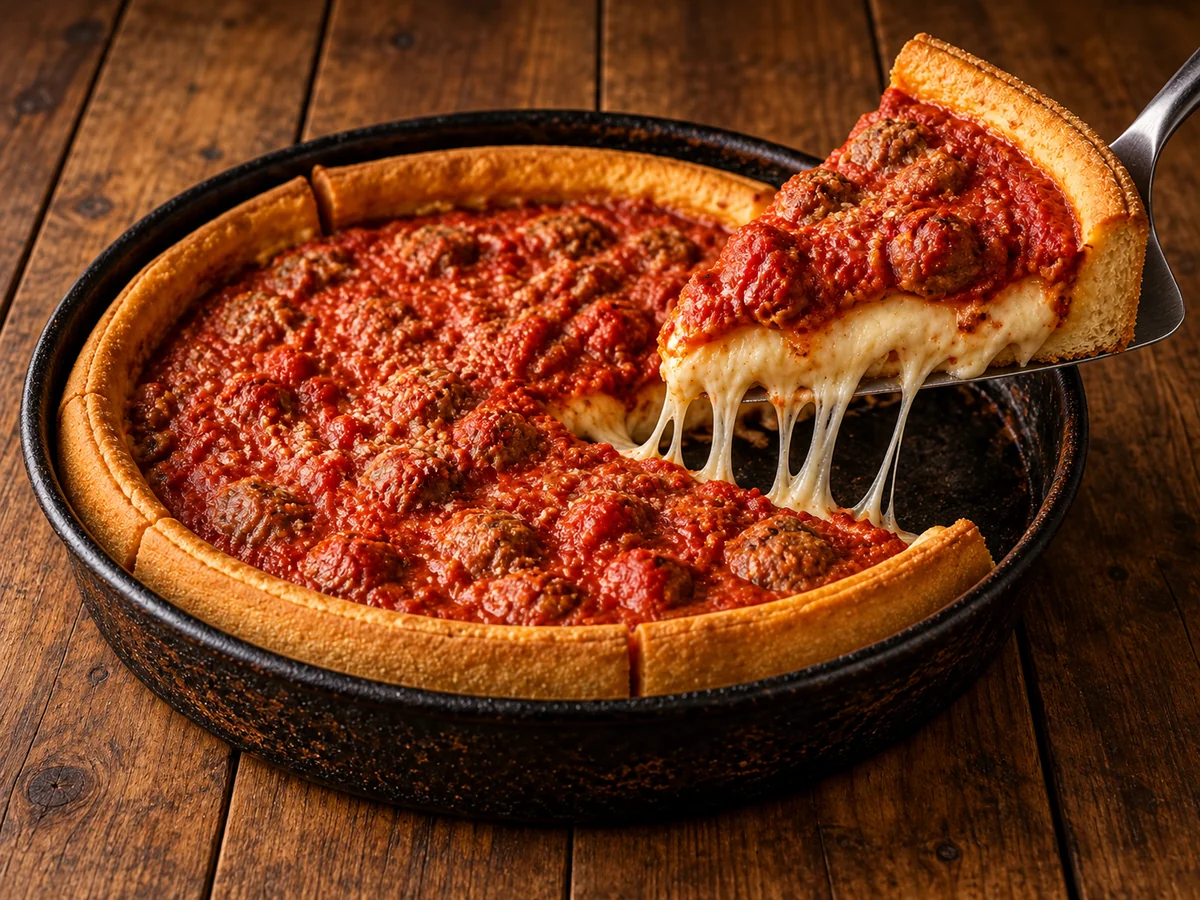
In 1943, at Pizzeria Uno on Chicago’s Near North Side, Ike Sewell and Ric Riccardo built a new pizza. They reversed the thin Neapolitan model and baked it in a deep steel cake pan coated in olive oil, with a dough enriched with cornmeal and laminated with butter into a flaky, biscuit-like crust.
The layering is upside down to protect the dairy through a forty-minute bake: sliced mozzarella against the dough, a continuous slab of raw seasoned sausage over the cheese, and a crown of crushed San Marzano tomatoes, oregano and Pecorino on top.
Dough
- 400 g3¼ cupsUnbleached plain flour, about 11.5 percent protein, sifted
- 50 g⅓ cupMedium yellow cornmeal
- 7 g2¼ tspInstant dry yeast
- 8 g1½ tspFine sea salt
- 10 g2 tspGranulated sugar
- 240 ml1 cupLukewarm water, about 40 °C
- 45 ml3 TbspExtra-virgin olive oil
- 60 g4 TbspUnsalted butter, softened, for the lamination
- 30 ml2 TbspOlive oil, for the pan
Sausage
- 500 g1.1 lbCoarsely ground pork shoulder, 80/20
- 3 cloves3 clovesGarlic, minced to a paste
- 8 g1 TbspSweet Hungarian paprika
- 4 g1½ tspDried oregano, crushed
- 2 g½ tspCrushed red pepper flakes
- 8 g1½ tspFine sea salt
- 3 g1 tspCoarsely ground black pepper
- 15 ml1 TbspCold red wine or red wine vinegar
Cheese and tomato
- 500 g1.1 lbWhole-milk low-moisture mozzarella, sliced into 5 mm slabsnever pre-shredded
- 800 g1 can (28 oz)Whole San Marzano tomatoes, hand-crushed and drained in a colander
- 40 g½ cupPecorino Romano or Parmigiano-Reggiano, finely grated
Why the layers are upside down
Cheese on top would burn and split into brown oil across a forty-minute bake. On the bottom, the sliced mozzarella is a fat barrier against the dough. The raw sausage renders down into it, and the tomatoes on top, mostly water, absorb the radiant heat and keep everything under them below 100 °C.
Laminated, biscuit-like crust
Softened butter rolled into the risen cornmeal dough sits in thin sheets between the layers. In the oven its water flashes to steam and separates them into a flaky, biscuit crumb with the grit of cornmeal.
Drain the tomatoes
Canned tomatoes are about 94 percent water. Fifteen minutes in a colander is the difference between a pie and a swamp.
The five tastes on this plate
Salt is the dough, the seasoned sausage and sharp Pecorino. Fat is laminated butter, olive oil in the pan and mozzarella. Acid is sweet-tart San Marzanos over the cheese and pork. Heat is red pepper, black pepper, garlic and paprika. Umami is browned sausage, mozzarella casein, reduced tomato and aged cheese.
Equipment
- 12-inch cast-iron skillet, or a 30 cm deep-dish pizza pan with 4 cm walls
- Stand mixer with a dough hook
- Rolling pin and offset spatula
- Fine-mesh colander
- Bench scraper, for cutting
A seasoned cast-iron skillet behaves like the blackened steel pans of the Chicago pizzerias, frying the bottom crust in olive oil with intense conducted heat.
Method
Mix and rise the cornmeal dough1 hr 10 min
In the mixer bowl, combine the warm water, yeast and sugar and let stand 5 minutes until foaming. Add the flour, cornmeal, olive oil and salt and knead on low 5 minutes to a smooth, supple dough. Rise in an oiled, covered bowl 1 hour until doubled.
Combine water at about 40 °C, yeast and sugar; stand 5 minutes until foaming. Add flour, cornmeal, olive oil and salt; knead on low 5 minutes until supple. Cover in an oiled bowl; rise 1 hour until doubled.
Laminate with butter50 min
Punch down and roll into a 30 by 40 cm rectangle. Spread the softened butter across it, roll up tightly like a jelly roll, flatten a little, fold in thirds like a letter, and shape into a ball. Wrap and refrigerate 45 minutes to firm the butter.
Deflate dough; roll to 30 by 40 cm. Spread softened butter, roll up tightly, flatten slightly and fold in thirds. Shape into a ball, wrap and refrigerate 45 minutes to firm butter.
Season the sausage3 min
Mix the pork with the garlic, paprika, oregano, red pepper flakes, black pepper, wine and salt for a minute until sticky. No fennel. Keep cold.
Mix the pork with the garlic, paprika, oregano, red pepper flakes, black pepper, wine and salt for a minute until sticky. No fennel. Keep cold.
Drain and season the tomatoes15 min
Crush the tomatoes by hand and drain 15 minutes in a fine colander. Season the pulp with a teaspoon of salt, a teaspoon of oregano and a tablespoon of olive oil.
Crush the tomatoes by hand and drain 15 minutes in a fine colander. Season the pulp with a teaspoon of salt, a teaspoon of oregano and a tablespoon of olive oil.
Press the dough into the pan10 min
Oil the base and 4 cm of the sides of the skillet. Roll the chilled dough to a 35 cm circle and lay it in, pressing it firmly into the corners and 4 cm up the walls. If it shrinks back, rest it 5 minutes and press again.
Oil the pan base and 4 cm up its sides. Roll cold dough to a 35 cm circle; press into corners and 4 cm up walls. If it shrinks, rest 5 minutes and press again.
Layer upside down5 min
Cover the base with overlapping slabs of mozzarella. Flatten pieces of the raw sausage between your palms and lay them over the cheese in one continuous sheet. Spread the drained tomatoes over the sausage to the edge. Scatter with Pecorino and a light drizzle of oil.
Overlap mozzarella slabs across the base. Flatten raw sausage into a continuous layer over cheese; cover to the edge with drained tomatoes. Scatter Pecorino and drizzle lightly with oil.
Bake and rest50 min
Bake on the lowest rack at 220 °C for 35 to 40 minutes until the crust rim is deep golden and crisp and the tomatoes bubble in the centre, 74 °C inside. Rest on a rack 10 minutes so the cheese sets enough to slice, then cut 6 to 8 wedges with a bench scraper.
Bake on the lowest rack at 220 °C for 35–40 minutes until the rim is deep golden and crisp, tomatoes bubble centrally and filling reaches 74 °C. Rest on a rack 10 minutes; cut 6–8 wedges with a bench scraper.
Sensory cues of doneness
- Visual: a 4 cm golden crust wall, a top blanketed in red crushed tomato and white cheese, and a cross-section showing a molten mozzarella pull over pink-brown sausage.
- Auditory: bubbling around the rim as the oiled pan fries the base, and a crunch when it is cut.
- Olfactory: toasted cornmeal and butter, sweet tomato, garlic, oregano and roasted pork.
Check for a golden 4 cm crust wall, bubbling tomato and cheese top and molten mozzarella over cooked sausage. Expect crisp cutting sounds and aromas of toasted cornmeal, butter, tomato, garlic, oregano and pork.
Troubleshooting
- Burnt, greasy cheese.
The cheese was on top. Deep-dish always has cheese on the bottom and tomato on top.
- A soupy, waterlogged pie.
Undrained tomatoes. Drain the crushed pulp in a colander first.
- Molten cheese floods the pan when cut.
Cut straight from the oven. Rest 10 minutes so the cheese sets.
Substitutions
One-to-one swaps, with the technique change each one needs.
Ingredient substitutions
| Ingredient | Replace with | Culinary impact and technique adjustment |
|---|---|---|
| Sliced whole-milk mozzarella | Block low-moisture mozzarella sliced 5 mm | Never bagged pre-shredded, coated in starch, nor fresh wet mozzarella |
| Cornmeal | Semolina or coarse polenta | One-to-one. Same crust crunch |
| Ground pork | Ground turkey, 85/15, or beef chuck | One-to-one. Keep the seasoning the same |
Scaling
Half
An 8-inch skillet, baked at 220 °C for 28 to 30 minutes.
Double
Two 12-inch pies in two skillets side by side on the lowest rack.
What to serve it with
- A Chicago garden salad of iceberg, cucumber and radish in sweet Italian dressing
- Hot giardiniera, the pickled sport peppers, cauliflower and celery in oil
- A Goose Island IPA, or a Chianti Classico
Questions
Why is the sausage applied raw?
Forty minutes at 220 °C cooks the thin sheet through to 74 °C, and its rendered juices baste the cheese and crust from inside.
Why cornmeal in the dough?
For the traditional yellow colour and small crunchy points against the buttery laminated crumb.
Why no fennel?
Chicago sausage leans on paprika, garlic, oregano and black pepper. The recipe keeps that profile and leaves fennel out.