Reindeer Sausage Skillet
Frontier one-pan cooking built for forty below. Smoked reindeer sausage seared in bacon fat until its edges blister, waxy red potatoes crisped in the drippings, onions and garlic, then an amber ale to lift the fond, shredded cabbage, stock, grainy mustard and cider vinegar, braised under a lid until the potatoes are tender and the liquid has reduced to a glaze.
- Prep
- 20 min
- Cook
- 30 min
- Serves
- 4 to 6
- Difficulty
- Medium
Researched · Kitchen testing pending
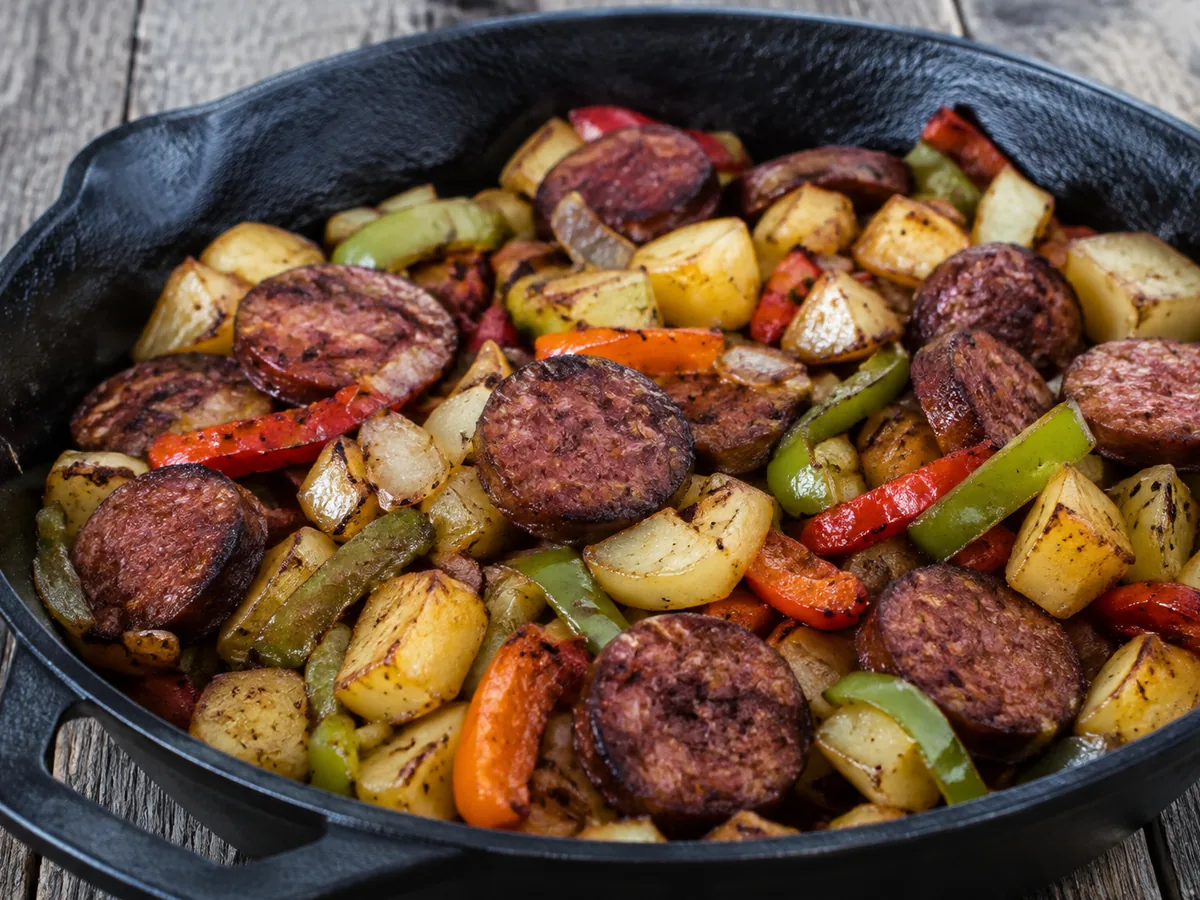
Domesticated Scandinavian reindeer were brought to Western Alaska in the late nineteenth century to support rural communities on the Seward Peninsula. Blended with pork fat and warm spices and smoked over birch or alder, reindeer sausage became a staple of hunting cabins, bush lodges and Anchorage breakfast counters.
Trappers and guides slice the links thick and fry them in seasoned cast iron with onions, red potatoes and cabbage, splash in an amber ale or a local cider, and serve the pan with stone-ground mustard. It is hearty cooking engineered for sub-zero weather.
- 700 g, 4 to 5 links1½ lbSmoked Alaskan reindeer sausage, sliced on the bias into 1 cm coinsor caribou or smoked pork sausage
- 30 ml2 TbspRendered bacon fat, lard or neutral oil
- 600 g1⅓ lb, 4 mediumSmall waxy red potatoes, scrubbed, unpeeled, in 2 cm cubes
- 250 g1 largeYellow onion, in 6 mm half-moons
- 400 g4 cups shreddedGreen cabbage, cored and cut into 1 cm ribbons
- 15 g4 clovesGarlic, thinly sliced
- 250 ml1 cupAmber aleor unfiltered apple cider
- 120 ml½ cupBeef stock
- 30 g2 TbspWhole-grain stone-ground mustard
- 15 ml1 TbspApple cider vinegar
- 5 g1 tspDried thyme
- 8 g1½ tspCoarse sea saltdivided
- 3 g1 tspBlack pepper, cracked
- 15 g¼ cupFlat-leaf parsley, chopped
Waxy potatoes hold
Red potatoes are high in moisture and low in amylose, so their cubes keep their edges through a braise. A russet would dissolve into the liquid.
The fond in the beer
Searing the sausage at about 175 °C leaves protein-rich browning on the pan floor. Amber ale dissolves it and adds malt sugars and melanoidins to the braise.
The five tastes on this plate
Salt is smoked sausage, bacon fat and sea salt. Fat is rendered sausage and bacon drippings. Acid is cider vinegar, mustard and the ale. Heat is cracked pepper, mustard seed and garlic. Umami is the smoked game meat, the browned edges and the stock fond.
Equipment
- 12-inch cast-iron skillet with a lid, or an enamelled braiser
- Flat metal spatula
- Wooden spoon
A lidded cast-iron skillet straight over the fire is the frontier tool. Any heavy 12-inch pan with a tight lid works. Brown the sausage first so the potatoes crisp in its fat before any liquid goes in.
Method
Brown the sausage7 min
Heat the fat in the skillet over medium-high. Lay the sausage coins in one layer and sear 3 to 4 minutes a side until blistered and dark at the edges. Lift to a plate, leaving the fat.
Heat the fat in the skillet over medium-high. Lay the sausage coins in one layer and sear 3 to 4 minutes a side until blistered and dark at the edges. Lift to a plate, leaving the fat.
Crisp the potatoes10 min
Add the potatoes in one layer, season with a teaspoon of salt and half a teaspoon of pepper, and cook over medium 8 to 10 minutes, turning with the spatula, until golden and half tender.
Add the potatoes in one layer, season with a teaspoon of salt and half a teaspoon of pepper, and cook over medium 8 to 10 minutes, turning with the spatula, until golden and half tender.
Onions and garlic5 min
Push the potatoes to the edges and sauté the onions in the centre 4 to 5 minutes until soft and browned at the edges. Stir in the garlic and thyme for 1 minute.
Push the potatoes to the edges and sauté the onions in the centre 4 to 5 minutes until soft and browned at the edges. Stir in the garlic and thyme for 1 minute.
Deglaze2 min
Pour in the ale and scrape up every browned bit. Boil hard 2 minutes to cook off the alcohol.
Pour in the ale, scrape up the browned bits and boil hard for 2 minutes.
Cabbage and stock1 min
Add the cabbage, stock, mustard, vinegar and the remaining salt and pepper. Stir well and nestle the sausage and its juices back in.
Add the cabbage, stock, mustard, vinegar and the remaining salt and pepper. Stir well and nestle the sausage and its juices back in.
Braise12 min
Lower the heat to medium-low, cover tightly, and braise 10 to 12 minutes until the potatoes are fork-tender and the cabbage has wilted into sweet ribbons.
Lower the heat to medium-low, cover tightly, and braise 10 to 12 minutes until the potatoes are fork-tender and the cabbage has wilted into sweet ribbons.
Reduce and serve3 min
Uncover, raise to medium and cook 2 to 3 minutes until the liquid becomes a glossy glaze. Scatter the parsley and serve from the pan with sourdough rolls and more mustard.
Uncover, raise to medium and cook 2 to 3 minutes until the liquid becomes a glossy glaze. Scatter the parsley and serve from the pan with sourdough rolls and more mustard.
Sensory cues of doneness
- Visual: mahogany-edged sausage, golden potato cubes with pale centres, cabbage soft and amber.
- Auditory: a hard sizzle as the sausage lands, settling into a steady bubble once the ale goes in.
- Olfactory: birch smoke, sizzling game and pork, caramelised onion, cider vinegar, cabbage.
Check for mahogany sausage edges, golden potatoes with pale centres and soft amber cabbage. Expect steady bubbling after the sear, with smoke, meat, caramelised onion, cider vinegar and cabbage aromas.
Troubleshooting
- Potatoes fell apart.
Starchy russets. Use waxy red or Yukon Gold and cube them evenly.
- A bitter, scorched pan base.
The fond was not lifted. Pour the ale in hot and scrape the pan clean before the cabbage.
- Watery, bland cabbage.
Too much stock. Cabbage sheds its own water; 120 ml of stock is enough.
Substitutions
One-to-one swaps, with the technique change each one needs.
Ingredient substitutions
| Ingredient | Replace with | Culinary impact and technique adjustment |
|---|---|---|
| Reindeer sausage | Smoked venison sausage, wild boar sausage or Polish kielbasa | Kielbasa is smokier and less gamy |
| Amber ale | Unfiltered apple cider, or chicken stock with 1 Tbsp cider vinegar | Sweet-tart moisture without the malt |
| Red potatoes | Yukon Gold or fingerlings | Hold their shape the same way |
Scaling
Half
A 10-inch skillet, about 25 minutes.
Double
Two 12-inch skillets or a 7-quart Dutch oven, so the potatoes brown rather than steam.
What to serve it with
- Warm sourdough rolls with butter and extra grainy mustard
- Pickled beets and dill pickles
- An amber ale or oatmeal stout, or a dry hard cider
Questions
What is in real reindeer sausage?
Alaskan reindeer blended with pork and beef for fat and binding, and smoked over alder. A quarter to a third of it is pork fat.
Kielbasa or andouille?
Yes. A good smoked garlic kielbasa, smoked bratwurst or venison sausage swaps in one-to-one.
Without beer?
Use 250 ml unfiltered cider, or chicken stock with an extra tablespoon of cider vinegar.