Pan-Seared Copper River King Salmon
The late-May fish, cooked the way Cordova line cooks do it. Skin scraped dry and scored, pressed flat onto 190 °C cast iron and left alone until the heat line climbs three-quarters of the way up, then basted with foaming butter, crushed garlic and chopped spruce tips and flipped for under a minute, to 52 °C at the centre.
- Prep
- 15 min
- Cook
- 10 min
- Serves
- 4
- Difficulty
- Hard
Researched · Kitchen testing pending
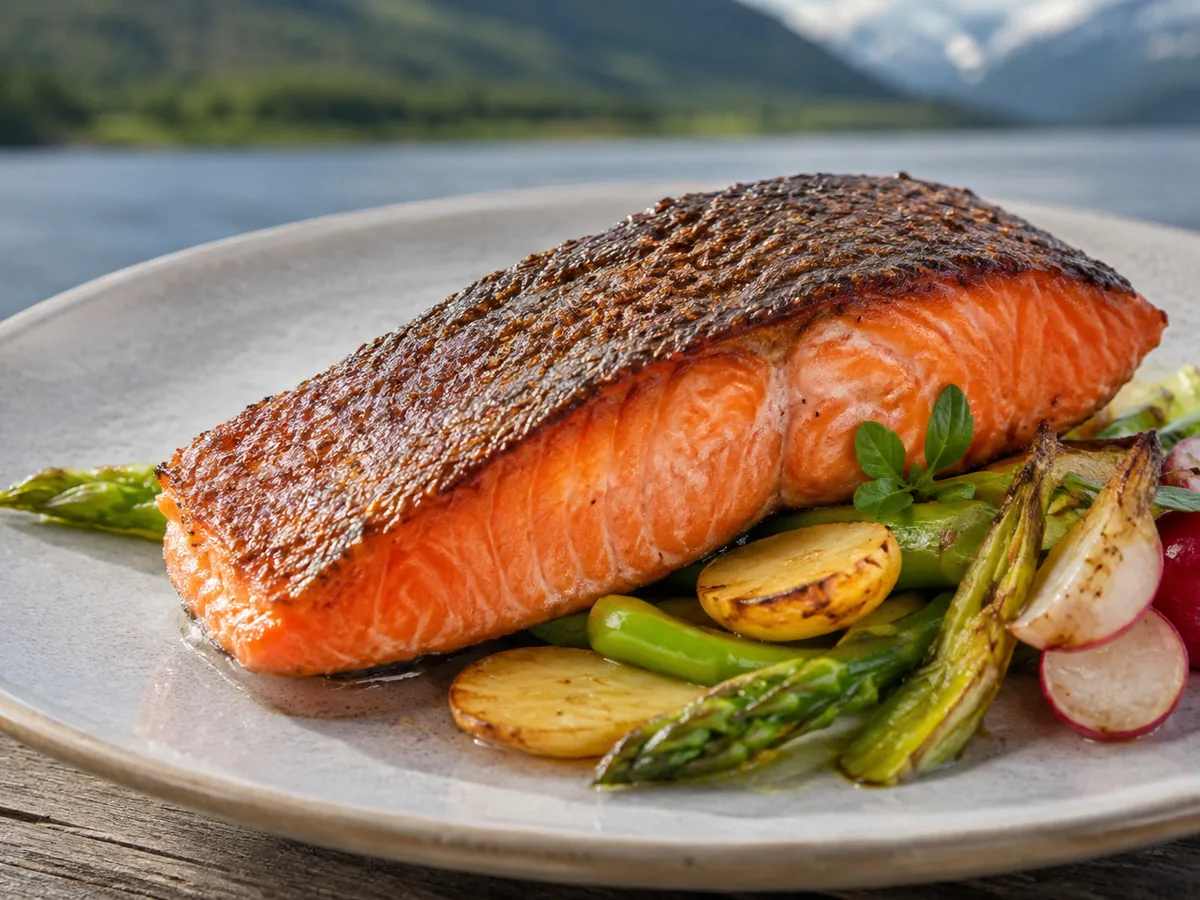
When the ice breaks on the Copper River in late May, king salmon fight three hundred miles upstream through glacial water. To make the climb they pack their muscle with long-chain marine fat, and that biology gives the fish its crimson flesh, its marbling and its buttery texture. The Ahtna Athabascan name for the wild chinook is łuk ch’egh.
Line cooks from Cordova to Anchorage cook it one way. The skin is scraped dry and scored, the cold fillet is pressed onto seasoned cast iron, and the fish is left alone while its own fat fries the skin to a brittle crust. Then foaming butter, crushed garlic and hand-foraged spruce tips are spooned over the top, and the fish is flipped for under a minute and pulled at 52 °C.
- 800 g, in 4 fillets1¾ lb, 4 x 7 ozWild Copper River king salmon fillets, skin on, scaled, pin bones pulled, dried on a rack 2 hours
- 30 ml2 TbspAvocado oil or refined canola oil
- 45 g3 TbspUnsalted European-style butter, chilled and cubed
- 10 g2 TbspFresh Sitka spruce tips, finely choppedor rosemary needles with lemon zest
- 15 g4 clovesGarlic, lightly crushed with the flat of a knife
- 8 g1½ tspCoarse flaky sea saltdivided
- 3 g1 tspBlack peppercorns, coarsely cracked
- 1 whole1 wholeMeyer lemon, in thick wedges
- 500 g cooked3 cups cookedWarm wild rice pilaf with dried cranberries and toasted almonds, to serve
Dry skin or no crust
Water boils at 100 °C; skin crisps between 140 and 165 °C. Wet skin steams in its own moisture and turns rubbery. Scraped dry, scored and pressed onto 190 °C iron, the fat under the skin renders, pushes the water out and fries the collagen into a brittle sheet.
Why so much time on the skin
The skin and its fat layer shield the flesh from direct heat. Cooking about 80 percent of the time skin-side down and flipping for a minute keeps the muscle from contracting and squeezing out white albumin.
The five tastes on this plate
Salt is flaky sea salt on scored skin and flesh. Fat is the salmon's own rendered belly fat and foaming butter. Acid is lemon juice and the citrus oils in spruce tips. Heat is cracked pepper and warm garlic. Umami is the seared skin and the browned butter crust.
Equipment
- 12-inch seasoned cast-iron skillet
- Flexible fish spatula
- Large spoon, for basting
- Digital probe thermometer
- Wire rack
Cast iron over birch coals or a camp burner is the Alaskan way. Heavy carbon steel or a five-ply stainless skillet does the same job indoors. Heat the pan dry until the oil shimmers.
Method
Score and dry the skin10 min
Run the back of a chef's knife firmly down each skin side to scrape off moisture. Cut shallow diagonal slits 1 mm deep and 1 cm apart without reaching the flesh. Season both sides with sea salt and cracked pepper. Rest 10 minutes at room temperature.
Scrape moisture from skin with the back of a knife. Score diagonal slits 1 mm deep, 1 cm apart, without cutting flesh. Season both sides with salt and pepper; rest 10 minutes at room temperature.
Heat the pan and lay the fish2 min
Set the skillet over medium-high and add the oil. Swirl until wisps of smoke appear, about 190 °C. Lay the fillets in skin-side down, away from you, and press each flat with the spatula for 15 seconds so the skin does not curl.
Heat skillet and oil over medium-high to about 190 °C, with wisps of smoke. Lay fillets skin-down away from you; press each flat for 15 seconds to prevent curling.
Sear on the skin6 min
Lower the heat to medium and leave the fillets alone 5 to 6 minutes. Watch the pale line climb the side of the fish. When three-quarters of the flesh has turned from translucent red to opaque coral, the skin is crisp.
Reduce to medium; cook undisturbed 5–6 minutes. Watch the opaque coral line rise up the sides: when three-quarters of the flesh has changed colour, the skin is crisp.
Baste with spruce butter2 min
Add the butter cubes, crushed garlic and spruce tips around the fish. As the butter foams, tilt the pan and spoon it over the flesh for 90 seconds.
Add the butter cubes, crushed garlic and spruce tips around the fish. As the butter foams, tilt the pan and spoon it over the flesh for 90 seconds.
Flip, finish, rest4 min
Turn the fillets onto the flesh side, squeeze lemon over, and cook 45 to 60 seconds only. The centre should read 50 to 52 °C. Move to a warm rack and rest 3 minutes.
Turn the fillets onto the flesh side, squeeze lemon over, and cook 45 to 60 seconds only. The centre should read 50 to 52 °C. Move to a warm rack and rest 3 minutes.
Plate
Spoon warm wild rice pilaf onto heated plates, set the salmon on top skin-side up, drizzle with the spruce butter, and finish with flaky salt and a lemon wedge.
Spoon warm wild rice pilaf onto heated plates, set the salmon on top skin-side up, drizzle with the spruce butter, and finish with flaky salt and a lemon wedge.
Sensory cues of doneness
- Visual: skin deep bronze, rigid and blistered; flesh pale coral at the edges and translucent ruby at the centre.
- Auditory: a loud steady hiss on contact, easing into gentle popping as the fat renders.
- Olfactory: nutty browned butter, pine from the spruce, seared fish skin.
Look for rigid, blistered bronze skin, pale-coral edges and a translucent ruby centre. Expect hissing easing into gentle popping, with browned butter, spruce and seared-skin aromas.
Troubleshooting
- Soggy, rubbery skin.
The pan was too cool or the skin was wet. Scrape it dry, air-dry on a rack, and lay it into shimmering 190 °C oil.
- White albumin oozing between the flakes.
Too hot for too long, so the muscle clenched. Cook mostly on the skin over moderate heat and flip for a minute at most.
- The fillet curls into a bowl.
Skin contracts the instant it hits hot metal. Press each fillet flat with the spatula for the first 15 seconds.
Substitutions
One-to-one swaps, with the technique change each one needs.
Ingredient substitutions
| Ingredient | Replace with | Culinary impact and technique adjustment |
|---|---|---|
| Copper River king salmon | Wild sockeye, coho or other Pacific chinook | Sockeye is leaner; cut the cooking time by about 90 seconds |
| Spruce tips | Fresh rosemary needles with grated lemon zest | The same pine and citrus notes |
| Alaska sea salt | Maldon flaky salt | Identical crunch at the finish |
Scaling
Half
Two fillets in a 10-inch skillet. Times and temperatures unchanged.
Double
Two skillets. Eight fillets in one pan drop the temperature and steam the skin instead of crisping it.
What to serve it with
- Wild rice pilaf with dried cranberries and toasted almonds
- Roasted root vegetables and grilled wild asparagus
- An Alaskan amber ale, or a Willamette Valley Pinot Noir
Questions
Can I eat the spruce tips, and where do I get them?
Yes. Young bright-green Sitka spruce tips are foraged in late spring and taste tender and citrusy. Rosemary needles with lemon zest give a close pine-citrus aroma.
Why cook it almost entirely on the skin side?
The skin and fat layer buffer the heat, protecting the flesh while the fat renders and crisps the skin.
King or sockeye?
King is larger, fattier and thick-flaked. Sockeye is leaner, deeper red and cooks faster. Both suit this sear.