Pholourie with Tamarind Chutney
Brought by East Indian indentured immigrants in the 19th century and now the island's favourite finger food. Yeast and baking powder build a network of gas bubbles over an hour of fermentation, and at 180 °C the surface water flashes to steam and blows that network into a spongy sphere.
- Prep
- 25 min
- Cook
- 15 min
- Serves
- 36 balls, 6 as a snack
- Difficulty
- Medium
Researched · Kitchen testing pending
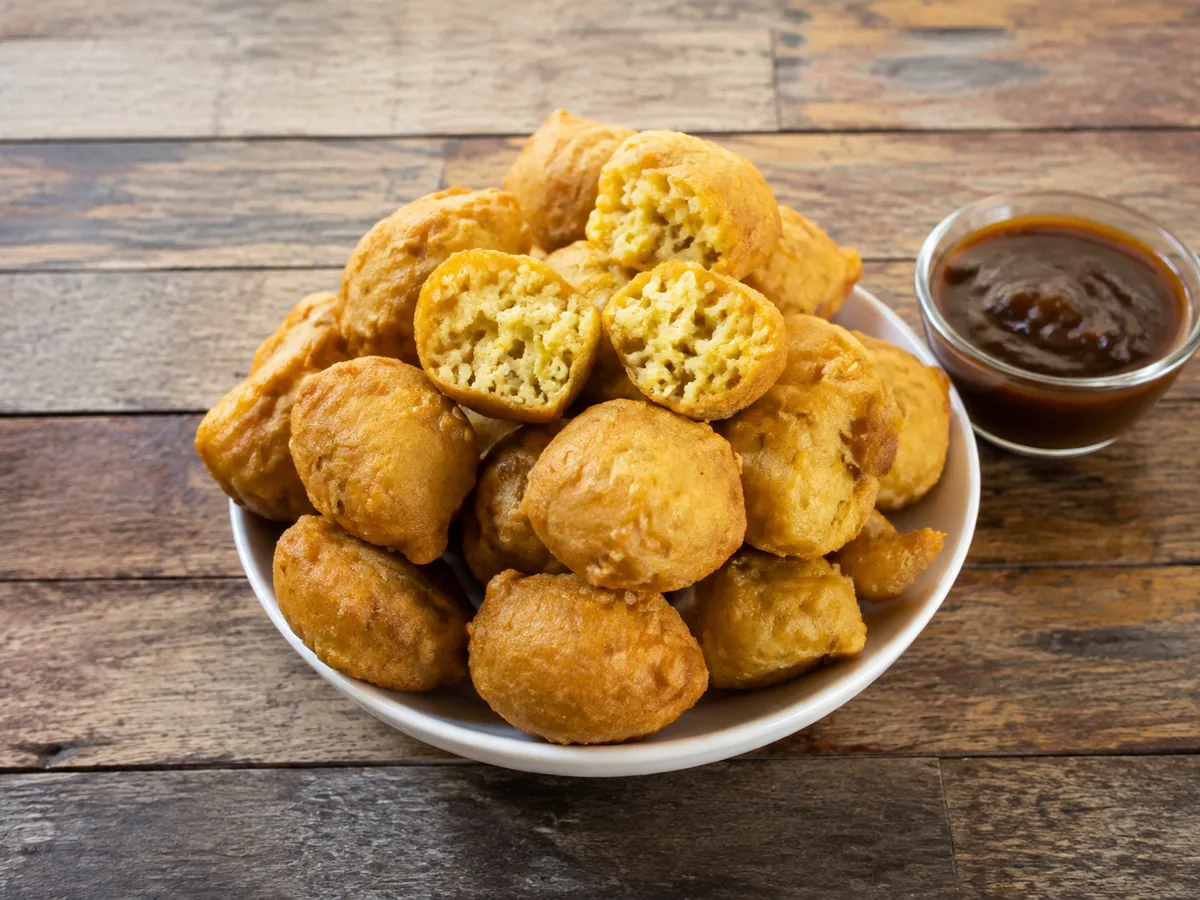
Walk past any street snack stand in Port of Spain and you will see glass display cases stacked with hot pholourie. It came with East Indian indentured immigrants in the 19th century, and it is Trinidad’s favourite finger food.
Yellow split peas are ground fine, mixed with wheat flour, turmeric, roasted geera, garlic and yeast, and fermented into a thick bubbly batter. The vendor scoops it with oiled fingertips and flicks round balls into bubbling oil, where they puff in seconds into golden spongy spheres.
Served by the dozen in brown paper bags, speared on wooden toothpicks and drowned in sweet-sour tamarind chutney.
The batter
- 200 g1 cupYellow split peas, soaked 6 hours and drained, or 1 cup split pea flour
- 300 g2.5 cupsAll-purpose wheat flour, 11% protein, sifted
- 7 g2.25 tspInstant dry yeast
- 6 g1.5 tspDouble-acting baking powder
- 10 g2 tspGround turmeric
- 8 g2 tspGeera, freshly toasted dark and ground
- 4 cloves4 clovesFresh garlic, minced to a fine paste
- 4 leaves4 leavesFresh chadon beni, finely minced
- ½ whole½ wholeScotch bonnet pepper, seeded and minced fine
- 8 g1.5 tspFine sea salt
- 10 g2 tspGranulated cane sugar
- 280 ml1.15 cupsLukewarm water at 38 °C120 ml into the blender, 160 ml into the batter
To fry
- 1 L4.2 cupsHigh-smoke vegetable oil
The tamarind chutney
- 150 g½ cupWet seedless tamarind pulp
- 240 ml1 cupWarm water
- 60 g¼ cup packedDark brown sugar
- 5 g1 tspGround roasted geera
- 2 cloves2 clovesGarlic, minced to a paste
- 2 leaves2 leavesChadon beni, minced fine
- 3 g½ tspFine sea salt
Ferment the batter a full hour
Yeast and baking powder together build a dense network of carbon dioxide bubbles, and the batter should end up frothy and light. Fried unfermented, the balls are dense and heavy.
Thick pancake batter
Pourable but not runny. If it runs like water the balls flatten into misshapen discs — whisk in two more tablespoons of flour and rest it ten minutes.
The fist-squeeze
Vendors push batter out between thumb and forefinger because the pinch creates surface tension that rounds the ball as it enters the oil. Two wet teaspoons work too.
180 °C, and wet fingers
Hot enough that the crust sets instantly rather than absorbing oil, and damp hands so the sticky batter releases cleanly.
Strain the tamarind properly
Mash the pulp in warm water, then press it through a sieve and discard the seeds and fibres. What is left reduces into a glossy sweet-tart syrup.
Passive time, counted separately
The split peas soak 6 hours, the batter ferments 1 hour, and the tamarind steeps 10 minutes. None of that is active work.
The five tastes on this plate
Salt is in the batter and the chutney. Fat is clean frying oil crisping the shell around an oil-free crumb. Acid is mouth-puckering tartaric acid from the tamarind. Heat is minced Scotch bonnet, garlic and dark roasted geera. Umami is toasted split pea protein, caramelised sugar and garlic.
Equipment
- Blender
- Large bowl and a wooden spoon
- 5 qt heavy Dutch oven with a deep-fry thermometer
- Small saucepan and a sieve
- Spider skimmer
Traditionally a cast-iron karahi over an open flame. A 5-quart Dutch oven with a thermometer works in a modern kitchen — the balls need a steady 180 °C to puff rather than soak.
Method
Blend and ferment the batter15 min
Blend the drained split peas with the garlic, chadon beni, Scotch bonnet and 120 ml of the water for 90 seconds into a smooth thick yellow paste.
Whisk the flour, yeast, baking powder, turmeric, geera, sugar and 8 g salt, add the purée and the remaining 160 ml water, and beat 3 minutes into a thick pourable batter. Cover and ferment 1 hour until doubled and bubbly.
Blend split peas soaked 6 hours and drained with garlic, chadon beni, Scotch bonnet and 120 ml water at 38 °C for 90 seconds. Mix flour, yeast, baking powder, turmeric, geera, sugar and 8 g salt; add purée and remaining 160 ml water. Beat 3 minutes, cover and ferment 1 hour until doubled and bubbly. If runny, whisk in 2 tablespoons flour and rest 10 minutes.
Make the tamarind chutney20 min
Mash the tamarind pulp in the 240 ml warm water and leave 10 minutes, then press it through a sieve into a saucepan, discarding seeds and fibres.
Add the brown sugar, garlic, geera, chadon beni and ½ tsp salt and simmer 5 minutes into a glossy sweet-tart syrup. Cool.
Mash tamarind in 240 ml warm water and steep 10 minutes. Press through a sieve, discarding seeds and fibres. Add brown sugar, garlic, geera, chadon beni and ½ tsp salt; simmer 5 minutes until glossy and syrupy. Cool.
Heat the oil5 min
Bring the litre of oil to 180–185 °C, with a small bowl of water beside the stove.
Heat 1 L frying oil to 180–185 °C. Keep a small bowl of water beside the stove for dampening fingers or teaspoons used to portion the batter.
Drop and fry15 min
Wet your fingers, scoop up a handful of bubbly batter, and squeeze a walnut-sized ball of about 20 g out between thumb and forefinger, flicking it into the oil. Two wet teaspoons work as well.
Ten or twelve at a time: they sink, surface, and roll into spheres. Fry 2.5 to 3 minutes, rolling constantly, until deep golden-yellow.
Using damp fingers or two wet teaspoons, portion walnut-sized balls of about 20 g into the oil. Fry 10–12 at a time for 2.5–3 minutes, rolling constantly, until round and deep golden-yellow.
Drain and serve
Lift out with a spider onto paper towel and repeat.
Serve hot in paper bags or bowls with toothpicks, and spoon the warm tamarind chutney generously over.
Lift fritters onto paper towel with a spider and repeat. Serve hot in bowls or paper bags with toothpicks and generous spoonfuls of warm tamarind chutney.
Sensory cues of doneness
- Visual: perfectly round golden-yellow spheres floating high in the oil, with a crisp shell over a soft yellow sponge-cake interior.
- Auditory: a lively bubbling sizzle as the batter lands, and a hollow airy yield when one is squeezed.
- Olfactory: fried split pea batter, earthy turmeric, roasted geera, garlic and sweet-sour tamarind.
Look for round golden-yellow balls floating high, with crisp shells and soft, airy yellow interiors. Expect lively sizzling and aromas of split peas, turmeric, roasted geera, garlic and tamarind.
Storing it
Reheat in a 180 °C oven for 5 minutes to bring the crisp shell back.
Troubleshooting
- Dense, heavy balls.
The batter was not fermented. Give it a full hour until frothy.
- Greasy pholourie.
The oil was below 175 °C. Hold 180 °C so the crust sets on contact.
- Flat misshapen discs.
The batter was too thin. Whisk in 2 tablespoons more flour and rest 10 minutes.
Substitutions
One-to-one global substitutions, with the technique adjustment each one requires.
Ingredient substitutions
| Ingredient | Replace with | Culinary impact and technique adjustment |
|---|---|---|
| Soaked split peas | Gram flour (besan) | One-to-one, mixed straight in — it removes the soaking entirely |
| Wet tamarind pulp | Concentrated tamarind paste | Dilute with a cup of water and the brown sugar |
| Chadon beni | Cilantro with stems and minced garlic | One-to-one |
Scaling
Half, for 18 balls
Halve everything, but keep the full litre of frying oil.
Double, for 72 balls
Double everything and fry in consecutive batches of twelve.
What to serve it with
- Tamarind chutney with roasted geera and garlic
- Sweet-spicy green mango chutney
- A cold Solo Kola Champagne, or a Carib
Questions
Can I use split pea or chickpea flour?
Yes. Ground dhal flour or besan mixes straight in with the wheat flour and water, with no soaking needed.
Can they be reheated?
Yes — five minutes in a 180 °C oven brings the crisp shell back.
Why do vendors squeeze the batter through a fist?
The pinch between thumb and forefinger creates surface tension that rounds the ball into a smooth sphere as it hits the oil.