Trinidad Macaroni Pie
Not American mac and cheese spooned loose from a pot — this is baked into a dense sliceable slab with clean right angles. Evaporated milk has 60% of its water removed, and those concentrated caseins resist curdling and set with the egg into a matrix firm enough to hold a square.
- Prep
- 20 min
- Cook
- 35 min
- Serves
- 8 squares
- Difficulty
- Easy
Researched · Kitchen testing pending
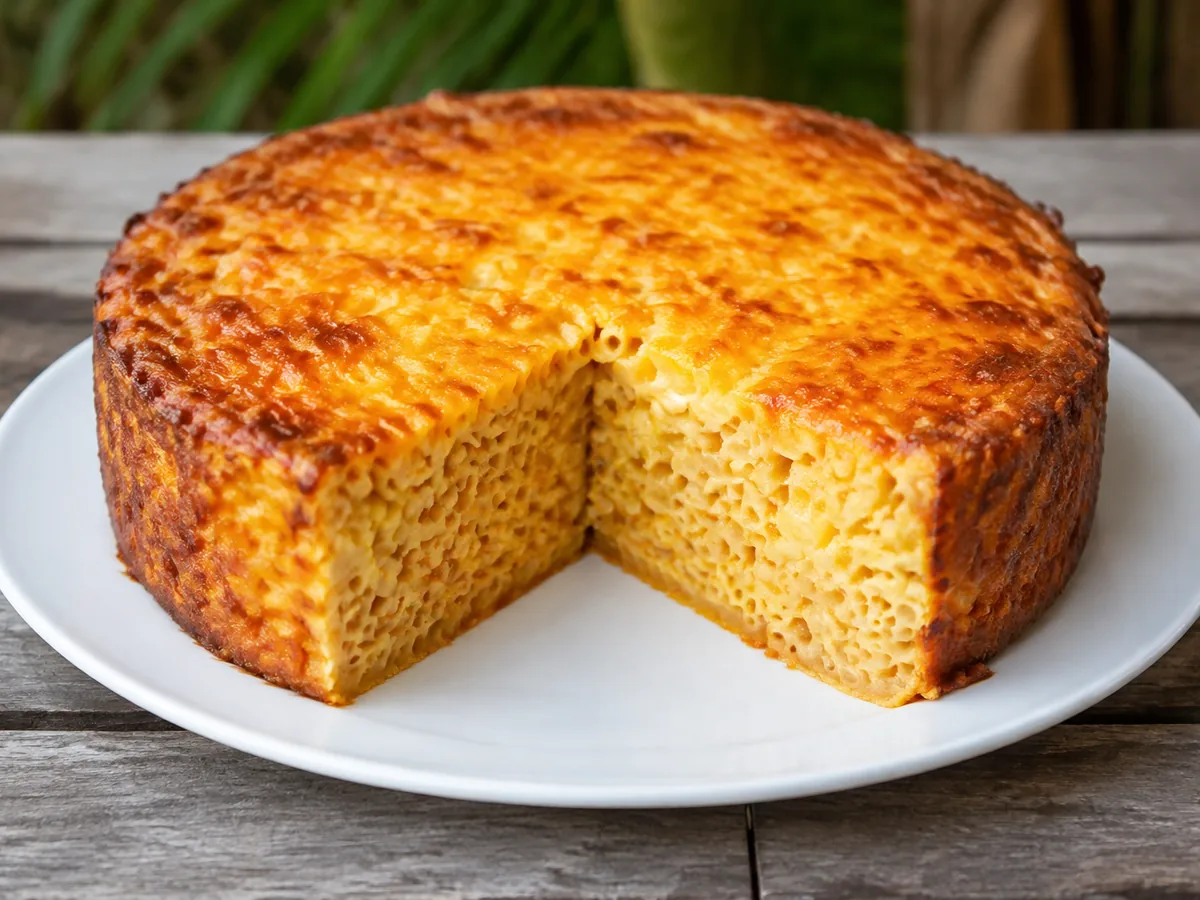
No Trinidadian Sunday lunch exists without macaroni pie. Do not confuse it with creamy American mac and cheese spooned loose from a pot — this is baked firm in a buttered dish into a dense, sliceable golden slab with clean right angles.
Long bucatini or elbow macaroni are boiled tender, tossed hot with butter, and bound in an egg-and-evaporated-milk custard. The seasonings are unmistakable: grated yellow onion, prepared mustard, black pepper and mountains of sharp cheddar.
Baked until the custard sets and the cheese crust blisters dark, it is cut into neat squares — and then buried under callaloo.
The pasta
- 450 g1 lbElbow macaroni, or bucatini broken into 8 cm pieces
- 4 L17 cupsBoiling water with 25 g sea salt
- 60 g4 TbspUnsalted European butter, softened
The cheese
- 500 g5 cups packedSharp New Zealand or English cheddar, coarsely grated from the block400 g through the pasta, 100 g over the top
The custard
- 350 ml1 tinEvaporated milk, undiluted
- 120 ml½ cupWhole milk
- 2 large2 largeFarm-fresh eggs at room temperature, lightly beaten
- 80 g1 mediumYellow onion, finely grated with its juice
- 15 ml1 TbspPrepared yellow mustard, or Dijon
- 15 ml1 TbspTrinidad green seasoning, or minced chadon beni
- 5 ml1 tspWorcestershire sauce
- 6 g1 tspFine sea salt
- 3 g1 tspGround white or black pepper
- 1 g¼ tspNutmeg, freshly grated
- 15 g1 TbspButter, for the dish
Evaporated milk, not fresh
Sixty per cent of its water is already removed, so its concentrated casein and lactose resist curdling at oven heat and give the density a slice needs. Whole milk alone bakes watery.
Slightly past al dente
Ten to eleven minutes. The tubular starches need to be soft enough to bind the custard — Italian al dente stays too firm to absorb it.
Grate from the block
Bagged shredded cheese is dusted with cellulose anti-caking starch, which stops it melting smoothly and turns the pie greasy and grainy.
Do not rinse the pasta
The surface starch is what helps the custard cling. Straight from the colander into the warm pot with the butter.
Rest 15 to 20 minutes
Egg proteins coagulate between 68 and 74 °C, but the matrix needs time off the heat to firm. Cut early and the custard runs out of the slice.
Passive time, counted separately
The baked pie rests 15 to 20 minutes on a rack before it is cut. That sits outside the times quoted above.
The five tastes on this plate
Salt is the pasta water, the sharp cheddar and the custard. Fat is butter, full-fat evaporated milk, yolks and melting cheese. Acid is yellow mustard and Worcestershire cutting the heavy dairy. Heat is raw grated onion juice, mustard, white pepper and a hint of nutmeg. Umami is aged cheddar peptides, concentrated milk solids and pasta starch.
Equipment
- Large pot and a colander
- Box grater
- Large measuring jug and a whisk
- 9 × 13 in ceramic baking dish
- Wire rack
Traditionally an enamelled steel pan or a Pyrex dish. A 9 × 13 inch ceramic dish works in a modern kitchen — ceramic insulates the sides so the custard bakes through before the edges catch.
Method
Boil the pasta11 min
Bring the 4 L water with 25 g salt to a rolling boil and cook the macaroni 10 to 11 minutes, a little past al dente.
Drain immediately — do not rinse.
Bring 4 L water with 25 g salt to a rolling boil. Cook macaroni 10–11 minutes, slightly beyond al dente; drain immediately without rinsing away its surface starch.
Butter and cheese5 min
Tip the hot pasta back into the warm pot, add the 60 g softened butter and toss until it coats every tube.
Add 400 g of the grated cheddar and toss vigorously until it melts into a stringy gooey coating.
Return hot pasta to the warm pot and toss with 60 g softened butter until evenly coated. Add 400 g freshly grated cheddar and toss until melted and stringy.
Whisk the custard4 min
Whisk the evaporated milk, whole milk, beaten eggs, grated onion with its juice, mustard, green seasoning, Worcestershire, pepper, nutmeg and 1 tsp salt until cohesive.
Whisk evaporated milk, whole milk, beaten eggs, grated onion and its juice, mustard, green seasoning, Worcestershire, pepper, nutmeg and 1 tsp salt until thoroughly combined.
Combine and assemble5 min
Pour the custard over the warm cheesy macaroni and fold until every tube is coated.
Heat the oven to 190 °C, butter the dish generously, spread the mixture level, and scatter the remaining 100 g of cheddar over the top in an unbroken layer.
Fold custard through warm cheesy pasta. Heat oven to 190 °C and butter the dish generously. Spread mixture level and cover evenly with the remaining 100 g cheddar.
Bake35 min
Bake on the middle rack 30 to 35 minutes until the custard is set and the edges bubble.
Two or three minutes under a high broiler blisters the crust with golden-brown spots, to a core of 74–76 °C.
Bake on the middle rack at 190 °C for 30–35 minutes until set and bubbling at the edges. Broil on high 2–3 minutes until golden-brown spots blister the crust and the centre reaches 74–76 °C.
Rest, then slice
Onto a wire rack and rest 15 to 20 minutes undisturbed before cutting.
That is what gives clean architectural squares instead of a running custard.
Transfer to a wire rack and rest undisturbed for 15–20 minutes before slicing, allowing the custard to firm enough for clean squares.
Sensory cues of doneness
- Visual: a golden-amber gratin crust blistered with dark hazelnut spots, cutting to clean right angles with no weeping liquid.
- Auditory: gentle bubbling along the rim of the dish, and a firm clean yield under the knife.
- Olfactory: toasted sharp cheddar, browned butter, evaporated milk, sweet grated onion and nutmeg.
Look for a golden-amber crust with darker toasted spots and clean slices without leaking liquid. Expect gentle bubbling at the rim and aromas of cheddar, butter, onion and nutmeg.
Storing it
Keeps 5 days covered in the fridge. Reheat slices at 180 °C for 10 minutes, or pan-fry cold slices in butter for a crisp crust.
Troubleshooting
- The custard runs out of the slice.
It was cut hot. Rest it 15 to 20 minutes so the protein matrix firms.
- A greasy, grainy texture.
Pre-shredded bagged cheese was used. Grate from the block.
- A watery pie.
Fresh milk alone. Undiluted evaporated milk is what gives the density.
Substitutions
One-to-one global substitutions, with the technique adjustment each one requires.
Ingredient substitutions
| Ingredient | Replace with | Culinary impact and technique adjustment |
|---|---|---|
| Sharp New Zealand cheddar | Sharp English, or white Vermont cheddar | One-to-one, always grated from a block |
| Evaporated milk | Whole milk and heavy cream, 50/50 | An emergency measure — the density will be lower |
| Elbow macaroni | Bucatini, or cavatappi | One-to-one, breaking long noodles into 8 cm lengths |
Scaling
Half, for 4 squares
Halve everything in an 8 × 8 inch dish and bake 25 to 30 minutes.
Double, for 16 squares
Double everything across two 9 × 13 dishes on separate racks, rotated halfway.
What to serve it with
- Trinidad callaloo, spooned straight over the square
- Trinidad stew chicken in its caramelised red gravy
- Sweet fried plantain tajadas
- Chilled sorrel, or a cold Carib
Questions
Why evaporated milk?
It is a West Indian staple, and its reduced water and concentrated proteins make a richer, firmer custard that holds a slice.
Which cheddar?
Sharp New Zealand cheddar is the Trinidadian standard, for its sharp savoury bite.
How do leftovers keep?
Five days covered. Reheat at 180 °C for 10 minutes, or pan-fry cold slices in butter.