Bahamian Steamed Fish
Steamed in the Bahamian sense, which means smothered. Grouper or snapper fillets seasoned with lime, salt and pepper and rested cold, then laid into a gravy of onion, sweet pepper and celery, tomato, thyme, tomato paste and fish stock simmered until lightly thickened. The lid goes on and the fish cooks in the steam until it flakes at 63 °C. Grits beside.
- Prep
- 25 min
- Cook
- 30 min
- Serves
- 4
- Difficulty
- Medium
Researched · Kitchen testing pending
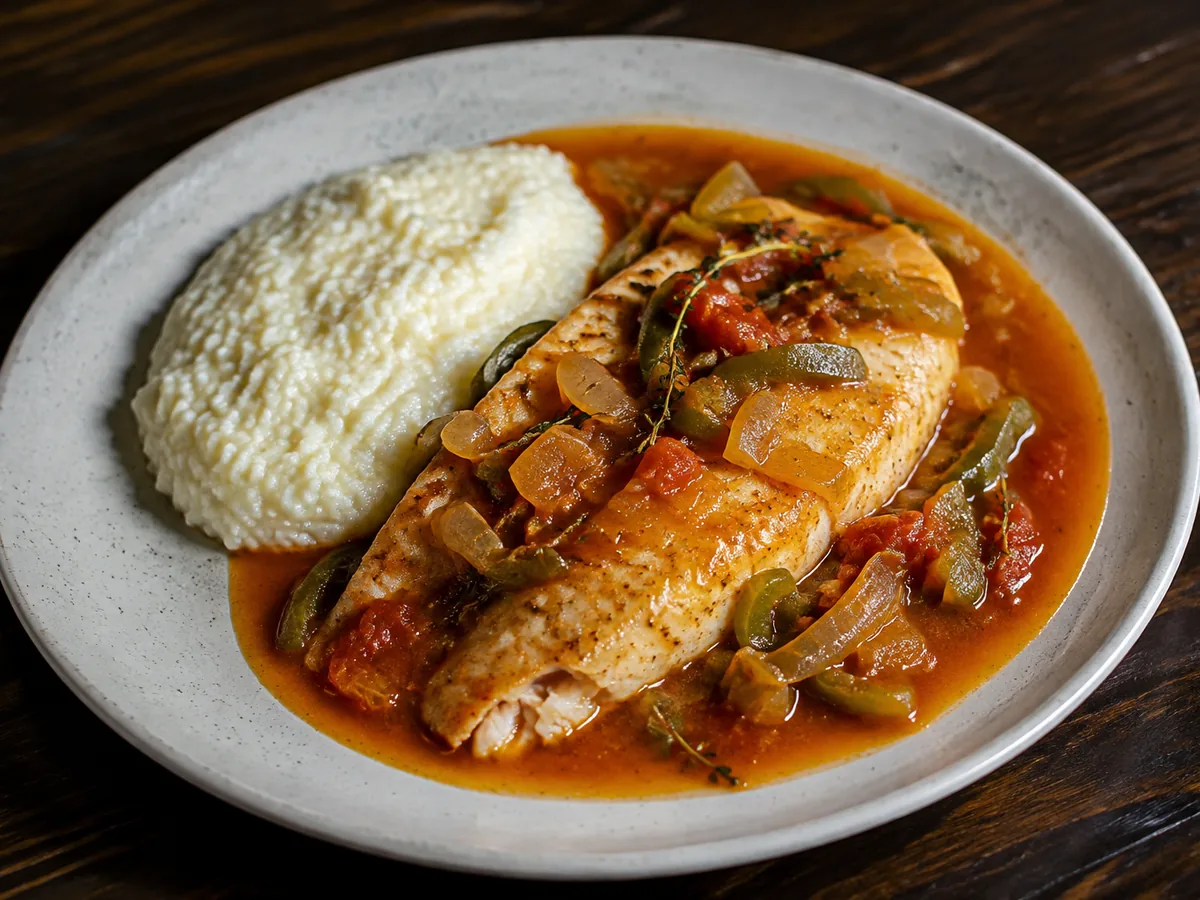
Steamed fish is the Bahamian dinner, and the word means something specific here: the fish is laid into a thick gravy of onion, sweet pepper, celery, tomato and thyme, the lid goes on, and it cooks in the trapped steam until it flakes. Grouper and snapper are the fish of the banks, and either is right.
It is served over grits or beside peas n’ rice, with the gravy spooned over everything, and a bottle of pepper sauce within reach.
- 44Grouper or snapper fillets, about 180 g each
- 22Limes, juiced
- 6 g1 tspFine saltdivided
- 2 g½ tspBlack pepper
- 30 ml2 TbspNeutral oil
- 1 medium1 mediumOnion, sliced
- 11Sweet pepper, sliced
- 2 stalks2 stalksCelery, sliced
- 2 medium2 mediumTomatoes, chopped
- 30 g2 TbspTomato paste
- 4 sprigs4 sprigsFresh thyme
- 500 ml2 cupsFish stock
Steamed means smothered
In the Bahamas a steamed fish is cooked under a lid in a thick tomato and onion gravy, not over water. The lid traps the steam and the fish cooks gently without ever frying or drying.
The lime rest
Fifteen minutes in lime, salt and pepper in the fridge seasons the fish through and firms the surface so it holds together in the gravy.
The five tastes on this plate
Salt is in the rub and the gravy. Fat is the oil. Acid is lime and tomato. Heat is black pepper, with hot sauce at the table. Umami is fish stock and tomato paste.
Equipment
- Wide, deep skillet with a lid
- Fish spatula
- Instant-read thermometer
The pan must be wide enough to lay the fillets flat in one layer. Stacked fish steams unevenly.
Method
Season the fish15 min
Rub the fillets with the lime juice, half the salt and the pepper. Refrigerate 15 minutes.
Rub fillets with lime juice, half the salt and black pepper. Refrigerate for 15 minutes while you prepare the vegetables and gravy.
Sweat the vegetables6 min
Heat the oil in the skillet over medium. Cook the onion, sweet pepper and celery 5 to 6 minutes until soft.
Heat oil in a skillet over medium heat. Cook sliced onion, sweet pepper and celery for 5–6 minutes until softened.
Build the gravy10 min
Add the tomatoes, tomato paste, thyme, stock and the remaining salt. Simmer 8 to 10 minutes until lightly thickened and no longer watery. Taste for salt.
Add tomatoes, tomato paste, thyme, stock and remaining salt. Simmer 8–10 minutes until the gravy thickens slightly and is no longer watery; taste for salt.
Steam the fish12 min
Lay the fillets into the gravy, skin side down if there is skin, and spoon some sauce over them. Cover and cook over low heat 10 to 12 minutes until the fish flakes at the thickest point and reads 63 °C.
Lay fish skin-down, if skin is present, in the gravy and spoon sauce over it. Cover and cook on low 10–12 minutes until the thickest flesh flakes and reaches 63 °C.
Serve
Lift each fillet onto a plate with the spatula and spoon the vegetables and gravy over. Grits or peas n' rice beside.
Lift each fillet onto a plate with a spatula. Spoon vegetables and gravy over the fish and serve with grits or peas n’ rice.
Sensory cues of doneness
- Visual: an opaque fillet that flakes when pressed, in a glossy red gravy with soft onion ribbons.
- Auditory: a soft bubble under the lid, never a rattle.
- Olfactory: thyme and stewed tomato, then clean fish.
Check for opaque, flaking fish in glossy red gravy with softened onion ribbons. Keep bubbling gentle under the lid; expect thyme, cooked tomato and clean fish aromas.
Storing it
Keeps 2 days refrigerated. Reheat gently in its gravy, covered, to 74 °C; the fish will be softer the second day.
Troubleshooting
- Fish fell apart.
Turned or stirred. Lay it in once, spoon over, and lift it out with a wide spatula.
- Watery gravy.
Not reduced before the fish went in. Simmer until it coats a spoon first.
- Dry fish.
Overcooked. Check at 10 minutes; 63 °C and flaking is done.
Substitutions
One-to-one swaps, with the technique change each one needs.
Ingredient substitutions
| Ingredient | Replace with | Culinary impact and technique adjustment |
|---|---|---|
| Grouper or snapper | Mahi-mahi, cod or a whole small snapper | A whole fish needs 18 to 20 minutes under the lid |
| Fish stock | Water with a bay leaf, or light chicken stock | Less depth; add a squeeze more lime at the end |
| Fresh tomatoes | 200 g canned chopped tomatoes | Slightly sharper; reduce the tomato paste to 1 Tbsp |
Scaling
Half
Two fillets in a smaller skillet; the same timings.
Double
Two skillets, or cook the fish in two rounds in the same gravy.
What to serve it with
- Grits, or peas n' rice
- Coleslaw or a green salad
- Hot pepper sauce and a lime wedge
Questions
Why is it called steamed?
Bahamian usage: fish cooked under a lid in a smothering gravy is steamed, as against boiled or fried.
Can I use a whole fish?
Yes, a 1 kg snapper scored on both sides, 18 to 20 minutes covered.
What is the difference from boiled fish?
Boiled fish is in a thin, sour, lime broth; steamed fish is in a thick tomato gravy. Boiled fish is breakfast; steamed fish is dinner.