Bahamian Johnny Cake
The dense, faintly sweet pan bread that goes with souse and boiled fish. Flour, baking powder, salt and a little sugar, cold butter rubbed in until sandy, milk stirred in only until no dry flour shows, the dough pressed into a buttered round pan, scored into wedges and baked at 190 °C until golden and set. Cooled ten minutes and cut thick, to be split and buttered.
- Prep
- 15 min
- Cook
- 35 min
- Serves
- 8 wedges
- Difficulty
- Easy
Researched · Kitchen testing pending
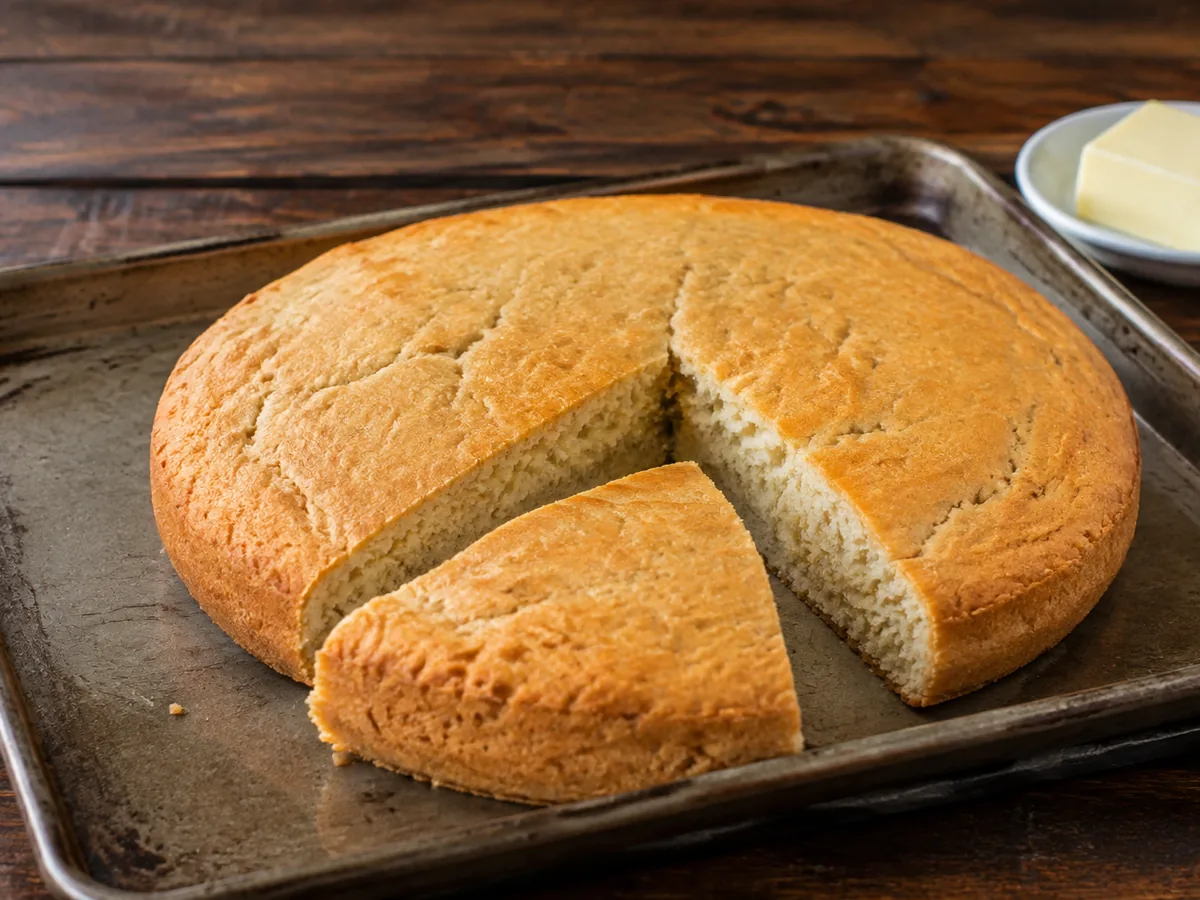
Johnny cake is the Bahamian bread, baked in one round pan and cut into wedges. It is dense and a little sweet, made with butter rubbed into flour and just enough milk to bring it together, and it exists to be dropped into a bowl of souse or boiled fish and to be buttered at breakfast.
The name is journey cake, worn smooth by two centuries of island use, and every family has a pan it is always baked in.
- 500 g4 cupsAll-purpose flour
- 20 g4 tspBaking powder
- 8 g1½ tspFine salt
- 50 g¼ cupSugar
- 100 g7 TbspButter, cold, in cubesplus more for the pan
- 300 ml1¼ cupsMilk
Mix it barely
Johnny cake is a quick bread. Stir the milk in until the flour is just wet and no further; the more it is worked, the tougher it gets. A shaggy dough pressed into the pan is right.
Dense on purpose
This is not a fluffy scone. Bahamian johnny cake is close-crumbed and sturdy so it can sit in a bowl of souse without dissolving, and a wedge should have some weight in the hand.
The five tastes on this plate
Salt and a little sugar are both in the dough. Fat is the butter, rubbed in and spread on. There is no acid or heat; the bowl it goes with supplies both. Umami is the browned crust.
Equipment
- Large bowl
- 23 cm round cake pan or cast-iron skillet, buttered
- Knife, for scoring
- Wire rack
A cast-iron skillet gives the darkest, crispest base; a cake pan gives a softer one. Both work.
Method
Heat the oven2 min
Heat the oven to 190 °C and butter the pan generously.
Heat the oven to 190 °C and butter the pan generously.
Rub in the butter5 min
Whisk the flour, baking powder, salt and sugar in the bowl. Rub in the cold butter with your fingertips until the mixture is sandy with a few pea-sized pieces.
Whisk flour, baking powder, salt and sugar. Rub in cold butter with fingertips until sandy, leaving a few pea-sized pieces for the finished crumb.
Add the milk3 min
Pour in the milk and stir with a fork only until no dry flour remains. The dough will be shaggy and soft.
Add milk and stir with a fork just until no dry flour remains. Stop while the dough is soft and shaggy; extra mixing makes it tough.
Press and score3 min
Turn the dough into the pan and press it to an even thickness with floured hands. Score the top lightly into 8 wedges with the knife.
Transfer dough to the pan. With floured hands, press to an even thickness, then lightly score the top into 8 wedges with a knife.
Bake35 min
Bake 30 to 35 minutes until the top is golden, the edges pull from the pan and a skewer in the centre comes out clean, about 95 °C inside.
Bake at 190 °C for 30–35 minutes until golden, pulling from the edges and about 95 °C in the centre; a central skewer should come out clean.
Cool and cut10 min
Cool in the pan 10 minutes, then turn out onto the rack and cut along the scores.
Cool in the pan for 10 minutes, then turn out onto a wire rack. Cut along the scored lines to make the wedges.
Sensory cues of doneness
- Visual: a golden, lightly cracked top and a pale, tight crumb when cut.
- Auditory: a hollow knock on the base when turned out.
- Olfactory: butter and toasted flour, faintly sweet.
Look for a golden, lightly cracked top and a pale, close crumb. The base should sound hollow when tapped, with a lightly sweet aroma of butter and toasted flour.
Storing it
Keeps 2 days wrapped at room temperature and 5 days refrigerated. Warm wedges in a 180 °C oven for 8 minutes, or split and toast them. Freezes for 2 months.
Troubleshooting
- Tough and dry.
Overmixed, or overbaked. Stir until just wet and pull it at golden.
- Raw in the middle.
Pressed too thick, or the oven ran cool. An even 4 cm and a skewer test.
- Pale and soft.
Too low a shelf, or the pan was not buttered. Middle shelf, buttered pan, and 5 minutes more.
Substitutions
One-to-one swaps, with the technique change each one needs.
Ingredient substitutions
| Ingredient | Replace with | Culinary impact and technique adjustment |
|---|---|---|
| Butter | Shortening or lard | Flakier and less flavour; the older island way |
| Milk | Water, or evaporated milk diluted by half | Water gives a plainer, chewier cake |
| Sugar | Brown sugar, or none | Brown sugar darkens the crust; plain cakes suit souse |
Scaling
Half
A 15 cm pan or a small skillet, 25 minutes.
Double
Two pans on the same shelf, rotated halfway.
What to serve it with
- Chicken souse or boiled fish, the bowl it was made for
- Butter and guava jam at breakfast
- Stew fish or stew conch on a Sunday
Questions
Is it the same as a Belizean johnny cake?
A cousin. Bahamian johnny cake is a single round pan bread cut in wedges; Belize and the Virgin Islands make individual fried or baked rounds.
Why is it dense?
By design: it is a bread for soaking up souse and boiled fish broth, and a light crumb would fall apart in the bowl.
Where does the name come from?
Journey cake, the provision bread sailors and labourers carried, worn down to johnny cake across the Caribbean.