Roti with Chicken and Kouseband
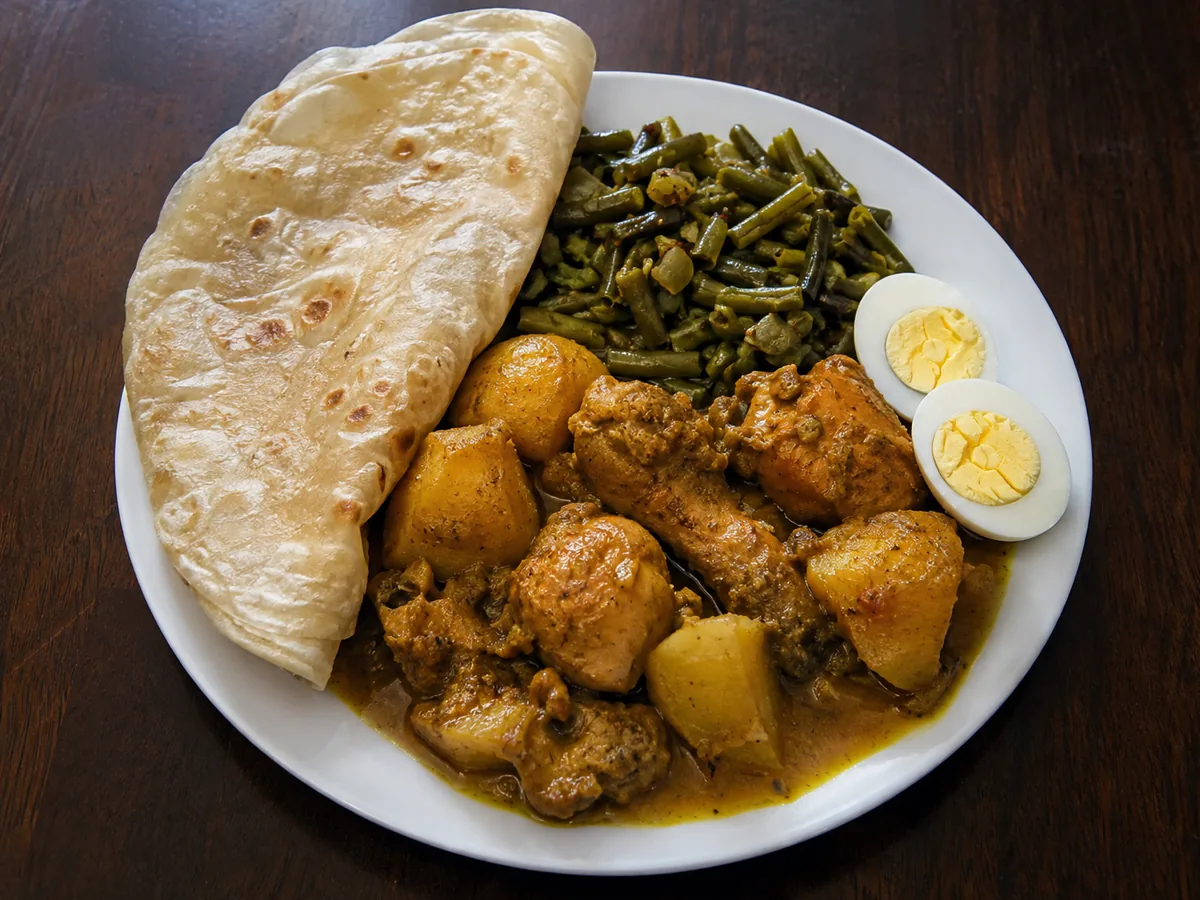
The Hindustani-Surinamese institution. Bone-in chicken and potatoes braised in a turmeric-heavy Surinamese massala bloomed in oil, yardlong beans cooked separately so they keep their snap, and a dhalpuri rotiplaat stuffed with ground cumin-spiced split peas, rolled thin and puffed on a dry griddle, eaten by hand.
- Prep
- 45 min
- Cook
- 50 min
- Serves
- 4 to 6, with 6 rotiplaaten
- Difficulty
- Hard
Researched · Kitchen testing pending
Surinamese roti is the defining contribution of the Hindustani-Surinamers, the contract workers who came from Uttar Pradesh and Bihar between 1873 and 1916. Over generations they rebuilt their flatbreads and curries around the tropical larder of the Guianas.
The dish has three parts. A dhalpuri rotiplaat, a thin unleavened flatbread stuffed with cumin-spiced ground split peas. Bone-in chicken and potatoes braised in a dark, turmeric-heavy Surinamese massala with no fennel or anise. And kouseband, crisp yardlong beans, cooked on their own. It is eaten by hand, tearing the soft bread to scoop up the curry.
Curry
- 1 kg2.2 lbBone-in chicken thighs, skin removed, each cut in two across the bone
- 45 g3 TbspSurinamese massala, fennel-free and anise-free
- 600 g4 mediumYukon Gold or waxy potatoes, peeled and cut into 4 cm chunks
- 2 medium2 mediumYellow onions, finely choppeddivided
- 8 cloves8 clovesGarlic, crushed to a pastedivided
- 20 g1½-inch pieceFresh ginger, finely grated
- 1 large1 largeRipe plum tomato, finely diced
- 30 g2 TbspDouble-concentrated tomato paste
- 600 ml2½ cupsHot water or chicken stockdivided
- 60 ml4 TbspVegetable oil or gheedivided
- 18 g1 TbspFine sea saltdivided across meat, beans and dough
- 1 whole1 wholeMadame Jeanette pepper, unbroken
Kouseband
- 400 g0.9 lbYardlong beans, trimmed and cut into 5 cm lengths
Rotiplaat
- 400 g3 cupsPlain flour, sifted, plus more for dusting
- 8 g1½ tspBaking powder
- 240 ml1 cupLukewarm water
- 150 g¾ cupYellow split peas, soaked 1 hour, boiled 15 minutes until tender-firm, drained and ground
- 6 g2 tspRoasted ground cumin
- 45 ml3 TbspMelted ghee or oil, for brushing
Bloom the massala
Curcumin and the aromatic oils in Surinamese massala are fat-soluble. Sixty seconds in 140 °C oil before any liquid dissolves them and turns raw powdery astringency into a mellow golden base. Burn it and it is bitter; skip it and it is grainy.
The roti balloon
A rested dough sealed round a pocket of dry, cumin-seasoned split peas rolls thin without tearing. On a 220 °C griddle the filling's moisture turns to steam and separates the two skins into a puff.
Beans apart
Kouseband simmered in the curry for half an hour goes soft and drab. Eight minutes in their own skillet keeps the snap and the emerald colour.
The five tastes on this plate
Salt is balanced across curry, beans and dhal filling. Fat is oil blooming the spice and ghee on the bread. Acid is tomato and paste cutting the starchy gravy. Heat is garlic, ginger, cumin and the whole pepper's steam. Umami is chicken marrow, roasted massala and braised potato.
Equipment
- 5-quart enamelled Dutch oven
- 12-inch seasoned cast-iron skillet or flat griddle, as the tawa
- Separate skillet, for the beans
- Rolling pin and a clean cloth
- Food processor
The traditional tawa is a flat concave cast-iron griddle and the curry pot a heavy aluminium caldero. A cast-iron griddle for the roti and a Dutch oven for the curry replace both.
Method
Make the dhal stuffing20 min
Boil the soaked split peas in unsalted water 15 minutes until tender but not mushy. Drain thoroughly. Grind in the processor with two garlic cloves, a teaspoon of salt and the roasted cumin to a crumbly, powdery meal.
Soak split peas 1 hour, then boil in unsalted water 15 minutes until tender, not mushy. Drain thoroughly; grind with 2 garlic cloves, 1 teaspoon salt and roasted cumin to a dry, crumbly meal.
Make the roti dough40 min
Whisk the flour, baking powder and a teaspoon of salt. Add the warm water and a tablespoon of oil and knead 6 minutes to a soft, smooth dough. Divide into six balls, brush with oil, cover with a damp cloth, and rest 30 minutes.
Whisk flour, baking powder and 1 teaspoon salt. Add warm water and 1 tablespoon oil; knead 6 minutes until soft and smooth. Divide into six balls, brush with oil, cover with a damp cloth and rest 30 minutes.
Stuff and roll20 min
Flatten each ball into a 10 cm disc, set two tablespoons of ground dhal in the centre, and gather the edges up to seal into a pouch. Rest 10 minutes. On a floured surface, roll gently to a thin 25 cm circle.
Flatten each ball into a 10 cm disc, set two tablespoons of ground dhal in the centre, and gather the edges up to seal into a pouch. Rest 10 minutes. On a floured surface, roll gently to a thin 25 cm circle.
Cook the rotiplaaten12 min
Heat the dry griddle over medium-high to about 220 °C. Cook a roti 45 seconds until bubbles appear, flip, brush with ghee, and flip again after 45 seconds; it will puff like a balloon. Fold in quarters in a clean cloth to keep soft.
Heat dry griddle over medium-high to 220 °C. Cook roti 45 seconds until bubbling; flip and brush with ghee. Cook another 45 seconds and flip again until puffed. Fold into quarters inside a clean cloth to keep soft.
Brown the chicken6 min
Heat 30 ml oil in the Dutch oven over medium and sauté the chicken 6 minutes until lightly browned. Remove.
Heat 30 ml oil in the Dutch oven over medium and sauté the chicken 6 minutes until lightly browned. Remove.
Bloom the massala4 min
Add the diced onion, the remaining garlic and the ginger to the pan fat and sauté 3 minutes. Add the massala and tomato paste and cook, stirring constantly, one minute until fragrant and deep mustard gold.
Sauté diced onion, remaining garlic and ginger in the pan fat 3 minutes. Add massala and tomato paste; stir constantly for 1 minute until fragrant and deep mustard-gold, without burning the spices.
Braise the chicken and potatoes30 min
Return the chicken, add the potatoes and the diced tomato, and stir to coat in the paste. Pour in 500 ml hot water and a teaspoon of salt, float the whole Madame Jeanette, cover, and simmer over medium-low 30 minutes until the potatoes are fork-tender and the chicken reads 74 °C.
Return chicken; add potatoes and tomato, coating with paste. Add 500 ml hot water, 1 teaspoon salt and whole Madame Jeanette. Cover; simmer on medium-low 30 minutes until potatoes are fork-tender and chicken reaches 74 °C.
Cook the kouseband12 min
In the separate skillet, heat 15 ml oil over medium, sauté one diced garlic clove and the beans 3 minutes, add 100 ml water and half a teaspoon of salt, cover, and steam 6 to 8 minutes until tender-crisp. Uncover and sauté dry.
Separately heat 15 ml oil over medium; sauté 1 diced garlic clove and beans 3 minutes. Add 100 ml water and ½ teaspoon salt. Cover and steam 6–8 minutes until crisp-tender; uncover and sauté dry.
Finish the curry and serve4 min
Lift out the pepper. Mash two potato chunks against the pot wall to thicken the gravy and simmer 3 minutes until it coats a spoon. Set a folded warm roti on each plate with the curry and gravy alongside and the beans beside it, to be eaten by hand.
Remove pepper. Mash 2 potato chunks against the pot; simmer 3 minutes until gravy coats a spoon. Serve folded warm roti with curry, gravy and beans alongside, for eating by hand.
Sensory cues of doneness
- Visual: a deep mustard-yellow gravy on tender chicken and golden potato, emerald beans, and thin pliable flatbreads flecked with yellow dhal.
- Auditory: a hiss as the massala paste hits the oil, and a soft puff as the roti balloons on the dry griddle.
- Olfactory: toasted cumin, roasted turmeric, garlic, ginger and the floral Madame Jeanette.
Look for mustard-yellow gravy, tender chicken and potato, emerald beans and thin pliable roti flecked with dhal. Expect sizzling masala and gently puffing bread, with toasted cumin, turmeric, garlic, ginger and floral pepper aromas.
Storing it
Cooked rotiplaaten stay soft wrapped in a towel for a day. For a crowd, hold them in a heavy towel in a 95 °C oven.
Troubleshooting
- The roti leaks and tears.
Wet dhal, or too much force on cold dough. Dry the boiled peas fully before grinding and roll lightly from the centre out.
- Bitter, grainy gravy.
The massala scorched, or never bloomed. Sixty seconds in medium-hot oil with the onion and garlic, then liquid.
- Soggy, drab beans.
They simmered in the curry. Cook them separately in a hot skillet for eight minutes.
Substitutions
One-to-one swaps, with the technique change each one needs.
Ingredient substitutions
| Ingredient | Replace with | Culinary impact and technique adjustment |
|---|---|---|
| Kouseband | Fine haricots verts or string beans | One-to-one |
| Yellow split peas | Split yellow lentils or dried pigeon peas | One-to-one |
| Surinamese massala | A Surinamese curry powder such as Nandan or Chan's, checked fennel-free | One-to-one |
Scaling
Half
Halve everything and make three rotiplaaten. The braise still takes 28 to 30 minutes.
Double
A 10-quart Dutch oven for the curry, and twelve rotis rolled ahead and kept warm wrapped in a towel in a 95 °C oven.
What to serve it with
- Green mango chutney with garlic, Madame Jeanette and roasted cumin
- Hard-boiled eggs browned in the massala oil and simmered with the potatoes
- Quick-pickled red onion slivers in vinegar
Questions
How does Surinamese massala differ from garam masala?
Massala is a turmeric, cumin and coriander braising powder used at the start. Garam masala is a finishing blend added at the end. Surinamese massala never contains fennel or anise.
Can I use flour tortillas?
They have no dhal filling and no puff. If fresh roti is impossible, use dhalpuri from a Caribbean bakery, or warm buttered naan.
Why bone-in thighs?
Marrow and collagen dissolve into the gravy over thirty minutes and give it a body boneless breast cannot.