Bojo
The national cake, flourless and unleavened, born of Jewish planters who needed a Passover cake and African cooks who knew cassava and coconut. Grated cassava and fresh coconut with evaporated and coconut milk, brown sugar, butter, almond and vanilla extracts, cinnamon and rum-soaked raisins, baked to a dense, fudgy slab with caramelised edges and finished with coloured sprinkles.
- Prep
- 35 min
- Cook
- 1 hr 15 min
- Serves
- 12 to 16 squares, from a 23 by 33 cm dish
- Difficulty
- Easy
Researched · Kitchen testing pending
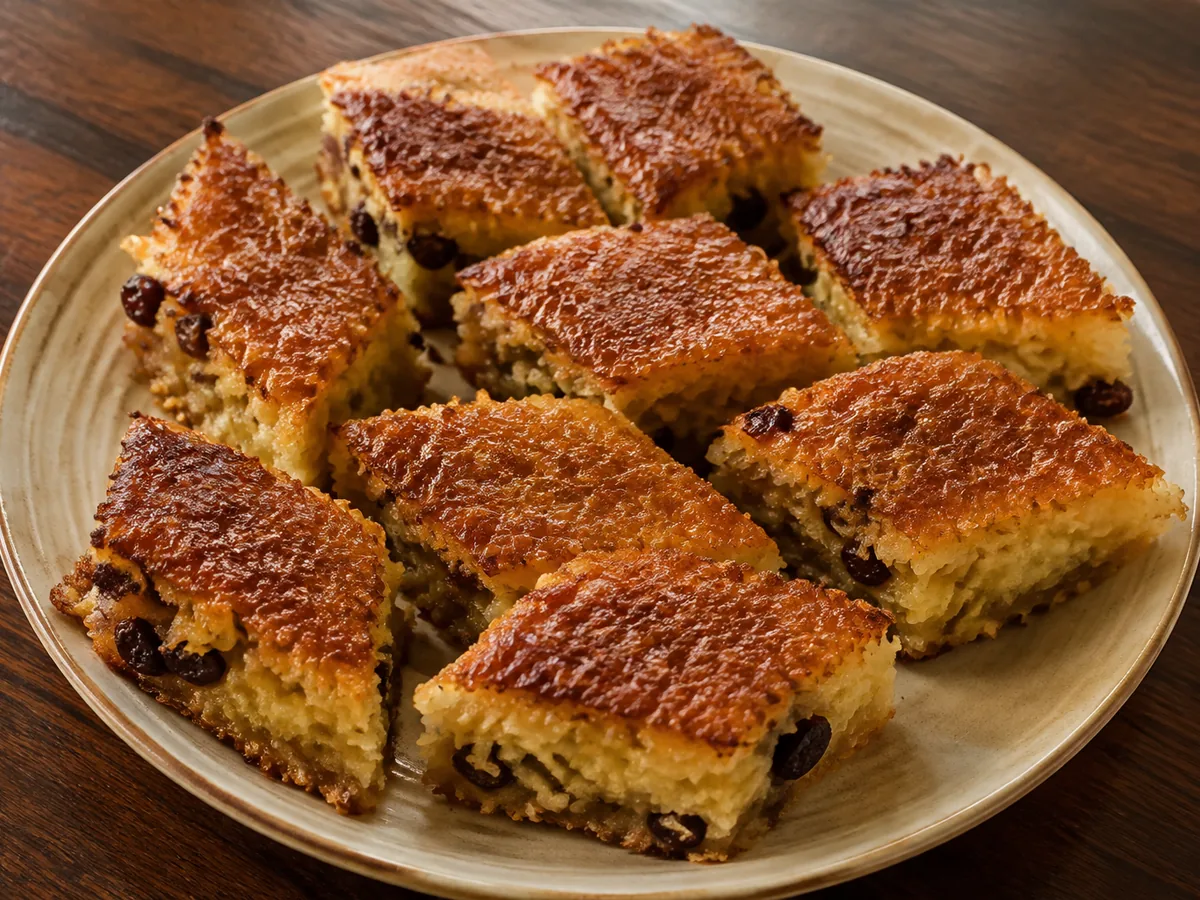
Bojo is Suriname’s national cake, an extraordinary gluten-free confection born in the eighteenth century from Jewish-Surinamese and Afro-Surinamese collaboration. Sephardic planters needed a flourless, unleavened cake for Passover; enslaved African women knew everything about cassava root and coastal coconut.
The cake needs no flour, no raising agent and no creaming. Grated cassava and fresh coconut are mixed with evaporated milk, butter, brown sugar, almond and vanilla, cinnamon and plump raisins, and baked until dense, fudgy and caramelised at the edges, finished with a brush of butter and a scatter of coloured sprinkles.
- 1 kg2.2 lbFresh cassava, peeled, cored and finely grated, lightly pressed of free liquidor thawed frozen grated cassava
- 400 g4 cups packedFreshly grated mature coconutor frozen unsweetened grated coconut
- 300 g1½ cups packedDark brown sugar
- 150 g⅔ cupUnsalted butter, melted and slightly cooled, plus more for the dish
- 350 ml1 can (12 fl oz)Evaporated whole milk
- 120 ml½ cupFull-fat coconut milk
- 120 g¾ cupDark seedless raisins
- 30 ml2 TbspAged dark rum, for the raisinsor warm water
- 10 ml2 tspPure almond extractthe signature aroma
- 10 ml2 tspPure vanilla extract
- 4 g1 tspGround cinnamon
- 2 g½ tspFreshly grated nutmeg
- 4 g¾ tspFine sea salt
- 30 g2 TbspMulti-coloured sugar sprinkles, to finish
No gluten, no leavening
Cassava is about eighty percent amylopectin. Baked with milk, butter and coconut fat at 175 °C it gelatinises around 65 to 70 °C, and with no gluten to build a crumb, the gel traps the fats into a dense, chewy, custard-like structure.
Press, do not squeeze
Freshly grated cassava sheds starchy water. Pressing off the free dripping liquid stops a soggy cake. Squeezing it dry makes a fibrous one.
The almond is the Jewish fingerprint
Almond extract carries the marzipan and almond-pastry tradition of Western Europe into a cake made of tropical roots.
The five tastes on this plate
Salt sharpens the coconut and tempers the sugar. Fat is butter, coconut oil and evaporated milk. Acid is the faint edge of molasses sugar and soaked raisins. Heat is cinnamon, nutmeg and almond. Umami is the caramelised coconut-cassava crust and milk solids.
Equipment
- 23 by 33 cm ceramic or heavy metal baking dish
- Box grater
- Large mixing bowl and wooden spoon
- Offset spatula
- Wire rack
A generously buttered ceramic ovenschaal is traditional. A heavy metal pan lined with parchment gives slightly crisper edges.
Method
Soak the raisins15 min
Soak the raisins in the rum 15 minutes until plump.
Soak the raisins in the rum 15 minutes until plump.
Grate the cassava and coconut20 min
Peel the cassava, remove the woody core, and grate it on the finest side of a box grater. Wrap it in a clean towel and squeeze gently to release the dripping liquid without drying it out. Grate the coconut finely.
Peel and core cassava; grate finely. Wrap in a clean towel and press gently to remove free dripping liquid without squeezing dry. Finely grate the coconut.
Mix the root base3 min
In a large bowl combine the cassava and coconut. Stir in the brown sugar, cinnamon, nutmeg and salt thoroughly.
In a large bowl combine the cassava and coconut. Stir in the brown sugar, cinnamon, nutmeg and salt thoroughly.
Add the wet ingredients3 min
Pour in the melted butter, evaporated milk, coconut milk, almond and vanilla extracts and stir hard to a thick, uniform, glossy batter. Fold in the raisins with their rum.
Pour in the melted butter, evaporated milk, coconut milk, almond and vanilla extracts and stir hard to a thick, uniform, glossy batter. Fold in the raisins with their rum.
Fill the dish3 min
Heat the oven to 175 °C. Butter the dish generously, pour in the batter, and level it with an offset spatula.
Heat the oven to 175 °C. Butter the dish generously, pour in the batter, and level it with an offset spatula.
Bake1 hr 15 min
Bake uncovered in the centre of the oven 1 hour 10 to 1 hour 20 minutes until the top is deep golden-brown, the edges pull from the sides, and the centre is set to the touch, about 92 °C.
Bake uncovered in the centre of the oven 1 hour 10 to 1 hour 20 minutes until the top is deep golden-brown, the edges pull from the sides, and the centre is set to the touch, about 92 °C.
Garnish1 min
Straight from the oven, brush the surface with a tablespoon of melted butter and scatter the sprinkles evenly over the hot top.
Straight from the oven, brush the surface with a tablespoon of melted butter and scatter the sprinkles evenly over the hot top.
Cool and slice2 hr
Cool completely on a rack, at least 2 hours, so the starch and coconut fat set. Cut into 16 squares and serve at room temperature or chilled.
Cool completely on a rack, at least 2 hours, so the starch and coconut fat set. Cut into 16 squares and serve at room temperature or chilled.
Sensory cues of doneness
- Visual: a deep golden-brown, glistening slab with dark caramelised edges, dotted with coloured sprinkles, and a dense, moist ivory-yellow interior.
- Auditory: a gentle sizzle round the dish in the last 15 minutes as the coconut fat bubbles.
- Olfactory: toasted coconut, sweet almond, brown butter, cinnamon and caramelised sugar.
Look for a glossy deep golden-brown top with caramelised edges, sprinkles and a dense, moist ivory-yellow centre. Expect gentle sizzling in the last 15 minutes and toasted coconut, almond, browned butter, cinnamon and caramel aromas.
Storing it
Covered, it keeps 3 days at room temperature or a week in the fridge, and slices cleaner cold.
Troubleshooting
- A soggy, wet cake.
Too much free starch water in the grated root. Press it lightly in a towel before measuring.
- Dry, fibrous crumb.
Sweetened desiccated flakes from the baking aisle. Use fresh or frozen unsweetened coconut with its moisture and fat.
- It crumbles when sliced.
Cut while hot. The starch and coconut fat need two hours to set firm.
Substitutions
One-to-one swaps, with the technique change each one needs.
Ingredient substitutions
| Ingredient | Replace with | Culinary impact and technique adjustment |
|---|---|---|
| Fresh cassava | Frozen grated cassava, yuca rallada, thawed and drained | One-to-one |
| Fresh grated coconut | Frozen unsweetened grated coconut, or rehydrated unsweetened medium shred | One-to-one; never sweetened baking flakes |
| Dark rum | Vanilla extract or water | One-to-one for soaking |
Scaling
Half
A 20 cm square ceramic dish, 55 to 60 minutes.
Double
Two separate 23 by 33 cm dishes for even heat.
What to serve it with
- Strong dark Surinamese coffee or espresso
- Homemade fermented ginger beer, gemberbier
- Lightly sweetened whipped cream on the side
Questions
Is bojo gluten-free?
Yes. There is no wheat, grain or gluten-bearing starch in it at all, only cassava and coconut.
Can I use frozen grated cassava?
Yes. Thaw it completely and drain the excess liquid; it is sold as yuca rallada in Latin and Asian grocers.
Why almond extract?
It is the Sephardic Jewish signature on the cake, the marzipan tradition of Western Europe carried into a cassava batter.