Ceviche
Fresh white fish cured in abundant lime for minutes, not hours, with ají, paper-thin red onion and cilantro. The leche de tigre is the sauce and the drink, and sweet potato, choclo and cancha live on the plate rather than in the bowl.
- Prep
- 50 min
- Serves
- 4 appetizer portions, or 2 generous mains
- Difficulty
- Medium
Researched · Kitchen testing pending
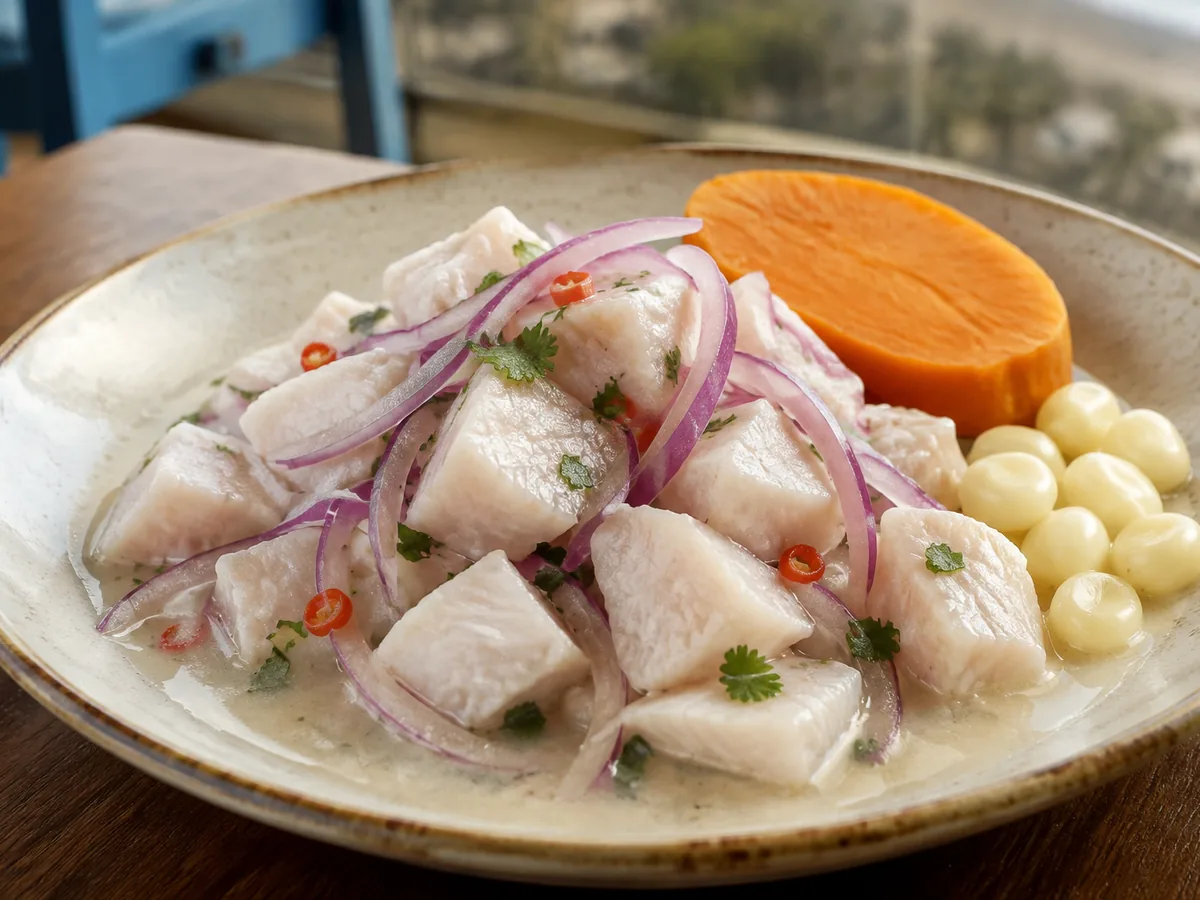
The fish goes on the board before the citrus goes in the bowl. That order matters: if the lime juice sits waiting while you hunt for a knife, you lose the race that makes Peruvian ceviche what it is.
This is not a dump-and-stir Mexican-style mix. The fish firms in acid for minutes, not hours, and the leche de tigre should taste sharp, briny and alive when it goes over the plate.
The dish waits for no one. Plate it when the timer says the fish is ready, not when the guests are finally sitting down.
Fish and cure
- 700 gabout 1½ lbVery fresh firm white fishcorvina if you can get it, otherwise sea bass, flounder or halibut with tight flesh and no fishy smell
- 180 ml¾ cupFreshly squeezed lime juicefrom about 8–10 limes; strain out the pulp and seeds
- 1–21–2Ají limo, seeded and mincedor 1 small rocoto, handled carefully — seeding and removing the membrane takes out most of the fire
- 1 medium1 mediumRed onion, sliced paper-thin into half-moonsabout 150 g / 5 oz
- 40 g⅓ cup loosely packedCilantro leaves, chopped just before serving
- 8 g1½ tspFine sea saltplus more to taste
- 1 small clove1 small cloveGarlic, grated to a pasteoptional
- 2–32–3Ice cubes, for the leche de tigreoptional, for a hot kitchen
Plate companions
- 1 large1 largeSweet potato, boiled until just tenderabout 400 g / 14 oz
- 200 gabout 1½ cupsChoclo (Peruvian giant corn) or large white corn kernels, boiled
- 80 g½ cupCancha (toasted corn nuts), for crunch
- Lettuce leaves for the plate, optional
Fish quality, and why timing is everything
Press the flesh; it should spring back. The cut surface should look translucent and moist, not dull or sticky. Smell only ocean and clean cold, never ammonia. Buy the fish the day you cook it, keep it on ice in the coldest part of the fridge, 0–2 °C / 32–36 °F, and cut it only when the lime juice and onion are ready.
What the acid actually does
Acid denatures the proteins on the surface of the cubes. That is the "cook." Leave the fish too long and the texture goes chalky and dry at the edges while the centre stays soft; too short and you get raw slip without the clean snap. Cubes of about 1.5–2 cm (⅝–¾ in) are the target. At that size, 8–12 minutes in well-salted lime is usually right at a room temperature around 20 °C / 68 °F. Warmer kitchens move faster; colder juice slows the cure.
On the limes
Juice them just before you need them — juice that sat overnight tastes flat and slightly bitter. Strain it; you want clear acid, not pulp soup. Good limes are heavy for their size, thin-skinned and fragrant when rolled. Bottled lime juice tastes dull and often bitter, and has no place here.
Equipment
- Sharp knife and a clean board kept away from raw poultry
- Non-reactive bowl, glass or stainless
- Fine strainer for the lime juice
- Timer
- Gloves, if you are working with rocoto
- Saucepan for the sweet potato and choclo
Method
On the board — cut and chill
Rinse the fish under cold water and pat it completely dry with paper towels. Water dilutes the leche de tigre.
Trim away any dark bloodline or pin bones, and slice into even cubes. Uneven pieces cure at different speeds and leave you guessing.
Drop the cubes into a non-reactive bowl and add the salt, tossing so every face gets a light coat. Salt draws a little moisture and seasons from the inside out — do this before the lime.
Cover and refrigerate 5 minutes while you finish the onion and chile. The fish should feel cold to the touch when the juice goes on.
Keep same-day fish on ice at 0–2 °C / 32–36 °F. Rinse, dry thoroughly and remove bloodline and bones. Cut uniform 1.5–2 cm (⅝–¾ in) cubes; toss with salt in a non-reactive bowl before adding lime. Cover and refrigerate 5 minutes.
On the onion — bite without bitterness8–10 min
Slice the red onion as thin as you can. Thick wedges stay harsh and dominate every bite.
Cover the slices with ice water for 8–10 minutes. This pulls out some of the sulphur compounds that make raw onion aggressive. Drain hard and pat dry — wet onion waters down the leche de tigre. The ice-water soak is not optional if your onions are sharp.
Keep the onion separate until the last minute so it stays crisp against the softening fish.
Slice red onion into paper-thin half-moons. Soak in ice water 8–10 minutes, then drain thoroughly and pat dry to avoid diluting the dressing. Keep separate until the final stage so it stays crisp.
On the chile and lime — heat and acid
Wear gloves if you use rocoto. Seed and mince finely. Ají limo is brighter and fruitier; rocoto is deeper and hotter. Start with less — you can always stir more into the liquid later.
Juice the limes now and strain them.
Taste the juice alone. It should make your jaw tighten. If the limes are mild, add one more. Weak acid never finishes the cure.
Wear gloves for rocoto; remove seeds and membranes and mince finely. Start with less chile and adjust later. Squeeze limes immediately before use and strain pulp and seeds; taste the juice and add another lime if weak.
On the cure — timed method8–15 min
Pour the lime juice over the salted fish. Add the minced chile, and the grated garlic if using. Stir gently so every cube is submerged. The liquid should look cloudy almost at once as proteins leach — that cloud is the start of leche de tigre.
Set a timer for 8 minutes and stir once at the halfway mark. Taste a cube at 8 minutes: the exterior should look opaque and pearly, and the centre can still show a faint translucence. That is correct for this style. If the cube is still glassy all the way through, give it 3–5 minutes more. If it is opaque and firm to the core already, stop — you are at the edge of overcure.
Fold in the drained onion and stir for 30 seconds. Add most of the cilantro, saving a pinch for the plate. Taste the liquid: it should be salty, lime-sharp, chile-warm, with a clean fish undertone. Adjust salt or add a squeeze more lime now. If it tastes thin, crush one cube against the side of the bowl to thicken the leche de tigre.
If the kitchen is hot, above 24 °C / 75 °F, drop in 2 ice cubes and swirl for 20 seconds, then remove them. This chills the bowl fast and keeps the texture from racing ahead.
Total acid contact is typically 8–15 minutes from juice-on to plate. Serve immediately after the onion goes in.
Pour lime over salted fish; add chile and optional garlic, gently submerging cubes. Cure 8 minutes, stirring halfway; if still glassy throughout, allow 3–5 minutes more, stopping before firm throughout. Stir in drained onion for 30 seconds, then most cilantro; adjust salt and lime. Crush one cube if liquid is thin. Above 24 °C / 75 °F, swirl with 2 ice cubes for 20 seconds and remove. Serve immediately; total acid contact 8–15 minutes.
On the sides — sweet, starch, crunch20–30 min
Sweet potato: scrub, cover with cold water, bring to a boil, then simmer until a knife slides through with slight resistance — usually 20–30 minutes depending on size. If you check with a probe, a centre near 95–98 °C / 203–208 °F is done. Cool just enough to handle, peel, and cut into thick rounds or wedges. The sweetness cuts the acid.
Choclo: boil in salted water until tender, 15–25 minutes for frozen giant corn, then drain. The big kernels are chewy and mild; they quiet the heat.
Cancha: warm briefly in a dry pan if they softened in the bag. They should crackle when you bite them.
Simmer scrubbed sweet potato from cold water 20–30 minutes until just tender, centre 95–98 °C / 203–208 °F. Cool enough to handle, peel and slice thickly. Boil frozen choclo in salted water 15–25 minutes; drain. Briefly dry-toast softened cancha until crisp.
Plate it
Spoon the fish into a shallow cold bowl or onto a chilled plate, ladle leche de tigre over and around it, tuck the sweet potato and choclo to the side, and scatter the cancha and the last of the cilantro.
The liquid should pool. People drink it. That is not a mistake; that is the point of leche de tigre.
Plate cold — warm plates soften the cure and make the onion wilt.
Spoon fish into chilled shallow bowls or plates and ladle leche de tigre over and around it. Place sweet potato and choclo alongside, then scatter cancha and reserved cilantro. Serve cold with the liquid pooling around the fish.
Sensory checkpoints and temperatures
- Fish before acid: cold, firm, translucent, held at 0–2 °C / 32–36 °F.
- During the cure: the bowl stays cool. If the room is hot, use the ice-cube trick or nest the bowl in a larger bowl of ice.
- A done cube: opaque rim, slight give in the centre, no raw slime and no dry chalk.
- Leche de tigre: cloudy pale, smelling of lime and ocean, tasting assertive. If it smells only of onion, the onion went in too early or was cut too thick.
- Serving: cold plates, always.
Hold fish at 0–2 °C / 32–36 °F before adding acid and keep the bowl cool over ice if needed. Check for opaque rims and yielding centres without chalkiness; leche de tigre should be cloudy and smell of lime and ocean. Use cold plates.
Storing it
Same-day dish
Ceviche is a same-day dish. Once cured, eat it within 30–60 minutes for peak texture. Leftovers held in the fridge at or below 4 °C / 40 °F in a covered glass container are edible the next day for some people, but the fish will be firmer and less lively, and that is not the intended experience.
Raw fish carries risk
Use sushi-grade fish, or the freshest your market will stand behind. People who are pregnant, immunocompromised, very young or elderly should avoid raw and acid-cured fish. Keep knives and boards clean, and do not cut fish on a board that has just held raw poultry. Wash your hands after handling chile, especially rocoto.
Do not cook it longer to make it safer
Extra acid time does not pasteurise fish; it only ruins the texture. Safety comes from source quality and the cold chain, not from leaving the fish in lime for an hour.
Troubleshooting
- The fish tastes bland.
Under-salted or under-limed. Salt the cubes before the juice, and taste the leche de tigre before plating. Add salt in small pinches; it dissolves fast in acid.
- The fish is mushy.
It was not fresh, was previously frozen badly, or sat in acid too long. Next time cut thicker and shorten the timer, and buy better fish.
- The fish is tough and dry at the edges.
Overcured. Shorter time, colder bowl, larger cubes.
- Too spicy.
You used rocoto with the membranes in, or minced too much. Dilute with more lime and a pinch of salt, and add extra sweet potato to the plate. Next time seed thoroughly and start with half a chile.
- The onion dominates.
Slices too thick, or not iced. The ice-water soak is not optional if your onions are sharp.
- The leche de tigre is watery.
Too much onion water, unstrained lime pulp, or wet fish. Dry everything, and crush one cube into the liquid to give it body.
- It smells fishy after curing.
The fish was already turning. Acid does not hide spoilage; it highlights it. Discard it.
- It looks like Mexican ceviche.
You probably added tomato, avocado and cucumber, and cured too long. Keep the bowl tight — fish, lime, chile, onion, cilantro, salt. The sides live on the plate, not in the cure.
Substitutions
Traditional core: fresh white fish, abundant lime, ají, red onion, cilantro, salt, a short cure, leche de tigre as both sauce and drink, and sweet potato and corn on the side. Served cold and immediate.
Small departures
Optional garlic paste, which some coastal cooks use and many do not. Ice cubes in the bowl when the kitchen is hot. Cancha on the plate for texture contrast even when the table already has choclo.
What stays out
No mayonnaise, no ketchup, and no overnight ceviche. Lime stays the main acid — lemon changes the aroma.
If you cannot find ají limo or rocoto
A seeded fresh red chile plus a drop of ají amarillo paste from a jar gets you into the neighbourhood, but the perfume will not be identical. Say so at the table; do not pretend it is the same.
Scaling
For 2
Use 350 g (¾ lb) fish and 90 ml (6 Tbsp) lime, with half the onion and chile. Same method, same timing — the cubes still need the full 8–12 minutes, so do not shorten it because the batch is smaller.
For 8
Double everything, but cure in two bowls so the fish stays submerged and you can stir without crushing it. Stagger the lime pour by 2 minutes if you are plating alone, so you are not racing eight plates at once. Boil extra sweet potato; it disappears first.
Party warning
Do not pre-cure a huge bowl an hour ahead. Hold the cut fish salted and cold, hold the juice and onion separate, and combine in batches as guests arrive.
What to serve it with
- Chilled lager, or a crisp white wine with acid of its own
- More cancha in a bowl on the table
- A small glass of strained leche de tigre for anyone who wants only the liquid
Skip heavy cream sauces and fried starters right before this; you want a clean palate.
Questions
Can I use frozen fish?
If it was frozen very fresh and thawed slowly in the fridge, yes, with a slight texture cost. Pat it extremely dry. Avoid fish that leaked a lot of liquid while thawing.
Is the fish raw?
It is acid-cured, not heat-cooked. The proteins change and the colour turns opaque, but it is not cooked in the thermal sense. Treat the sourcing like sashimi.
Can I make it with shrimp or octopus?
Different dish, different timing. Shrimp often get a brief blanch first in many Peruvian kitchens, and octopus is usually cooked before the acid. This write-up is for fish.
Why no tomato?
Because this is not a salsa dump. Tomato water softens the leche de tigre and pushes the plate toward a different tradition.
How do I know the limes are good?
Heavy for their size, thin-skinned, fragrant when rolled. Bottled lime juice tastes dull and often bitter.
What if I only have ají amarillo?
Use a little paste in the juice for aroma, and a fresh mince of whatever hot chile you have for cut heat. It leans more toward a hybrid — still honest, as long as you do not oversell it as classic limo or rocoto ceviche.
Can I meal-prep this?
Prep the components: boiled sweet potato, boiled choclo, sliced onion in water, chile minced, limes ready to juice. Cut and cure the fish only at serving time.