Vigorón Granadino
Invented in 1914 in Granada's central plaza to feed baseball crowds, and still served straight onto a banana leaf. Three temperatures and three textures at once: hot starchy yuca, shattering pork crackling, and a cold vinegar slaw whose acid dissolves the pork fat off your palate between mouthfuls.
- Prep
- 25 min
- Cook
- 30 min
- Serves
- 4 street-style portions
- Difficulty
- Easy
Researched · Kitchen testing pending
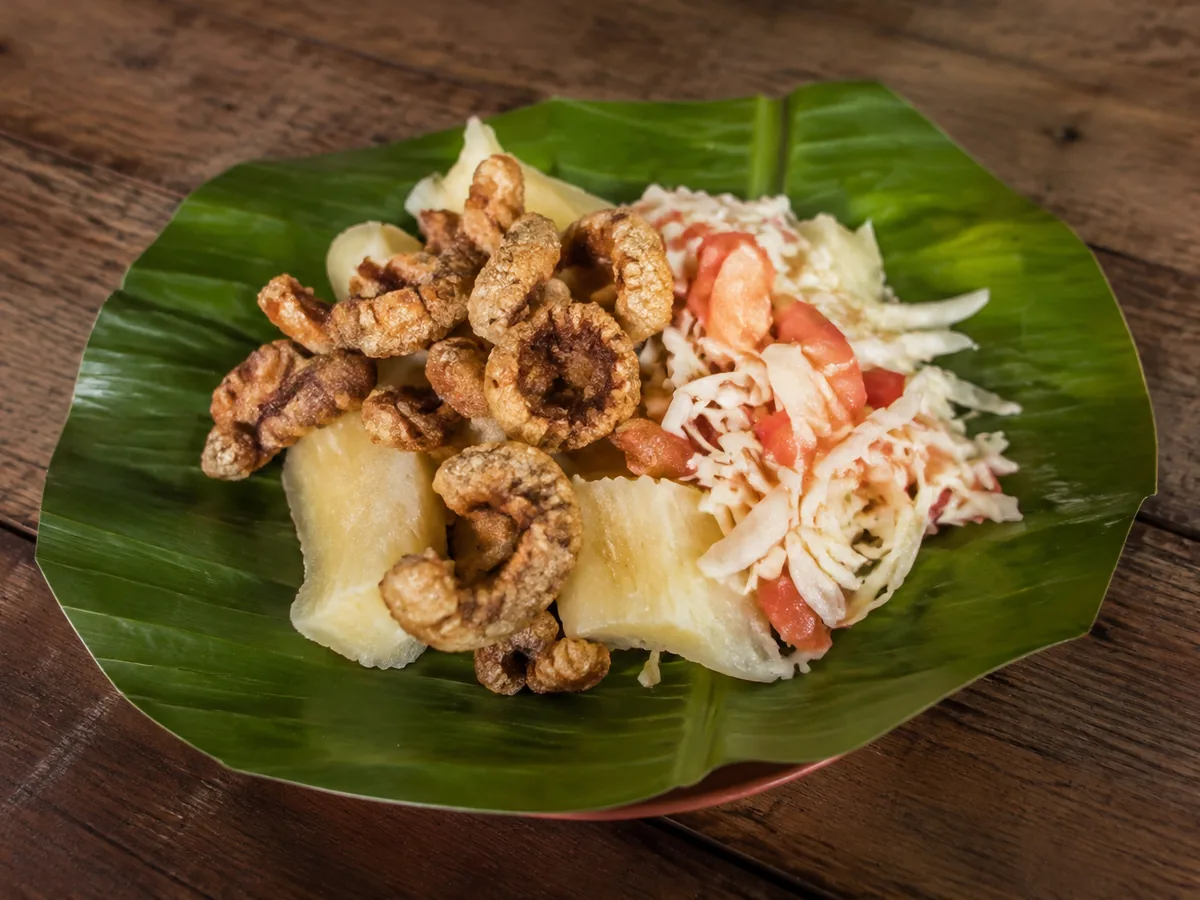
In 1914, beneath the colonial arches of Granada’s central plaza, María Luisa Cisneros Lacayo created vigorón to feed hungry baseball fans coming from the ballpark. A century on, vendors still scoop it straight onto broad fresh banana leaves.
It is built on three contrasting textures. At the bottom, hot freshly boiled yuca that splits into soft starchy boulders. Over it, a generous heap of crisp pork belly crackling. On top, a tart slaw of shredded cabbage, tomato and onion pickled in vinegar and sour mimbro fruit.
You eat it with your fingers, directly off the leaf.
The yuca
- 1.2 kg2.6 lbFresh yuca root, peeled, woody core removed, cut into 8 cm logs
- 20 g1 Tbsp + 1 tspCoarse sea salt, for the boiling water
The pork
- 500 g1.1 lbAuthentic chicharrón de cáscara with the fried meat attached, broken into shards
The curtido
- 400 g½ headGreen cabbage, finely shredded into 2 mm ribbons
- 3 medium3 mediumRipe plum tomatoes, cored and cut into fine 5 mm dice
- 1 medium1 mediumYellow or white onion, cut into fine 4 mm brunoise
- 60 ml¼ cupWhite cane vinegar, or cider vinegar
- 60 ml¼ cupFresh sour orange juice, or lime juice
- 6 pieces6 piecesMimbro fruit, sliced thin, or extra sour orange juice
- 6 g1 tspFine sea salt
- 2 g½ tspFreshly ground black pepper
- 1 fresh1 freshChile congo or habanero, minced fineoptional
To serve
- 4 sheets4 sheetsFresh green banana leaves, washed and cut into 30 × 30 cm squares
Pull the yuca the moment it splits
Past thirty-five minutes the exterior dissolves into starch paste. When the root cracks open down the centre and a knife passes through, it is done.
Salt the water heavily
Cassava absorbs salt as its starches swell, and this is the only chance to season the interior. Boiled in plain water it is simply bland.
Three temperatures, on purpose
Hot yuca, warm crisp pork, cold acidic slaw. The cold vinegar juices drip down through the cracklings and dissolve the surface pork lipids on the palate, which is what stops the plate becoming heavy.
Bruise the cabbage
A minute of tossing by hand breaks the cell walls slightly so the shreds drink the vinegar rather than sitting in it.
Assemble at the very last moment
Wet slaw sitting on cracklings for ten minutes softens them completely. Build each leaf as it goes out.
Chicharrón con carne, not pork rinds
Nicaraguan chicharrón has crisp skin *and* tender meat attached. Puffed pork rinds have no savoury meat layer at all.
Passive time, counted separately
The curtido stands 15 minutes after mixing. That sits outside the times quoted above.
The five tastes on this plate
Salt penetrates the boiled yuca and seasons the cracklings. Fat is rendered pork crackling coating the starch beneath. Acid is cane vinegar, sour orange and tart mimbro against the fat. Heat is raw onion, black pepper and the optional chile congo. Umami is the crackling and the sweet boiled cassava starch.
Equipment
- 8 qt stainless stockpot
- Wide glass bowl
- Baking sheet, to re-crisp the chicharrón
- Tongs
Traditionally a large aluminium pot over charcoal, served on fresh unheated banana leaves. An 8-quart stockpot works in a modern kitchen, and five minutes on a sheet pan at 180 °C restores cracklings that have gone soft.
Method
Boil the yuca30 min
Bring 3 litres of water and the 20 g coarse salt to a rolling boil and drop the yuca logs in.
Boil 25 to 30 minutes until they swell, crack open down the centre and turn fork-tender. Drain thoroughly and keep hot in the covered pot.
Boil 3 litres water with 20 g coarse salt. Add yuca and cook 25–30 minutes until swollen, split centrally and fork-tender. Drain thoroughly as soon as tender; keep hot in the covered pot.
Mix the curtido15 min
Combine the cabbage, tomato, onion and sliced mimbro in a glass bowl, pour over the vinegar and sour orange juice, and season with the salt, pepper and chilli.
Toss by hand for a full minute to bruise the cabbage, then leave 15 minutes.
Combine cabbage, tomato, onion and sliced mimbro in glass. Add vinegar, sour orange, salt, pepper and optional chilli. Toss by hand for a full minute to bruise the cabbage; let stand 15 minutes.
Warm the chicharrón5 min
If the cracklings have cooled, spread them on a baking sheet and give them 5 minutes at 180 °C to crisp back up and render the surface oil.
Use chicharrón with meat attached. If cooled, spread on a baking sheet and heat at 180 °C for 5 minutes until the skin crisps again and surface oil renders.
Build on the leaf
Lay a banana leaf square on each plate and arrange 3 or 4 steaming chunks of yuca in the centre.
Heap the hot crackling over the warm yuca.
Place a banana-leaf square on each plate and arrange 3 or 4 steaming yuca chunks centrally. Heap hot, crisp chicharrón over the yuca immediately before serving.
Crown with curtido
With tongs, lift a generous handful of slaw, letting the excess vinegar drain off, and pile it over the cracklings.
Drizzle two tablespoons of the tart pickling juice over the top and serve immediately — hot yuca, crisp pork, cold slaw.
Lift a generous handful of cold curtido with tongs, draining excess vinegar, and pile over pork. Drizzle with two tablespoons pickling juice; serve immediately while yuca is hot and pork remains crisp.
Sensory cues of doneness
- Visual: snow-white yuca under dark golden cracklings, topped with shredded cabbage and red tomato, all on green leaf.
- Auditory: a glass-like crunch through the crackling, and the soft yield of the yuca.
- Olfactory: steaming cassava, roasted pork fat, sharp cane vinegar and freshly cut cabbage.
Check for white, soft yuca beneath dark-golden cracklings and fresh cabbage-tomato slaw. The pork should crunch sharply while yuca yields easily, with aromas of steamed cassava, roast pork fat and tart cabbage.
Troubleshooting
- Yuca dissolving into paste.
It boiled too long. Pull it the moment it splits open.
- Soft, chewy cracklings.
The wet slaw sat on them. Assemble right before eating.
- Bland cassava.
The water was under-salted. It absorbs salt as the starches swell, and only then.
Substitutions
One-to-one global substitutions, with the technique adjustment each one requires.
Ingredient substitutions
| Ingredient | Replace with | Culinary impact and technique adjustment |
|---|---|---|
| Fresh yuca | Frozen peeled cassava | One-to-one, boiled from frozen in salted water in about 20 minutes |
| Mimbro | Fresh lime juice, or unripe green mango matchsticks | One-to-one. The same mouth-puckering sourness |
| Chicharrón con carne | Crisp fried pork belly chunks, or thick bacon lardons | One-to-one, as long as it genuinely crunches |
Scaling
Half, for 2 portions
Halve everything in a 4-quart pot. The boil stays 25 minutes.
Double, for 8 portions
Double everything in a 14-quart pot so the yuca boils freely without crowding.
What to serve it with
- Chicha de maíz, spiced with clove and vanilla
- Fresco de cacao with roasted rice, milk and cinnamon
- A cold Toña
Questions
What is mimbro?
Bilimbi — an intensely sour cucumber-like fruit that grows in Central America. Sour orange or extra lime juice substitutes perfectly.
Can I use shop pork rinds?
Traditional chicharrón has crisp skin with tender meat attached. Look for "chicharrón con carne" at a Latin butcher rather than puffed rinds.
Can I use frozen yuca?
Yes. It boils in about 20 minutes straight from frozen and splits cleanly.