Carne Desmenuzada
Where Cuban ropa vieja goes savoury and olive-forward, the Nicaraguan version goes *agridulce*. Sour orange, cane sugar and tomato paste together hit acid, sweet and glutamate receptors at once — and the flank is cut with the grain and pulled along it, so the shreds stay long enough to hold the glaze.
- Prep
- 25 min
- Cook
- 1 hr 30 min
- Serves
- 6 portions
- Difficulty
- Medium
Researched · Kitchen testing pending
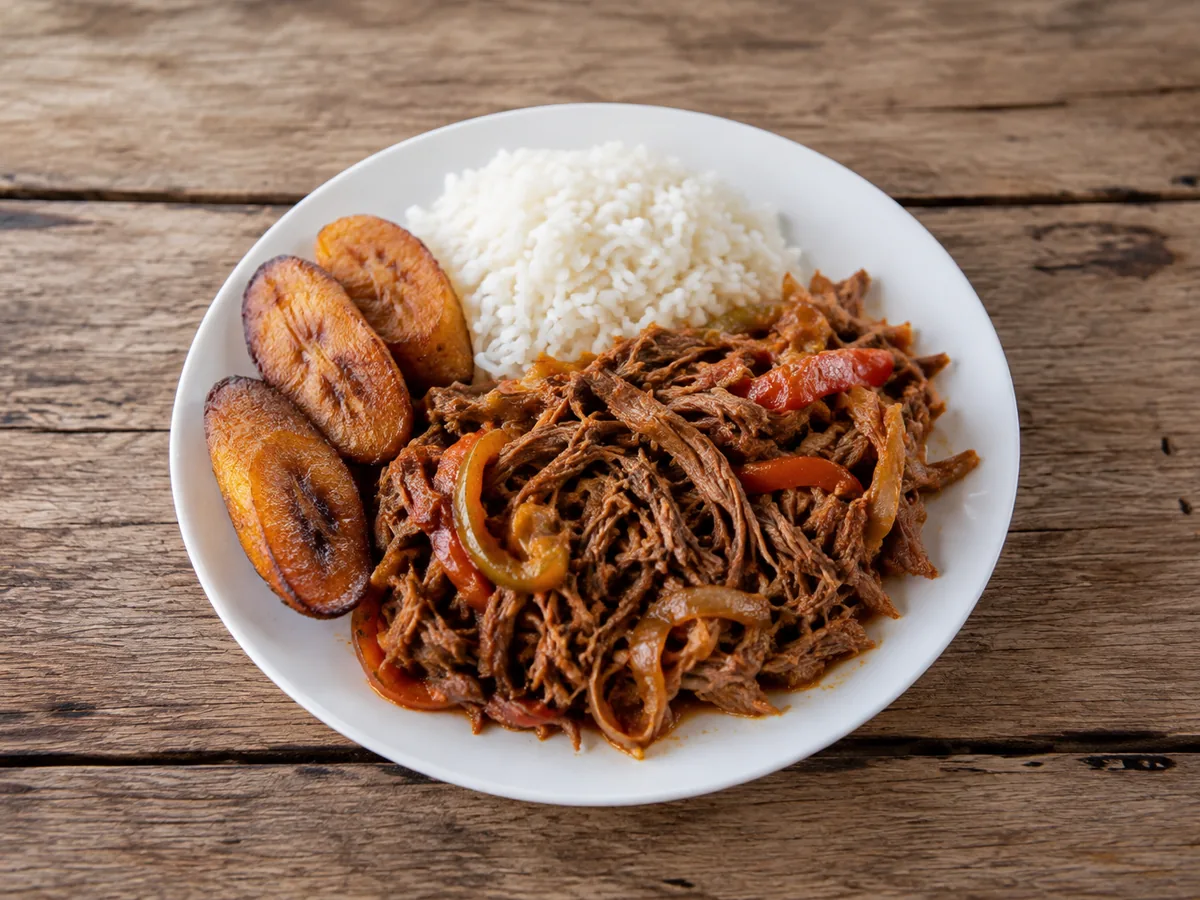
Carne desmenuzada is a centrepiece of Nicaraguan family tables and neighbourhood fritangas. Unlike Cuban ropa vieja, which is savoury and olive-forward, the Nicaraguan version is distinctly sweet and sour.
Flank steak is simmered with garlic and onion until tender, then shredded by hand into thin delicate strands and tossed into a hot skillet with an abundant sofrito of sweet onion, green chiltoma, garlic and ripe tomato.
The sauce is deglazed with sour orange juice, Worcestershire, tomato paste and a touch of cane sugar, and reduced into a glossy red gravy that coats every shred.
The beef
- 1 kg2.2 lbBeef flank steak (falda) or brisket flat, trimmed and cut with the grain into 8 cm slabs
- 1.5 L6.3 cupsCold filtered water
The sofrito
- 45 ml3 TbspRendered pork lard, or vegetable oil
- 2 large2 largeYellow onions — one quartered for the braise, one sliced into thin half-moons
- 6 cloves6 clovesFresh garlic, minced to a paste3 into the braise, 3 into the sofrito
- 2 large2 largeSweet green chiltoma peppers, cored and sliced into thin strips
The sauce
- 4 large4 largeRipe plum tomatoes, peeled, seeded and chopped fine
- 30 g2 TbspDouble-concentrated tomato paste
- 80 ml⅓ cupFreshly squeezed sour orange juice, or 3 parts orange to 1 part lime
- 30 ml2 TbspWorcestershire sauce (salsa inglesa)
- 15 g1 TbspGranulated cane sugar, to balance the sour orange
- 300 ml1.25 cupsThe reserved beef braising broth, hot
The seasoning
- 5 g1.5 tspCumin seeds, freshly toasted and ground
- 3 g1 TbspDried wild oregano, crushed
- 15 g1 TbspFine sea salt10 g into the braise, 5 g into the sauce
- 3 g1 tspCoarsely ground black pepper
To finish
- 20 g⅓ cupFresh cilantro, chopped
Cut with the grain, shred along it
Flank is long parallel myofibrillar bundles. Cut across the grain first and you get chopped meat; cut into 8 cm lengths with it and pull along the fibres, and you get long feathery threads.
Shred while warm
Warm fibres separate into filaments without snapping. Cold, they tear short.
The agridulce is three things at once
Citric acid from the sour orange, sucrose from the cane sugar and glutamates from the tomato paste, together. Drop any one and the balance goes.
Reduce until it clings
This is not a soupy stew. Simmer uncovered until the sauce is a glaze on the meat and there is no liquid pooling.
Fresh sour orange, not bottled juice
Commercial orange juice has none of the bracing acid the balance needs. Fresh naranja agria, or orange cut with lime.
Passive time, counted separately
The beef cools enough to handle before shredding, and the finished pan rests 3 minutes. Neither is active work.
The five tastes on this plate
Salt is the seasoned braise and the Worcestershire in the gravy. Fat is pork lard carrying the sofrito and coating the fibres. Acid is sour orange and ripe tomato. Heat is garlic, toasted cumin, sweet chiltoma and black pepper. Umami is caramelised beef fond, reduced stock, tomato paste and the tamarind in the Worcestershire.
Equipment
- 6 qt Dutch oven, for the braise
- Wide 12 in skillet
- Two forks, for shredding
- Fine strainer
Traditionally an aluminium caldero or cast-iron paila. A 6-quart Dutch oven for the braise and a wide 12-inch skillet for the reduction works in a modern kitchen — the width is what lets the sauce glaze rather than pool.
Method
Braise the flank1 hr 15 min
Combine the beef, 1.5 L cold water, quartered onion, 3 crushed garlic cloves, cumin, oregano, black pepper and 10 g salt.
Boil and skim, then cover partially and simmer low 1 hour 15 minutes until fork-tender. Lift the beef out and strain off 300 ml of the broth.
Cut flank into 8 cm lengths along the grain. Combine with 1.5 L cold water, quartered onion, 3 crushed garlic cloves, cumin, oregano, pepper and 10 g salt. Boil, skim and simmer low, partially covered, 1 hour 15 minutes until fork-tender. Remove beef; strain and reserve 300 ml broth.
Shred while warm12 min
While still warm, pull the flank along its natural grain into thin feathery threads, discarding any tough gristle.
Let beef cool only enough to handle, then pull along its natural grain into long, fine threads while still warm. Discard tough gristle as you shred.
Sauté the sofrito8 min
Heat the lard in the skillet over medium and sauté the sliced onion, chiltoma strips and remaining garlic 6 to 8 minutes until soft and translucent.
Heat lard over medium. Sauté sliced onion, chiltoma strips and the remaining 3 garlic cloves for 6–8 minutes until the vegetables are soft and translucent.
Build the sweet-and-sour sauce5 min
Add the chopped tomato, tomato paste, sugar, Worcestershire and 5 g salt, and cook over medium 5 minutes until the tomatoes break down into a thick glossy red paste.
Add chopped tomato, tomato paste, sugar, Worcestershire and the remaining 5 g salt. Cook over medium for 5 minutes until the tomatoes collapse into a thick, glossy red paste.
Glaze the beef15 min
Add the shredded beef and toss to coat every fibre, then pour in the 300 ml broth and the 80 ml sour orange juice.
Simmer uncovered on medium-low 12 to 15 minutes, stirring occasionally, until the liquid reduces into a glossy gravy that clings.
Toss shredded beef through the sauce, then add 300 ml reserved broth and 80 ml fresh sour orange juice. Simmer uncovered over medium-low 12–15 minutes, stirring occasionally, until the sauce clings without pooling.
Garnish
Off the heat, scatter the cilantro over and rest 3 minutes before serving hot.
Remove the skillet from the heat, scatter cilantro over the glazed beef and let it rest for 3 minutes before serving the meat hot.
Sensory cues of doneness
- Visual: a glistening reddish-orange tangle of tender shreds coated in thick sauce, flecked with tomato and green pepper, with no watery liquid pooling.
- Auditory: a lively sizzle as the beef hits the sofrito, settling into a quiet thick simmer.
- Olfactory: caramelised beef, sweet cooked onion, green chiltoma, toasted cumin, garlic and bright sour orange.
Check for tender reddish-orange shreds evenly coated in thick, glossy sauce, without watery pools. The simmer should be quiet and thick, with aromas of beef, cooked onion, chiltoma, cumin, garlic and sour orange.
Storing it
Freezes exceptionally well in its sauce for up to 3 months. Thaw and warm in a skillet with a splash of water.
Troubleshooting
- Chopped meat instead of shreds.
It was cut across the grain before braising. Cut with it, then pull along the fibres.
- A watery, soupy pan.
It was not reduced. Simmer uncovered until the sauce clings to the meat.
- A flat, sweet sauce.
Bottled sweet orange juice was used. It needs fresh sour orange, or orange with lime.
Substitutions
One-to-one global substitutions, with the technique adjustment each one requires.
Ingredient substitutions
| Ingredient | Replace with | Culinary impact and technique adjustment |
|---|---|---|
| Sour orange | 3 parts fresh orange juice to 1 part lime | One-to-one. The same tart-sweet acidity |
| Flank steak | Skirt steak, or brisket flat | One-to-one. Both give long tender shreds |
| Green chiltoma | Green bell pepper, or Italian frying pepper | One-to-one. The same sweet vegetal aroma |
Scaling
Half, for 3 portions
Halve everything in a 10-inch skillet. The reduction stays 12 to 15 minutes.
Double, for 12 portions
Double everything in a wide 14-inch sauté pan or a Dutch oven.
What to serve it with
- Hot gallo pinto
- Fried sweet plantain slices
- Shredded cabbage and tomato salad in vinegar
- Fresco de grama, or a cold Toña
Questions
Which cut is best?
Flank, for its long distinct grain. Skirt or brisket flat also work well.
Pressure cooker?
Yes — 35 minutes on high with a natural release, and it shreds effortlessly.
Does it freeze?
Exceptionally well, in its sauce, for up to 3 months.