Pastel de Tres Leches
A pale sponge that only becomes itself after it drinks a cold bath of evaporated milk, condensed milk and whole milk, then sits until the crumb is heavy and cold. The soak is the method, not a garnish — overpour and you get soup, underpour and you get dry cake with a wet top.
- Prep
- 45 min
- Cook
- 30 min
- Serves
- One 23×33 cm / 9×13 in cake, about 12–15 squares
- Difficulty
- Medium
Researched · Kitchen testing pending
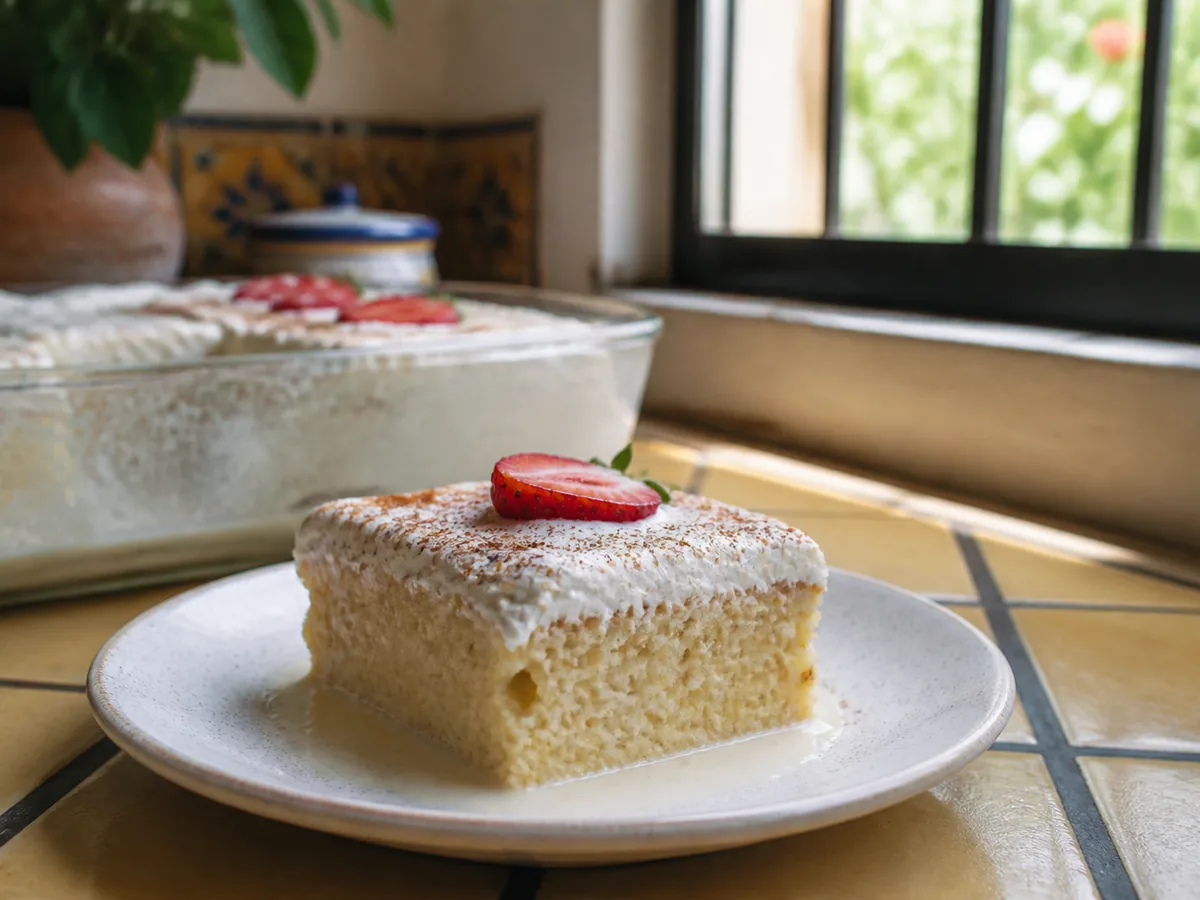
Pastel de tres leches is a pale sponge that only becomes itself after it drinks a cold bath of evaporated milk, condensed milk, and whole milk, then sits until the crumb is heavy and cold. The soak is the method, not a garnish. Overpour and you get soup; underpour and you get dry cake with a wet top.
This recipe runs on timers, temperatures and reasons. Metric first, US in parentheses. If your cake has ever turned to soggy mush, or stayed dry in the centre, the troubleshooting section is for you.
Sponge cake (structure for soaking)
- 160 g1¼ cupsAll-purpose flour
- 1½ tsp1½ tspBaking powder
- ¼ tsp¼ tspFine salt
- 5 large5 largeEggs, separated, at cool room temperatureabout 18–20 °C / 65–68 °F
- 200 g1 cupGranulated sugar, divided
- 80 ml⅓ cupWhole milk
- 1 tsp1 tspVanilla extract
- ½ tsp½ tspGrated lime zestoptional, for a quiet citrus lift — not traditional everywhere; it suits a cake served with berries
Tres leches soak
- 354 ml12 ozEvaporated milk1 standard can
- 397 g14 ozSweetened condensed milk1 standard can
- 240 ml1 cupWhole milkor 180 ml / ¾ cup whole milk + 60 ml / ¼ cup heavy cream for a richer bakery-style soak
- Pinch of fine salt
- 1–2 Tbsp1–2 TbspDark rum or brandyoptional labelled departure, stirred into the cold soak — omit for children's parties and for the classic bakery profile
Topping — whipped cream (common at home and in many bakeries)
- 480 ml2 cupsCold heavy cream
- 30–40 g2–3 TbspPowdered sugarto taste
- 1 tsp1 tspVanilla extract
Topping — soft meringue (older bakery style in some regions)
- 3 large3 largeEgg whites
- 100 g½ cupGranulated sugar
- Pinch of cream of tartar, or ½ tsp lemon juice
- Torch, optional, for light browning
Finish
- Ground cinnamon, maraschino cherries, or sliced strawberries
- Fresh lime zest, optional
Choose one topping
Whipped cream or soft meringue, not both. Whipped cream holds better past day one; meringue weeps if the cake sits, so plan to serve it within a day.
Why a pale sponge
You need an open crumb and set egg foam, not a deep crust that blocks liquid. Pull the cake when the top is set and only faintly gold at the edges.
Passive time, counted separately
The cake cools 30–40 minutes before soaking, and then chills at least 4 hours and ideally overnight. That is hands-off and sits outside the times quoted above: hands-on work is under an hour, while the clock time from starting the batter to slicing runs about 5½–8 hours.
Equipment
- 23×33 cm / 9×13 in metal baking pan — glass runs cooler, so add a few minutes
- Mixer
- Two bowls and a whisk
- Toothpick or skewer
- Measuring jug
- Offset spatula
- Fridge space
Method
Prep the pan and oven5 min
Heat the oven to 175 °C / 350 °F, with a rack in the middle. Grease the pan lightly, then line the bottom with parchment if you like easy lifts. For tres leches, greasing and flouring and leaving the cake in the pan to soak is the better route, because the milk needs walls to hold it.
Metal pans brown a little faster and give a more even sponge. If you only have glass, start checking at 28 minutes.
Heat oven to 175 °C / 350 °F with the rack centred. Lightly grease and flour the pan, leaving the cake in it for soaking; optional parchment eases lifting. For glass pans, begin checking at 28 minutes.
Dry mix and yolks8 min
Whisk the flour, baking powder and salt in a bowl and set it aside.
In a large bowl, beat the egg yolks with half the sugar, 100 g (½ cup), on medium-high until the mixture is thick, pale yellow, and falls from the whisk in a slow ribbon — about 3–4 minutes. Beat in the milk and vanilla.
The ribbon stage means enough air and dissolved sugar for the sponge to rise without collapsing into eggy rubber.
Whisk flour, baking powder and salt together. Beat yolks with 100 g (½ cup), half the sugar, on medium-high for 3–4 minutes until pale, thick and ribboning. Beat in milk and vanilla.
Whip the whites5–7 min
In a clean, grease-free bowl, whip the egg whites on medium until foamy. Gradually add the remaining 100 g (½ cup) sugar while whipping, to medium-stiff glossy peaks — peaks that hold but still curl slightly at the tip.
Over-whipped whites look dry and chunky and fold into lumps; under-whipped whites leave the cake dense. Stop when the meringue looks like shaving foam with a soft bend.
In a clean, grease-free bowl, beat whites on medium until foamy. Gradually add the remaining 100 g (½ cup) sugar. Stop at glossy medium-stiff peaks with slightly curled tips, before the whites become dry or clumpy.
Fold and bake25–32 min
Sift or sprinkle the flour mix over the yolk batter and fold gently until almost combined. Add one-third of the whites to loosen, then fold in the rest in two additions. Use a spatula: cut down the centre, scoop under, turn the bowl. Stop when no white streaks remain but the batter still looks airy and pourable — overfolding kills the lift.
Scrape it into the pan and smooth the top lightly. Do not bang the pan hard, or you knock out the bubbles.
Bake 25–32 minutes. It is done when the centre springs back to a light touch, a toothpick comes out clean or with a few dry crumbs, and the top is pale with just a hint of gold at the rim. The internal temperature near the centre lands around 93–96 °C / 200–205 °F if you check. If the top is deep brown you went too far, and the crust will resist soaking.
Cool the cake in the pan on a rack 30–40 minutes, until warm-room: a hot cake can scramble the dairy soak into a strange texture, and an ice-cold cake soaks unevenly.
Gently fold flour mixture into yolks, then one-third of whites, followed by remaining whites in two additions. Stop when streak-free and airy. Transfer to pan without banging. Bake 25–32 minutes until pale, springy and a toothpick emerges clean; centre about 93–96 °C / 200–205 °F. Cool in pan on a rack 30–40 minutes until barely warm.
Mix the cold soak3 min
Whisk the evaporated milk, condensed milk, whole milk (or milk and cream) and the pinch of salt until uniform and cold from the fridge ingredients.
Taste: sweet, milky, slightly salty so it is not flat. If you are using the rum departure, stir it in now, and say so when you serve — "tres leches with a little rum" keeps the classic clear.
Why a cold soak: warm dairy can make the crumb gummy. Cold liquid enters slowly and sets as the cake chills.
Whisk cold evaporated milk, condensed milk, whole milk or milk-and-cream, and salt until uniform. Taste for sweetness and balance. Stir in optional rum or brandy now and disclose it when serving; omit alcohol for children.
Poke and soak10 min active, then chill
Poke the cake all over with a skewer or fork — holes every 1–1.5 cm (about ½ in), going most of the way to the bottom but not tearing the slab apart.
Pour the soak slowly in passes: first over the whole surface, wait 2–3 minutes for absorption, then pour again, tilting the pan so the corners get their share. You may not need every last drop; reserve 60–80 ml (¼–⅓ cup) if the cake already looks glossy and heavy with liquid sitting in a thin sheen.
A good soak looks wet on top without a lake deeper than a few millimetres. If a puddle remains after 15 minutes, spoon it back over the dry spots, or hold some back — do not force a flood.
Cover and refrigerate at least 4 hours, overnight preferred. The cake will firm slightly as the starch and protein set around the milk, turning from "wet sponge" to "sliceable milk cake."
Poke holes every 1–1.5 cm (about ½ in), nearly to the bottom. Pour cold soak in passes, waiting 2–3 minutes between pours and tilting toward corners. Hold back 60–80 ml (¼–⅓ cup) if saturated. After 15 minutes, redistribute puddles over dry spots rather than flooding. Cover and refrigerate at least 4 hours, preferably overnight.
Top before serving10–15 min
Whipped cream: whip the cold cream, powdered sugar and vanilla to soft-medium peaks — spreadable, not stiff butter. Spread it over the cold cake. Dust with cinnamon, or add cherries or strawberries.
Meringue: whip the pasteurized whites with cream of tartar to soft peaks, stream in the sugar, and whip to glossy medium-stiff peaks. Spread in peaks and swirls. Toast quickly with a torch if you like, keeping the interior soft. Meringue weeps if the cake sits for days, so plan to serve within a day if you choose it.
Slice with a sharp knife, wiped between cuts. The crumb should be uniformly moist and sweet, and still hold a square shape on the plate — not a milk soup, and not a dry centre with wet edges.
Choose one topping. Whip cold cream, powdered sugar and vanilla to soft-medium peaks; spread on cold cake and garnish. For meringue, use pasteurized whites: whip with cream of tartar to soft peaks, add sugar gradually and beat glossy medium-stiff. Spread, optionally torch briefly, and serve within a day. Slice with a sharp knife wiped between cuts.
Storing it
Keep it covered and refrigerated. Best within 48 hours, and still good to day 3–4 as the crumb softens further. Whipped cream holds better than meringue past day one. Do not freeze the fully soaked assembled cake if you care about clean texture — ice crystals wreck the sponge. You can freeze the unsoaked baked sponge, wrapped well, up to a month; thaw it in the pan, then soak and chill as usual. Never leave tres leches at room temperature more than about 2 hours; dairy and eggs want the fridge.
Troubleshooting
- The cake is dry in the centre after chilling.
The holes were too shallow or too sparse, or you held back too much soak. Next time poke deeper and pour in three passes. For this cake, poke again, drizzle the reserved soak into the dry zone, and chill another 2 hours.
- The cake collapsed into mush, or oversoaked.
You poured a standing lake and left it, or the sponge was underbaked and fragile. Use a properly baked pale sponge and pour gradually. If it is already mush, freeze scoops and call it a frozen milk dessert, or serve it in cups with extra whipped cream and stop calling it a clean slice. Prevention beats rescue.
- A dense, eggy sponge.
The whites were under-whipped or folded too aggressively, or the oven was too hot and the cake set before rising. Whip to glossy medium-stiff, fold gently, and confirm the oven temperature with a thermometer — home ovens lie.
- A gummy layer on the bottom.
The cake was hot when soaked, or the pan sat in a cold wet bath of unabsorbed milk for days. Soak at warm-room temperature, pour measured passes, and chill uncovered 20 minutes before covering so steam does not get trapped.
- The top browns too fast.
The oven runs hot, or the pan sat too high. Tent loosely with foil after 15 minutes next time, or drop to 165 °C / 330 °F and add a few minutes. Pale is correct for soaking.
- The whipped cream weeps on day two.
The sugar was low, or the cream was overwhipped and then relaxed. Stabilise with 1 tsp cornflour whisked into the sugar, or a spoon of instant pudding mix if you need picnic stability. Spread closer to serving when you can.
- The meringue beads or weeps.
Humidity, or undercooked sugar in the foam. Serve sooner, or switch to whipped cream for make-ahead trays.
- Too sweet.
Condensed milk dominates. Use the whole-milk version of the soak rather than cream, a pinch more salt, and unsweetened whipped cream. Lime zest on top cuts sweetness without changing the classic identity.
- Not sweet enough, or bland.
Your condensed milk brand varies, or you used low-fat evaporated milk. Full-fat dairy matters. A dusting of cinnamon and a cherry reads as bakery-correct and helps aromatically.
Substitutions
Traditional, the Mexican bakery classic: a light sponge from whipped eggs; a soak of evaporated, condensed and whole milk; a long cold chill; a whipped cream or soft meringue topping; a cinnamon or cherry finish. Served cold in squares. Not flan, which is custard. Not churros, which are fried dough. And not a tres leches "cake mix dump" without structure.
Accepted home variation
A splash of cream in the soak for a richer mouthfeel, lime zest in the batter, a strawberry topping. Still tres leches when the three milks and the sponge logic hold.
Labelled departure — rum or brandy
1–2 Tbsp in the cold soak for adult tables. Say it out loud. Skip it for school parties, and for anyone who wants the pure milk profile.
Departures this page does not lead with
A chocolate sponge, coconut milk as the main soak, or ultra-thick butter cakes. Those can be tasty projects; they are not this cake's identity.
Scaling
Round pans
Two 20 cm (8 in) rounds work. Divide the batter, reduce the bake time by a few minutes, and soak carefully so the filling does not wash out if you stack them. The sheet pan is the better shape for even soaking and bakery-style squares.
What to serve it with
Serve cold, straight from the fridge. This is celebration cake: birthdays, Sunday lunch, the tray you bring when someone says "bring dessert."
- Small plates and forks
- Espresso, or café de olla
- A dusting of cinnamon, cherries, or sliced strawberries
Keep the toppings simple so the three milks stay the star. If you used rum, mention it once so no one is surprised.
Questions
Can I make it in round pans?
Yes — two 20 cm (8 in) rounds work. Divide the batter, reduce the bake time by a few minutes, and soak carefully so the filling does not wash out if you stack them. The sheet pan is the better shape for even soaking and bakery-style squares.
Why separate the eggs?
Yolks give richness and ribbon structure; whites give the foam lift that creates a soak-friendly crumb. Whole-egg sponges can work but are less forgiving for this dessert.
Can I use only two milks?
You can, but then it is not tres leches. The evaporated brings cooked-milk depth, the condensed brings sweetness and body, and the whole milk or cream brings the fluidity that lets the soak penetrate. All three earn their place.
Can I make it gluten-free?
A 1:1 gluten-free flour blend with xanthan can work; expect a slightly more fragile crumb, so poke gently and soak in lighter passes. Treat the timing as a guide and watch the spring-back test.
Can I make it dairy-free?
Not this recipe's promise. The name is the method. Look for a different dessert rather than forcing oat milk into a classic that depends on dairy proteins and lactose sweetness.
How do I know I did not oversoak?
After chilling, a slice should glisten and dampen the plate lightly without collapsing when moved. If liquid pools around the square in a puddle, you overdid it; if the centre crumb looks matte and tastes like plain sponge, you underdid it.
Can I soak it overnight on the counter?
No. Refrigerate. Food safety and texture both want cold.
Metal or glass pan?
Metal is the default for an even bake and a pale top. Glass needs a few extra minutes and sometimes browns the bottom more; put glass on the middle rack and start checking later.