Rice and Peas
The Sunday side that every braise on this list sits on. Kidney beans boiled with garlic and pimento until the water runs red, then coconut milk, scallion and thyme, long-grain rice, and a whole Scotch bonnet resting on top while the pot steams under a foil seal.
- Prep
- 20 min
- Cook
- 45 min
- Serves
- 8 side portions
- Difficulty
- Medium
Researched · Kitchen testing pending
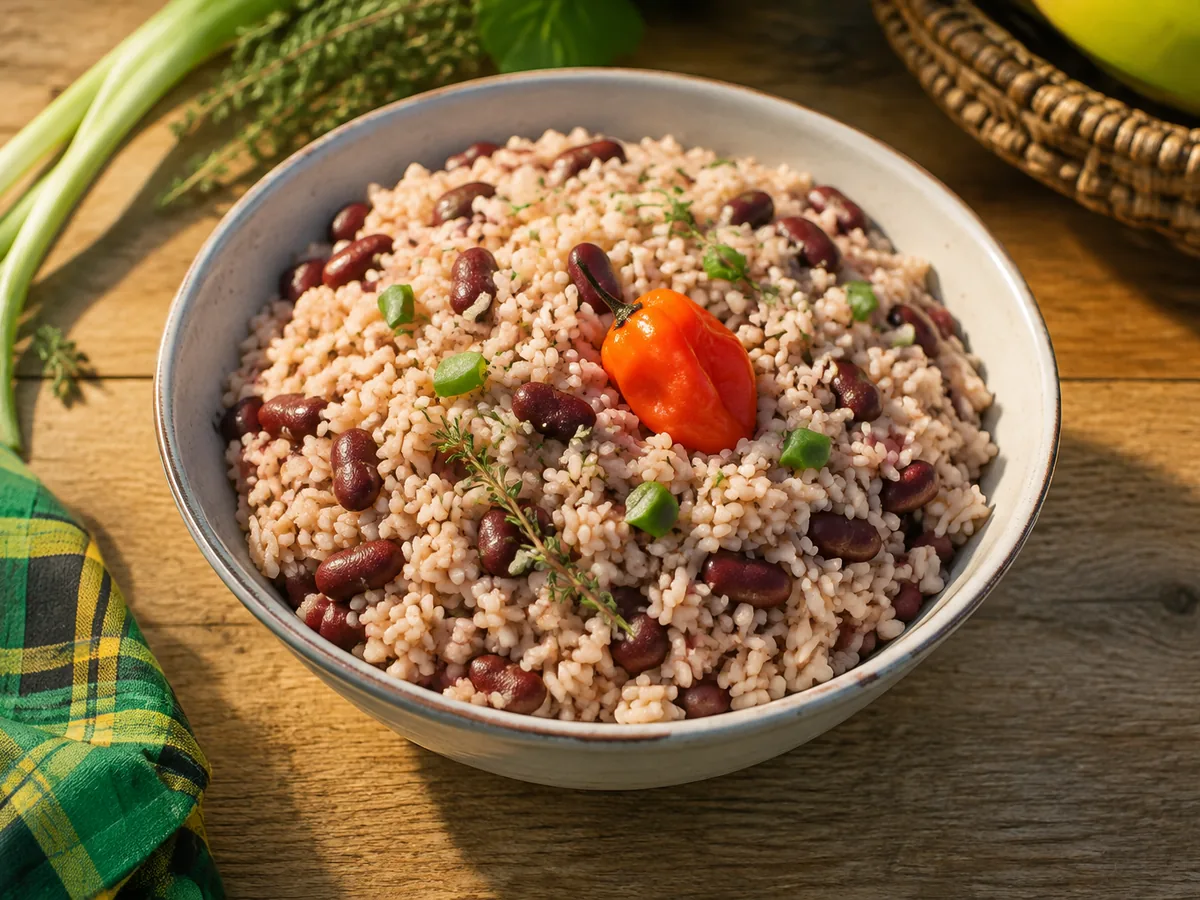
Sunday dinner in Jamaica lives or dies by the pot of rice and peas. The peas are dried red kidney beans, or fresh green gungo peas around Christmas. They boil with garlic and pimento until the water turns deep red, then coconut milk, bruised scallion, thyme and salt go in, and the rice on top of that.
A whole Scotch bonnet rests on the grains like a crown. The pot is sealed tight with foil and left on the lowest flame, and as the rice steams it drinks in the coconut fat and bean broth, coming out in fluffy, separate, savoury grains that carry the perfume of thyme and pepper without any of the burn.
- 250 g1¼ cups driedDried red kidney beans, picked over and soaked overnightor two 15 oz cans, undrained
- 1 L4.2 cupsCold water, for boiling the beans
- 400 ml1 can (13.5 oz)Full-fat unsweetened coconut milk
- 500 g2½ cupsLong-grain white rice, parboiled or jasmine, rinsed until the water runs clear
- 4 stalks4 stalksScallions, crushed flat with the side of a knife
- 4 cloves4 clovesGarlic, crushed flat
- 6 sprigs6 sprigsFresh thyme, tied with twine
- 8 whole8 wholePimento (allspice) berries, lightly crushed
- 1 whole1 wholeGreen or red Scotch bonnet pepper, whole with the stem on and no tears in the skin
- 10 g2 tspFine sea salt
- 3 g1 tspCoarsely ground black pepper
- 30 g2 TbspUnsalted butter
Why the grains stay separate
Long-grain rice is about a fifth amylose. Boiled in plain water with stirring, that amylose leaches out and glues the grains together. Coconut milk is an oil-in-water emulsion, and as the rice swells its fats coat every kernel, so neighbouring grains cannot fuse.
The pepper is perfume, not heat
Rested whole on top of the rice with its skin unbroken, the Scotch bonnet releases its volatile esters into the rising steam and none of its capsaicin. One tear in the skin changes that.
One knuckle of liquid
When the rice goes in, the liquid should sit about 1.5 cm above it. More than that and the rice turns soggy.
The five tastes on this plate
Salt is dissolved into the liquid before the rice goes in, so it seasons every grain. Fat is coconut milk and butter. Acid is mellow, left to the braises served alongside. Heat is the pepper's aroma, allspice and bruised scallion. Umami is the red bean broth and the slow-cooked alliums.
Equipment
- 5 to 6-quart enamelled cast-iron Dutch oven or heavy pot with a tight lid
- Aluminium foil
- Large fork, for fluffing
A sheet of foil crimped under the lid makes an airtight seal that traps the steam so the top layer cooks at the same rate as the bottom. Traditionally the Dutchie is sealed with brown paper over low coals.
Method
Boil the beans50 to 60 min
Drain the soaked beans. Put them in the Dutch oven with 1 litre cold water, the crushed garlic and the crushed pimento. Bring to a boil, then reduce to medium-low, cover, and simmer 50 to 60 minutes until the beans are tender but still hold their shape. You should have about 2 cups of dark red cooking liquid; top up with water if it is low.
Drain overnight-soaked beans; add 1 L cold water, garlic and pimento. Boil, reduce to medium-low and cover; simmer 50–60 minutes until tender but intact. Keep about 2 cups cooking liquid, topping up with water if low.
Build the coconut liquid5 min
Pour the coconut milk into the pot with the beans and their liquid. Add the crushed scallions, thyme bundle, salt, black pepper and butter. Bring to a lively boil over medium-high and boil 5 minutes so the scallion and thyme infuse. Taste: it should be pleasantly salty and fragrant. Add another half teaspoon of salt if it is bland.
Add coconut milk, crushed scallions, tied thyme, salt, pepper and butter to beans and broth. Boil briskly over medium-high for 5 minutes. Taste; if bland, add another ½ teaspoon salt.
Add the rice and the pepper1 min
Add the rinsed rice and stir once to distribute the beans. The liquid should sit about 1.5 cm, a knuckle's depth, above the rice. Rest the whole Scotch bonnet on top in the centre.
Add rinsed rice and stir once to distribute beans. Liquid should stand about 1.5 cm above the rice. Place the whole, unbroken Scotch bonnet in the centre.
Boil down the free liquid6 to 8 min
Leave the pot uncovered over medium heat until the liquid drops level with the rice and steam holes appear across the surface.
Leave uncovered over medium heat for 6–8 minutes, until liquid reaches rice level and steam holes appear across the surface; avoid further stirring.
Seal and steam25 min
Turn the heat to its lowest. Lay foil over the pot and press the lid down firmly over it to lock in the steam. Cook undisturbed 25 minutes. Do not lift the lid.
Reduce heat to its lowest. Cover the pot with foil and press the lid firmly over it. Steam undisturbed for 25 minutes without lifting the lid.
Fluff and rest5 min
Take the pot off the heat and remove the lid and foil. Lift out the whole pepper without bursting it, and discard the thyme stems and scallions. Fluff from the bottom with a large fork to separate the grains and spread the beans. Cover and rest 5 minutes.
Remove from heat and uncover. Lift out the pepper without bursting it; discard thyme stems and scallions. Fluff gently from the bottom with a fork, cover and rest 5 minutes.
Sensory cues of doneness
- Visual: fluffy pale-pink grains speckled with dark red beans, scallion strands and thyme, falling separate from the fork.
- Auditory: a gentle, dry crackle from the pot floor in the last 3 minutes as the free liquid is absorbed.
- Olfactory: sweet coconut milk, boiled kidney beans, thyme, allspice and Scotch bonnet.
Look for fluffy pale-pink grains that separate from the fork, with whole red beans. A faint dry crackle in the final 3 minutes signals absorbed liquid; expect coconut, thyme and allspice aromas.
Troubleshooting
- The rice is fiery.
The pepper was punctured. Keep it whole, rest it on top, and lift it out intact.
- Soggy, sticky rice.
Too much liquid, or the rice was not rinsed. Keep the liquid 1.5 cm above the rice and rinse away the surface starch first.
- Hard beans in cooked rice.
The rice went in before the beans were tender. Rice takes 25 minutes; beans take an hour. The beans must be soft first.
Substitutions
One-to-one swaps, with the technique change each one needs.
Ingredient substitutions
| Ingredient | Replace with | Culinary impact and technique adjustment |
|---|---|---|
| Dried red kidney beans | Canned kidney beans, or gungo (pigeon) peas | One-to-one. Canned beans cut the prep time sharply |
| Long-grain rice | Jasmine or basmati | One-to-one. Jasmine comes out fragrant and a little softer |
| Scotch bonnet | Habanero | One-to-one. Keep it completely whole |
Scaling
Half, for 4
Halve everything in a 3-quart saucepan. Steaming stays at 25 minutes.
Double, for 16
Double the ingredients in a 10 to 12-quart Dutch oven, and make sure the burner is wide enough to heat the whole base evenly.
What to serve it with
- Jerk chicken, oxtail or curry goat, its Sunday partners
- Fried ripe plantains
- Steamed cabbage with carrots
- Ting, sorrel or Red Stripe
Questions
Can I use canned beans?
Yes. Two 15 oz cans with their liquid, plus the coconut milk, a cup of water and the seasonings. Boil 5 minutes before adding the rice and steam as directed.
Can I use brown rice?
Yes, with an extra cup and a half of water and 45 minutes of steaming instead of 25.
Why foil under the lid?
It makes an airtight seal so the steam stays in and the top layer of rice cooks at the same rate as the bottom without drying out.