Yuca con Chicharrón
Cassava boiled in heavily salted water until internal pressure splits it open along its own longitudinal seams — and then drained the instant it does, because left sitting in the hot water the starches retrograde into glue. Over it goes pork belly fried in two phases into glass-like crackling.
- Prep
- 25 min
- Cook
- 35 min
- Serves
- 4 generous platters
- Difficulty
- Easy
Researched · Kitchen testing pending
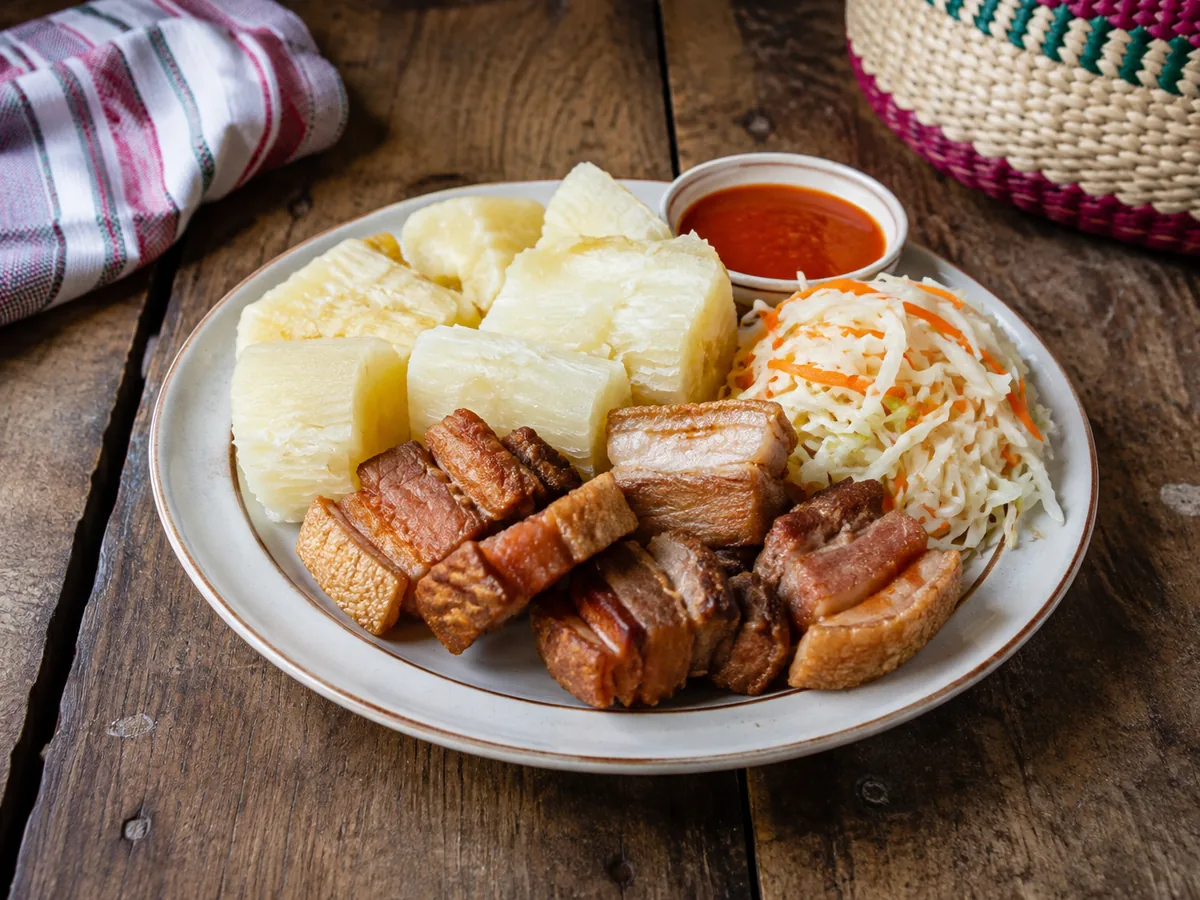
In the open-air market stalls of El Progreso and Comayagua, huge enamel platters overflow with yuca con chicharrón.
Fresh cassava is peeled, cut into thick logs and boiled in salted water until it swells and bursts open along its natural fissures, fork-tender and snow-white. Piled over the warm yuca goes a mountain of finely shredded green cabbage, and over that, hot freshly fried pork belly cut into crunchy golden nuggets.
The whole plate is then smothered in warm cooked tomato and pepper salsa criolla, topped with bright pink pickled onions and a squeeze of lime.
The yuca
- 1.2 kg2.6 lbFresh yuca root, peeled, woody ends trimmed, cut into 8 cm logs
- 20 g1 Tbsp + 1 tspCoarse sea salt, for the boiling water
The chicharrón
- 800 g1.76 lbFresh pork belly with the skin on, cut into 3 cm chunks
- 200 ml¾ cup + 1 TbspWater, for the initial render
- 4 cloves4 clovesFresh garlic, crushed to a paste
- 5 g1 tspCumin seeds, freshly toasted and ground
- 8 g1.5 tspFine sea salt
- 2 g½ tspFreshly ground black pepper
- 500 ml2.1 cupsRendered pork lard, or frying oil
The salsa criolla
- 4 large4 largeRipe plum tomatoes, peeled, seeded and puréed
- 1 medium1 mediumYellow onion, finely diced
- 1 medium1 mediumSweet green bell pepper, finely diced
- 30 ml2 TbspAchiote oil
- 15 ml1 TbspWhite cane vinegar
To finish
- 400 g½ headGreen cabbage, shredded paper-thin on a mandoline
- 240 ml1 cupEncurtido — pickled red onions with vinegar and habanero
- 2 large2 largeFresh limes, halved
Drain the moment it cracks
As the cells swell past 85 °C the internal pressure fractures the tuber along its seams. Leave it sitting in the hot water after that and the starches retrograde into something waterlogged and slimy.
Salt the water generously
20 g of coarse salt to 2.5 litres. Cassava is dense and bland, and this is the only chance to season it right through.
Two phases for the crackling
Simmering in a little water with garlic and cumin cooks the meat and renders the subcutaneous fat. Only once that water has gone does 180 °C lard vaporise the skin moisture into the steam bubbles that make crackling.
Below 160 °C the skin stays rubber
There is no gradual version of this. The skin either reaches puffing temperature or it does not.
Shred the cabbage paper-thin
Thick slaw stays chewy. Paper-thin, it wilts slightly under the warm salsa and becomes part of the plate.
Passive time, counted separately
The shredded cabbage crisps 2 minutes in ice water and drains dry. That sits outside the times quoted above.
The five tastes on this plate
Salt penetrates the dense boiled yuca and seasons the cracklings. Fat is rendered pork belly and crackling skin against the neutral cassava. Acid is cane vinegar in the pickled onions and lime straight through the pork fat. Heat is garlic, toasted cumin, black pepper and the encurtido. Umami is fried pork fond, cooked tomato salsa and boiled yuca starch.
Equipment
- 6 qt saucepan
- 5 qt Dutch oven with a deep-fry thermometer
- Saucepan, for the salsa
- Mandoline
- Colander and tongs
Traditionally a heavy aluminium pot for the yuca and a cast-iron paila for the chicharrón. A 6-quart saucepan and a 5-quart Dutch oven with a thermometer work in a modern kitchen — the thermometer is there for the 180 °C the skin needs.
Method
Boil the yuca25 min
Cover the yuca logs with cold water by 3 cm and add the 20 g coarse salt.
Boil hard 20 to 25 minutes until the yuca swells, cracks open along its seams, and a knife goes through with no resistance. Drain immediately, pull out any tough central cords, and keep warm.
Cover yuca by 3 cm with cold water and add 20 g coarse salt. Boil hard 20–25 minutes until swollen, split and easily pierced. Drain immediately, remove tough central cords and keep warm.
Fry the chicharrón24 min
Season the pork belly with the garlic paste, cumin, black pepper and 8 g salt, and boil in the Dutch oven with 200 ml water 12 minutes until the water goes and the pork spatters in its own fat.
Add the 500 ml lard to submerge it and fry at 180 °C for 10 to 12 minutes, turning, until the skin puffs into golden crisp bubbles. Drain on paper towel.
Season pork with garlic, cumin, pepper and 8 g salt. Boil with 200 ml water 12 minutes until water evaporates and pork fries in its fat. Add 500 ml lard to submerge; fry at 180 °C 10–12 minutes, turning, until skin puffs crisp and golden. Drain on paper.
Cook the salsa criolla14 min
Sauté the onion and green pepper in the achiote oil 4 minutes.
Add the puréed tomato, the vinegar, ½ tsp cumin, black pepper and 1 tsp salt, and simmer on medium-low 10 minutes until thick and glossy.
Sauté the onion and green pepper in the achiote oil 4 minutes.
Add the puréed tomato, the vinegar, ½ tsp cumin, black pepper and 1 tsp salt, and simmer on medium-low 10 minutes until thick and glossy.
Shred and crisp the cabbage5 min
Shred the cabbage paper-thin, rinse it in ice water 2 minutes to crisp, and drain completely dry.
Shred the cabbage paper-thin, rinse it in ice water 2 minutes to crisp, and drain completely dry.
Build the platter
Lay the warm yuca logs across each platter and heap shredded cabbage over them.
Mound the hot crackling on top, ladle over the warm salsa criolla, crown with a spoonful of pink encurtido, and serve with lime halves.
Lay the warm yuca logs across each platter and heap shredded cabbage over them.
Mound the hot crackling on top, ladle over the warm salsa criolla, crown with a spoonful of pink encurtido, and serve with lime halves.
Sensory cues of doneness
- Visual: snow-white burst yuca logs under crisp green cabbage, golden-chestnut cracklings, red salsa and magenta pickled onion.
- Auditory: a glass-like shatter through the hot crackling, and the silent yield of the boiled yuca.
- Olfactory: rendered pork lard, stewed tomato, garlic, boiling cassava and sharp cane vinegar.
Look for split white yuca beneath crisp green cabbage, golden-chestnut pork, red sauce and magenta onion. The crackling should shatter while yuca yields easily; expect lard, cooked tomato, garlic, cassava and cane-vinegar aromas.
Troubleshooting
- Waterlogged, slimy yuca.
It sat in the hot water after cooking. Drain the moment it cracks open.
- Rubbery crackling skin.
The oil was below 160 °C. The skin has to reach 180 °C to puff.
- Chewy cabbage.
It was cut too thick. Shred it paper-thin on a mandoline.
Substitutions
One-to-one global substitutions, with the technique adjustment each one requires.
Ingredient substitutions
| Ingredient | Replace with | Culinary impact and technique adjustment |
|---|---|---|
| Fresh yuca | Frozen peeled cassava | One-to-one, boiled straight from frozen in 18 to 20 minutes |
| Pork belly | Pork shoulder carnitas-style, or bacon lardons | One-to-one, fried until genuinely crisp |
| Encurtido | Pickled jalapeño escabeche, or pickled red onions | One-to-one for the acidic garnish |
Scaling
Half, for 2 platters
Halve everything. Boiling and frying times are identical.
Double, for 8 platters
Double everything and fry the chicharrón in two batches to hold 180 °C.
What to serve it with
- Encurtido de cebolla with habanero and allspice
- Extra warm salsa criolla
- An ice-cold SalvaVida, or fresh passionfruit juice
Questions
Can I use frozen yuca?
Yes. Frozen peeled cassava needs no thawing and boils tender in 18 to 20 minutes straight from frozen.
Is there a lighter version?
Use roasted shredded pork shoulder — chicharrón de carne — instead of deep-fried belly.
How do I peel fresh yuca?
Cut the root into 8 cm cylinders, slit the brown bark vertically, and slide a knife blade under it to pop the thick rind off in sheets.