Cassava Pone
Neither cake nor pudding. Raw sweet cassava, fresh coconut and calabaza pumpkin grated fine and mixed with Demerara sugar, butter, evaporated milk, vanilla, nutmeg, cinnamon and clove, baked in a shallow layer until the starch sets into a dense, chewy, translucent slab with dark caramelised corners.
- Prep
- 35 min
- Cook
- 1 hr 15 min
- Serves
- 12 to 16 squares
- Difficulty
- Medium
Researched · Kitchen testing pending
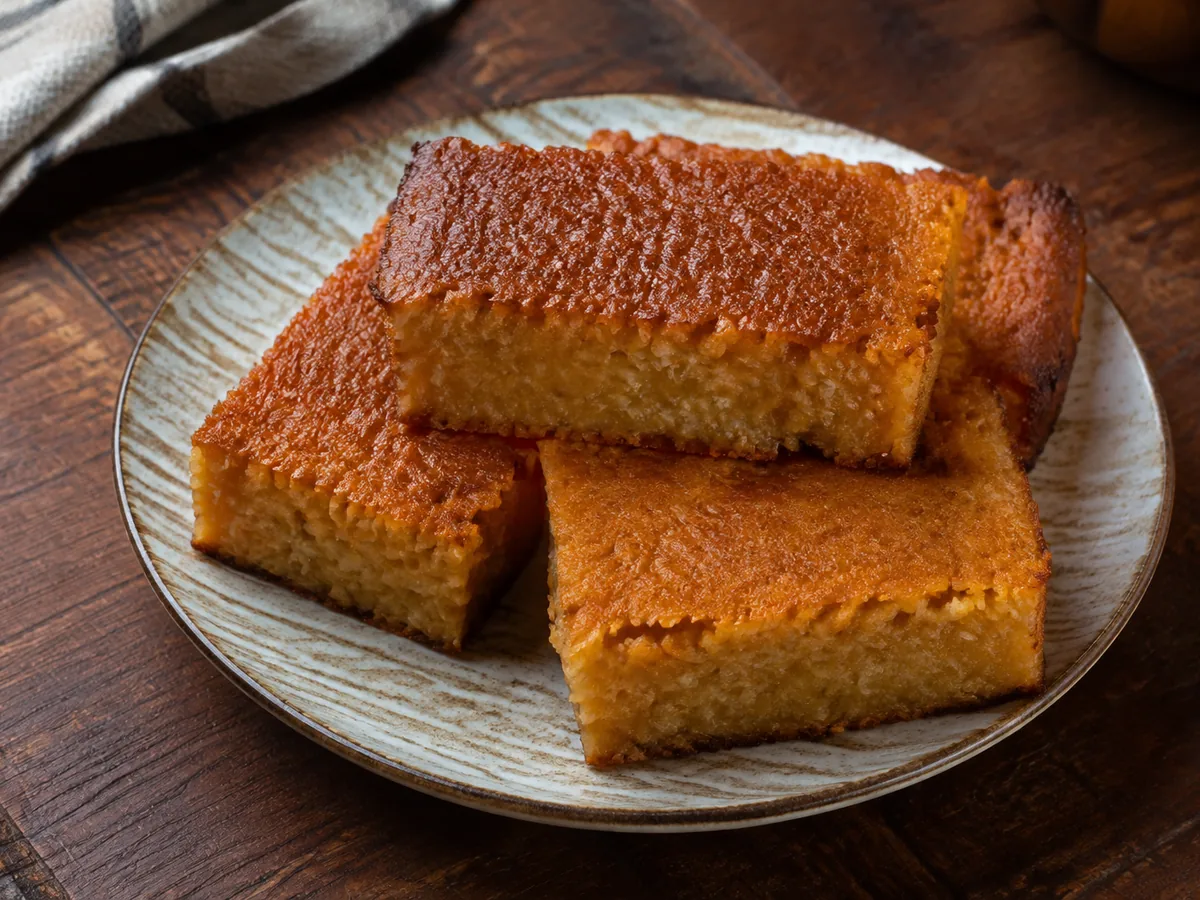
Cassava pone honours the ancient Amerindian root of Guyana, sweetened by Afro-Guyanese and Indo-Guyanese hands. Found in home kitchens and bakeries from Georgetown to Berbice, it is neither a cake nor a pudding but a dense, chewy, moist confection with caramelised edges and a glossy, gelatinous centre.
It is made from freshly grated raw sweet cassava, fresh coconut and orange calabaza pumpkin, bound with evaporated milk, Demerara sugar, butter and vanilla, and spiced with nutmeg, cinnamon and clove. A slow oven sets the starches into a chewy golden slab with dark, sticky corners.
- 700 g4 cups gratedSweet cassava, peeled, core removed, finely grated on a box grater
- 250 g2 cups gratedFresh brown coconut, finely gratedor unsweetened desiccated coconut
- 200 g1½ cups gratedCalabaza pumpkin, peeled and finely grated
- 300 g1½ cupsDemerara sugar
- 115 g½ cupUnsalted butter, melted and cooled
- 350 ml1½ cupsEvaporated milkor rich coconut milk
- 15 ml1 TbspPure vanilla extract
- 6 g1½ tspGround Ceylon cinnamon
- 3 g1 tspFreshly grated nutmeg
- 1 g¼ tspGround cloves
- 4 g¾ tspFine sea salt
- 15 g1 TbspButter, for the pan
Starch, not flour
Raw cassava is about a third starch. Grating ruptures the cells and releases the granules into the batter; at 95 °C in the oven they absorb the milk and pumpkin moisture, swell, burst and set into a continuous chewy gel. Sugar and butter between the starch chains keep it from turning to rock as it cools.
Keep the juice
The natural moisture of the grated root is what the starch needs. Squeeze it out and the pone comes out dry and chalky.
Pumpkin for colour and moisture
Without the calabaza the pone is greyish-white and drier. It gives the amber hue and a natural sweetness.
The five tastes on this plate
Salt lifts the sweetness and cuts the starch and butterfat. Fat is butter, evaporated milk and coconut. Acid is the faint edge of unrefined Demerara and pumpkin. Heat is nutmeg, clove and cinnamon. Umami is slow-baked cassava and caramelised milk solids.
Equipment
- 23 by 33 cm metal baking pan
- Box grater
- Large mixing bowl and a sturdy wooden spoon
- Offset spatula
- Wire rack
Use metal. A metal pan gives far crisper caramelised edges than glass. In Guyana it is a heavy cast-aluminium pan, sometimes in a coal-pot oven.
Method
Heat the oven and grease the pan5 min
Heat the oven to 180 °C and butter the pan generously.
Heat the oven to 180 °C and butter the pan generously.
Grate20 min
On the fine side of a box grater, grate the cassava, coconut and pumpkin into a large bowl. Do not squeeze out any juice.
Use peeled sweet cassava with its core removed. Finely grate it with coconut and pumpkin into a large bowl; retain the juices.
Mix the spiced sugar2 min
Combine the Demerara sugar, cinnamon, nutmeg, cloves and salt.
Combine the Demerara sugar, cinnamon, nutmeg, cloves and salt.
Mix the batter5 min
Add the spiced sugar to the grated mixture and work it through with a spoon or your hands for 2 minutes until the sugar draws the juices out into a wet, shiny mass. Pour in the melted butter, evaporated milk and vanilla and stir hard to a thick, pourable, porridge-like batter.
Work spiced sugar into the grated mixture for 2 minutes until wet and shiny. Stir in melted butter, evaporated milk and vanilla vigorously to make a thick, pourable batter.
Fill the pan2 min
Pour into the pan and level it with an offset spatula to an even layer about 2.5 cm deep.
Pour into the pan and level it with an offset spatula to an even layer about 2.5 cm deep.
Bake1 hr 15 min
Bake uncovered in the centre of the oven 1 hour 15 minutes. It is done when the top is deep golden, the edges are dark and pulling from the sides, and a toothpick in the centre comes out clean but tacky, about 95 °C.
Bake uncovered in the oven centre 1 hour 15 minutes, until deep golden with dark edges pulling from the pan. A centre toothpick should emerge clean but tacky; the centre should reach about 95 °C.
Cool completely2 to 3 hr
Cool on a rack at room temperature at least 2 to 3 hours. Hot pone is too soft to cut clean.
Cool on a rack at room temperature at least 2 to 3 hours. Hot pone is too soft to cut clean.
Slice
Cut into 5 cm squares with a sharp knife wiped on a damp cloth between cuts. Serve at room temperature.
Cut into 5 cm squares with a sharp knife wiped on a damp cloth between cuts. Serve at room temperature.
Sensory cues of doneness
- Visual: a glossy amber-brown slab with dark caramelised edges, and a moist, dense, translucent interior flecked with white coconut and orange pumpkin.
- Auditory: a gentle bubbling sizzle round the pan edges in the last 20 minutes as butter and sugar caramelise on the metal.
- Olfactory: toasted coconut, fresh nutmeg, melted butter, sweet cassava and vanilla.
Look for a glossy amber-brown top, dark caramelised edges and a moist, dense, translucent centre flecked with coconut and pumpkin. Expect gentle bubbling at the edges in the last 20 minutes and toasted coconut, nutmeg, butter and vanilla aromas.
Storing it
Wrapped in parchment and foil it keeps 3 days at room temperature or 2 weeks refrigerated. Warm 5 minutes in a 150 °C oven if you like.
Troubleshooting
- A mushy, underbaked centre.
Too deep a dish. Spread the batter no more than 2.5 cm thick so the heat reaches through the dense starch.
- Dry, chalky texture.
The cassava juice was squeezed out, or dry desiccated coconut was used without adjusting the liquid. The root's own moisture is essential.
- It crumbles when cut.
Sliced hot. The starch gel has to cool fully to set into firm squares.
Substitutions
One-to-one swaps, with the technique change each one needs.
Ingredient substitutions
| Ingredient | Replace with | Culinary impact and technique adjustment |
|---|---|---|
| Fresh cassava | Thawed frozen grated cassava, with its liquid | One-to-one. Keep the liquid in the bag |
| Calabaza pumpkin | Kabocha, butternut or sweet potato | One-to-one |
| Evaporated milk | Full-fat coconut milk | One-to-one, and makes the pone dairy-free |
Scaling
Half
Halve everything in a 20 cm square metal pan, 55 to 60 minutes at 180 °C.
Double
Double the ingredients across two 23 by 33 cm pans. Never one deep pan; the centre stays raw.
What to serve it with
- Hot black Guyanese coffee, or spiced cocoa tea
- A scoop of vanilla ice cream
- Aged Demerara rum such as El Dorado 15 neat, ginger beer, or cold milk
Questions
Can I use frozen grated cassava?
Yes, thawed, and keep whatever liquid is in the bag when you measure.
What does the pumpkin do?
Moisture, natural sweetness and the golden colour. Without it the pone is greyish and drier.
How long does it keep?
Three days at room temperature wrapped tight, or two weeks in the fridge.