Pepián de Pollo
Declared cultural heritage in 2007, and traceable to Kaqchikel Maya ritual. Everything that matters happens on a dry comal — pumpkin and sesame seeds toasted until they pop, chillies blistered for fifteen seconds a side, tomatoes and garlic charred black, and a stale tortilla burnt to give the recado body.
- Prep
- 35 min
- Cook
- 50 min
- Serves
- 6 hearty portions
- Difficulty
- Hard
Researched · Kitchen testing pending
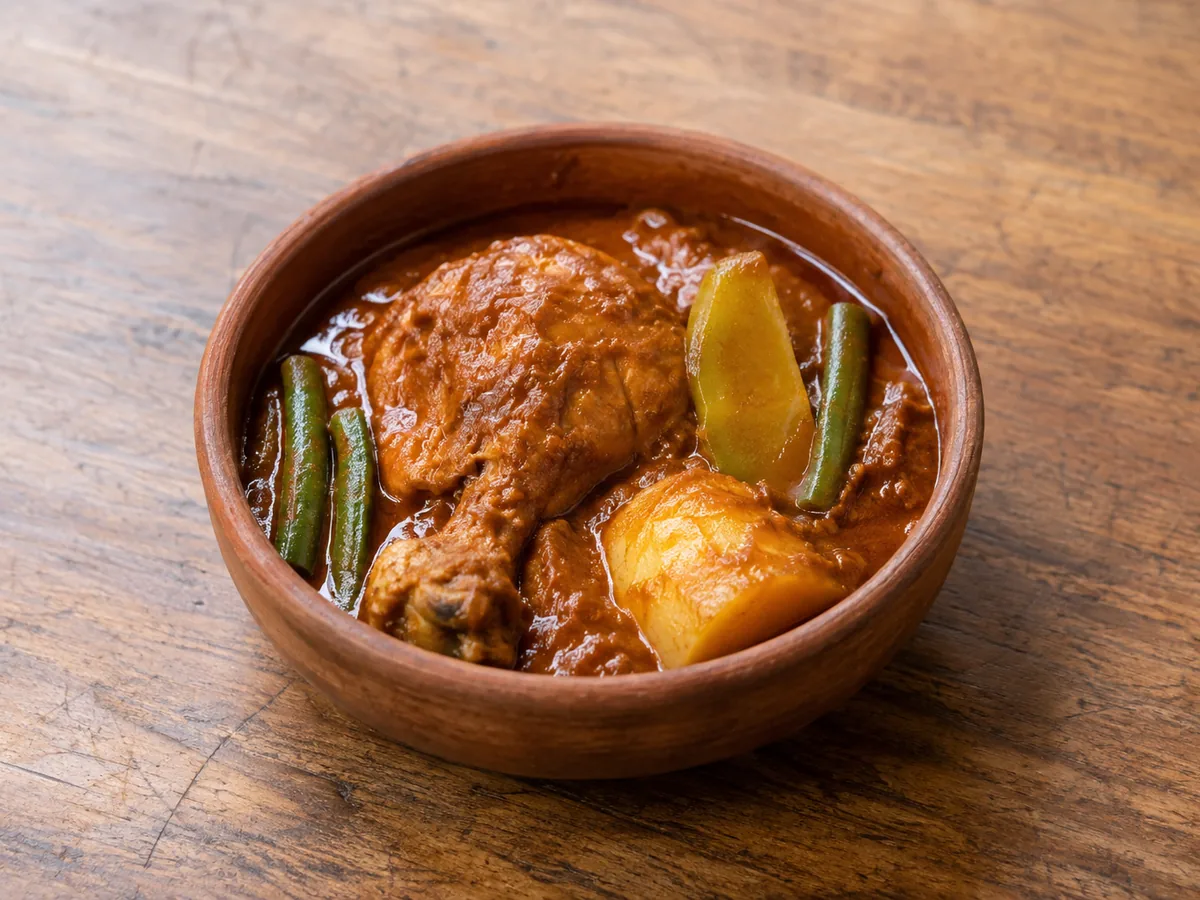
High in the misty highlands of Chimaltenango and Antigua, woodsmoke curls from clay hearths where pepián simmers. Declared cultural heritage in 2007, the recado traces back to ancient Kaqchikel Maya ritual and was later enriched with Spanish colonial spices.
The heart of pepián is the comal. Green pumpkin seeds and white sesame are dry-roasted until they pop and release their oils. Beside them, whole dried chile guaque and chile pasa toast until blistered, alongside charred tomatoes, tart green miltomates, sweet onion and whole unpeeled garlic.
Ground smooth with a piece of charred corn tortilla for body, the recado simmers with poached chicken, güisquil, green beans and potato into a thick brick-red stew with deep toasted warmth.
Chicken and stock
- 1.5 kg3.3 lbBone-in, skin-on chicken leg quarters, trimmed of excess fat
- 1.8 L7.5 cupsCold filtered water
- 15 g1 TbspFine sea salt10 g for the poach, 5 g for the recado
- 2 g½ tspFreshly ground black peppercorn
The recado
- 60 g½ cupRaw hull-less green pumpkin seeds (pepitoria verde)
- 45 g⅓ cupWhite sesame seeds (ajonjolí)
- 2 pieces2 piecesDried chile guaque, wiped clean, stemmed and seeded
- 2 pieces2 piecesDried chile pasa, wiped clean, stemmed and seeded
- 600 g4 largeRipe red plum tomatoes, whole and unpeeled, for charring
- 250 g6 mediumFresh miltomates (small green tomatillos), husked and washed clean of their sticky residue
- 1 large1 largeYellow onion, cut into thick 1 cm rounds
- 6 cloves6 clovesFresh garlic, unpeeled, for roasting in the skin
- 1 whole1 wholeStale corn tortilla, charred dark on the comal
- 1 small1 smallPan francés or bolillo crumb, toasted crisp
- 3 g1 in stickCeylon cinnamon, lightly toasted
- 3 whole3 wholeAllspice berries (pimienta gorda)
- 2 whole2 wholeCloves
The vegetables
- 2 medium2 mediumGüisquil (chayote), peeled, cored and cut into 3 cm chunks
- 300 g2 mediumYukon Gold potatoes, peeled and cut into 3 cm chunks
- 200 g1.5 cupsGreen beans (ejotes), topped, tailed and cut into 4 cm batons
- 30 g½ cupFresh cilantro leaves, roughly chopped
Toast the seeds, never scorch them
Dry-roasting pepitoria and sesame at 150–165 °C ruptures the oil bodies inside and releases polyunsaturated fats and pyrazine aromatics. Taken black, those same fats oxidise into acrid bitterness. Stir constantly and tip them out the second they pop and turn pale gold.
Fifteen seconds a side for the chillies
Press them flat on hot iron just until fragrant and blistered, then straight into hot broth to steep. Blackened chillies make the whole stew acrid.
The burnt tortilla is the thickener
Charring produces retrograded starches that swell and gelatinise at about 75 °C when blended with hot stock, binding the seed-and-chilli slurry into a recado that clings to the chicken instead of splitting into grease.
No added fat anywhere
The seeds supply all of it. The recado goes into a dry pot and bubbles in its own extracted oils.
Add the broth gradually
Too much at once and the sauce is thin. Bring it to the consistency of heavy cream, then judge again once the vegetables are in.
Passive time, counted separately
The chillies steep 15 minutes in hot broth and the finished pot rests 10 minutes so the sauce settles. Neither is active work and both sit outside the times quoted above.
The five tastes on this plate
Salt is in the poaching stock and the seasoned recado. Fat is roasted pumpkin-seed lipid, sesame oil and rendered chicken fat. Acid is the bright tartness of charred miltomates cutting the richness of the seeds. Heat is mild — toasted guaque and pasa, roasted garlic, pepper and allspice. Umami is chicken bone fond, roasted seed amino acids and charred tomato.
Equipment
- 6 to 7 qt enamelled cast-iron Dutch oven
- 12 in cast-iron skillet, as the comal
- High-powered blender
- Coarse sieve
- Tongs and a wooden paddle
Traditionally a clay comal for the dry-roasting and a wide olla de barro for the simmering. A heavy 12-inch cast-iron skillet and a 6-to-7 quart enamelled Dutch oven work in a modern kitchen — cast iron holds the radiant heat needed to blister vegetables, and the heavy pot stops the thick recado catching.
Method
Poach the chicken35 min
Put the chicken into the Dutch oven with 1.8 litres cold water and 10 g salt, and bring to a gentle boil, skimming the grey foam for 10 minutes.
Drop to low, cover partially and simmer 25 minutes until tender but intact, about 72 °C / 162 °F. Lift the chicken out and cover; strain and keep all the broth.
Bring chicken, 1.8 litres cold water and 10 g salt to a gentle boil; skim 10 minutes. Partially cover; simmer on low 25 minutes until tender but intact, about 72 °C / 162 °F. Remove and cover; strain and reserve broth for the remaining cooking.
Toast the seeds and spices5 min
Heat a clean dry skillet to medium-low, about 150 °C, and toast the pepitoria 2 to 3 minutes, tossing constantly, until they swell, turn pale gold and pop. Into a bowl.
Toast the sesame 90 seconds until golden-tan, then the cinnamon, allspice and cloves for 30 seconds. Add them to the bowl and cool.
Heat a dry skillet to medium-low, about 150 °C. Toss pepitoria constantly 2–3 minutes until puffed, pale gold and popping; remove. Toast sesame 90 seconds until golden-tan, then cinnamon, allspice and cloves 30 seconds. Combine and cool; never scorch seeds.
Blister and char15 min
Press the guaque and pasa flat on the dry skillet 10 to 15 seconds a side until fragrant — no longer. Cover with 250 ml hot broth and steep 15 minutes.
In the smoking skillet, char the whole tomatoes, miltomates, onion rounds and unpeeled garlic 10 to 12 minutes, turning, until blackened and blistered. Peel the garlic.
Finally char the stale tortilla and the bread until dark grill marks form.
Toast guaque and pasa flat in a dry skillet only 10–15 seconds per side; steep in 250 ml hot broth 15 minutes. Char tomatoes, miltomates, onion and unpeeled garlic in the smoking skillet 10–12 minutes, turning; peel garlic. Char tortilla and bread with dark marks.
Blend the recado5 min
Pulse the cooled seeds and whole spices to a fine powder.
Add the steeped chillies with their liquid, the charred tomatoes, miltomates, onion, peeled garlic, tortilla and bread, and 400 ml warm broth. Blend 90 seconds to an ultra-smooth brick-red purée.
Pass it through a coarse sieve, pressing with a ladle.
Grind cooled seeds and spices finely. Add chillies with soaking liquid, charred vegetables, peeled garlic, tortilla, bread and 400 ml warm broth; blend 90 seconds until very smooth and brick-red. Press through a coarse sieve with a ladle.
Simmer the recado and vegetables20 min
Pour the recado into the Dutch oven over medium heat — no oil needed — and stir with a wooden paddle 5 minutes as it bubbles and darkens.
Add 600 ml hot broth until it has the consistency of heavy cream, then the güisquil, potatoes and green beans with 5 g salt and the pepper.
Simmer uncovered over medium-low 15 minutes until the potato and güisquil are fork-tender.
Stir recado in a dry pot over medium 5 minutes until darker; add no oil. Gradually add 600 ml hot broth to heavy-cream consistency, then güisquil, potatoes, beans, 5 g salt and pepper. Simmer uncovered on medium-low 15 minutes until potato and güisquil are tender.
Return the chicken and rest10 min
Lower the poached chicken into the bubbling recado and simmer on low 8 to 10 minutes, to 77–80 °C / 170–175 °F.
Off the heat, scatter the cilantro and rest 10 minutes so the sauce settles and thickens.
Lower the poached chicken into the bubbling recado and simmer on low 8 to 10 minutes, to 77–80 °C / 170–175 °F.
Off the heat, scatter the cilantro and rest 10 minutes so the sauce settles and thickens.
Sensory cues of doneness
- Visual: a dense shimmering brick-red sauce coating tender chicken, dotted with pale potato and bright green ejote batons.
- Auditory: whispering clicks as sesame and pumpkin seeds dance on the dry comal, then slow heavy murmurs from the pot.
- Olfactory: toasted sesame and pepitoria, blistered dried chilli, roasted garlic and rich chicken broth.
Look for thick, shimmering brick-red sauce coating tender chicken, with pale potato and green beans. Seeds should softly click while toasting and stew bubble slowly; expect sesame, pepitoria, toasted chillies, roasted garlic and chicken broth aromas.
Storing it
Like most mole-style stews it is better the next day, once the toasted seed oils and chilli aromatics equilibrate. Reheat gently on low with a splash of water.
Troubleshooting
- A bitter, acrid stew.
The seeds or the chillies went too far. Toast seeds only to pale gold, and press chillies for 10 to 15 seconds a side.
- A watery recado.
The charred tortilla was skipped, or too much broth went in at once. The tortilla starch is the body — add liquid gradually until it coats a spoon.
- The sauce splits into grease.
The seed oils separated. Keep it at a gentle simmer and stir as it reduces.
Substitutions
One-to-one global substitutions, with the technique adjustment each one requires.
Ingredient substitutions
| Ingredient | Replace with | Culinary impact and technique adjustment |
|---|---|---|
| Chile guaque | Mexican guajillo | One-to-one. The same sweet dried red pepper notes and crimson hue |
| Chile pasa | Mexican pasilla or ancho | One-to-one. Supplies raisin, dried plum and dark earthy notes |
| Güisquil | Chayote, or tender zucchini | One-to-one. Chayote keeps its crisp sweetness in the hot recado |
Scaling
Half, for 3 portions
Halve everything in a 4-quart saucepan. The chicken and vegetable simmering times are unchanged.
Double, for 12 portions
Double everything in an 11-to-12 quart stockpot, and toast the seeds in two batches so they roast evenly across the pan floor.
What to serve it with
- Arroz blanco chapín — steamed rice with diced carrot and sweet corn
- Tamalitos de masa, and thick hand-patted corn tortillas from the canasto
- Atol de elote, or an ice-cold Gallo
Questions
Can I make it with beef?
Yes — pepián de res is equally revered. Use bone-in beef shank or chuck, simmer an hour and a half until fork-tender, and blend the recado with the beef broth.
What if I cannot find miltomates?
Use standard green tomatillos. Miltomates are smaller and tarter, but tomatillos give the same malic-acid counterpoint to the rich seeds.
Can it be made ahead?
Yes, and it is better for it. Reheat gently on low heat with a splash of water.