Gâteau Bâtard Tourtani
The territory's dessert, named the bastard cake. Raw white sweet potato grated fine and folded into a custard of coconut milk, dark cane sugar, butter, eggs, aged agricultural rum, vanilla, nutmeg, cinnamon and lime zest with a little flour, baked slowly in a sugared pan until deep brown at the edges, cooled fully and cut into diamonds.
- Prep
- 30 min
- Cook
- 1 hr 15 min
- Serves
- 10 to 12 dessert servings
- Difficulty
- Medium
Researched · Kitchen testing pending
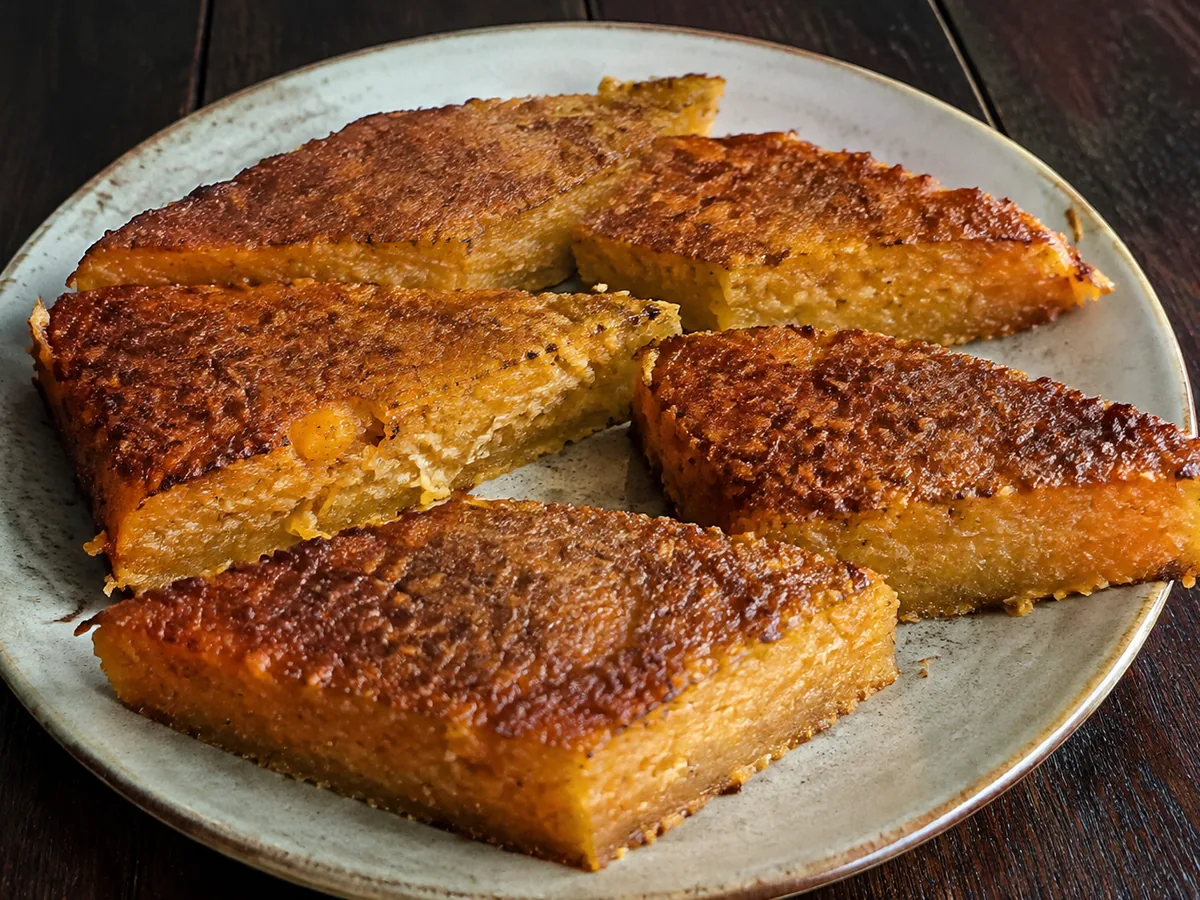
Gâteau Bâtard (also known by its indigenous-Creole name Tourtani) is the legendary traditional dessert of French Guiana. Its curious French colonial name—literally ‘bastard cake’—speaks to its hybrid culinary lineage: neither a French sponge cake (génoise) nor an English fruitcake, but a dense, pudding-like confection born from the union of indigenous Amazonian tubers and African plantation foodways. Prepared for village communions, weddings, and holidays, Tourtani is built upon finely grated raw sweet potato (patate douce—specifically the white or purple-skinned local varieties), combined with freshly pressed coconut milk, unrefined dark cane sugar, butter, eggs, nutmeg, cinnamon, and a generous pour of dark aged Guianese rum. Baked slowly until it develops a caramelized, dark brown crust and a dense, fudgy, moist crumb, it is sliced into diamond wedges and savored with afternoon coffee or rum punch.
- 1000 g2.2 lbs (approx. 5 cups grated)Patates douces blanches or violettes (raw white/purple sweet potatoes), peeled, finely grated
- 400 ml1 can (13.5 fl oz)Lait de coco pur (pure unsweetened full-fat coconut milk)
- 250 g1.25 cupsSucre de canne roux (unrefined dark cane sugar or cassonade)
- 120 g1/2 cup (8 tbsp)Beurre doux (unsalted butter), melted and cooled
- 4 whole4 whole eggsŒufs entiers frais (large fresh eggs)
- 60 ml4 tbspRhum vieux agricole de Guyane (dark aged rum, 50°)
- 15 ml1 tbspExtrait de vanille pure (pure vanilla extract)
- 3 g1 tspNoix de muscade fraîchement râpée (freshly grated nutmeg)
- 4 g1 tspCannelle moulue (ground Ceylon cinnamon)
- 1 lime1 limeZeste de citron vert (fresh lime zest), finely microplaned
- 80 g2/3 cupFarine de blé T55 (all-purpose flour) for structure
- 4 g1/2 tspSel fin marin (fine sea salt)
- 15 g1 tbspBeurre et sucre pour le moule (butter and sugar for coating pan)
Culinary science
The chemistry of Gâteau Bâtard / Tourtani differs completely from leavened wheat cakes. Containing only 80 grams of flour to 1000 grams of raw grated sweet potato, it has no gluten structure and zero chemical leaveners. Instead, structural cohesion relies on sweet potato starch gelatinization combined with egg protein coagulation. Raw sweet potatoes contain endogenous beta-amylase enzymes that, as the cake slowly heats between 55°C and 75°C (131°F–167°F), hydrolyze native starches into maltose sugars, intensifying the cake's natural honeyed sweetness. Simultaneously, egg ovalbumin and yolk globulins denature at 80°C (176°F), trapping the melted butter and coconut fats into a dense, moist, custard-like suspension that sets firm as it cools to room temperature.
Five-taste audit
Salt: Fine sea salt balancing the dense sweetness of sweet potato fructose and dark cane sugar. Fat: Rich coconut fats from pure coconut milk and dairy butterfats delivering a velvety, custard-like crumb. Acid: Microplaned fresh lime zest providing bright citrus essential oils that lift the heavy spiced dairy profile. Heat / Pungency: Warm aromatic spices: freshly grated nutmeg, ground cinnamon, and the alcohol warmth of aged agricultural rum. Umami: Earthy legume-sweetness from baked sweet potato starches and deep oak barrel esters from dark rum.
Equipment
- A heavy round tin or iron cake mold baked in a wood-fired outdoor masonry oven.
- A heavy 9x13-inch rectangular ceramic baking dish or a 10-inch springform / round cake pan.
Method
Prepare the pan
Heat the oven to 175 °C. Butter the baking dish thoroughly and dust the base and sides with cane sugar.
Heat the oven to 175 °C. Butter the baking dish thoroughly and dust the base and sides with cane sugar.
Grate the sweet potato
Finely grate the peeled sweet potato. Work promptly so it does not oxidise; do not rinse away its starch.
Finely grate the peeled sweet potato. Work promptly so it does not oxidise; do not rinse away its starch.
Mix the custard
Whisk coconut milk, sugar, melted butter, eggs, rum, vanilla, nutmeg, cinnamon, lime zest and salt until smooth.
Whisk coconut milk, sugar, melted butter, eggs, rum, vanilla, nutmeg, cinnamon, lime zest and salt until smooth.
Combine
Fold in the grated sweet potato, then the flour, until every strand is coated and no dry pockets remain.
Fold in the grated sweet potato, then the flour, until every strand is coated and no dry pockets remain.
Bake slowly
Spread evenly in the pan and bake 65–80 minutes, rotating once, until the top is deep brown, the edges caramelise and the centre reaches about 93 °C.
Spread evenly in the pan and bake 65–80 minutes, rotating once, until the top is deep brown, the edges caramelise and the centre reaches about 93 °C.
Cool completely
Cool in the pan at least 90 minutes. The starch and egg structure firms as it cools; cutting hot produces a wet, ragged slice.
Cool in the pan at least 90 minutes before slicing so the cake sets firmly; cutting it hot leaves wet, ragged slices.
Cut
Loosen the edges and cut into small diamonds or squares with a lightly buttered knife.
Loosen the edges and cut into small diamonds or squares with a lightly buttered knife.
Storing it
Storage and reheating
Cover and refrigerate up to 4 days. Bring slices toward room temperature before serving. Freeze tightly wrapped portions up to 2 months.
Troubleshooting
- A wet centre
The cake was underbaked or cut hot. Bake to 93 °C and cool fully before slicing.
- A fibrous texture
The sweet potato was grated too coarsely. Use the fine holes of a box grater.
- A greasy layer
The butter and coconut milk were not emulsified with the eggs before the sweet potato was added.
Substitutions
Ingredient substitutions
| Ingredient | Replace with | Culinary impact and technique adjustment |
|---|---|---|
| Patates douces blanches | Orange sweet potatoes, Japanese white sweet potatoes (Satsumaimo), or Boniato: | Boniato or Japanese sweet potato stays closest to the dry dense texture; orange sweet potato is wetter and may need 5–10 minutes longer. |
| Sucre de canne roux | Dark brown sugar, turbinado sugar, or grated panela: | Dark brown sugar is moister, turbinado drier and panela more mineral; all deepen the crust differently. |
| Rhum vieux agricole | Any aged dark Caribbean rum (Appleton Estate or El Dorado): | Any aged dark Caribbean rum works, but molasses-based rum is rounder and less grassy than agricole. |
Scaling
Half batch
Bake in a 20 cm square or 23 cm round pan and begin checking at 50 minutes.
Double batch
Use two pans. A double-depth cake sets unevenly and can burn at the edge before the centre is done.
What to serve it with
- Strong coffee
- A small pour of aged agricultural rum
- Fresh pineapple or lightly tart tropical fruit
Questions
Does the cake need baking powder?
No. Tourtani is intentionally dense and pudding-like; starch gelatinisation and eggs set it.
Can orange sweet potatoes be used?
Yes. They are wetter and softer, so the colour and texture change; bake until the centre reaches the same temperature.
Does all the alcohol remain?
No, but baking does not guarantee zero alcohol. Omit rum and replace it with coconut milk if that matters to diners.