Riguas de Maíz Tierno con Queso
The banana leaf is not packaging — it is the cooking vessel. Raw sweet-corn batter on bare iron scorches its own sugars long before the centre sets, so it goes inside a leaf that conducts heat gradually and traps the steam, then chars black and pyrolyses smoke straight into the cake.
- Prep
- 25 min
- Cook
- 16 min
- Serves
- 8 large riguas, about 18 cm long
- Difficulty
- Medium
Researched · Kitchen testing pending
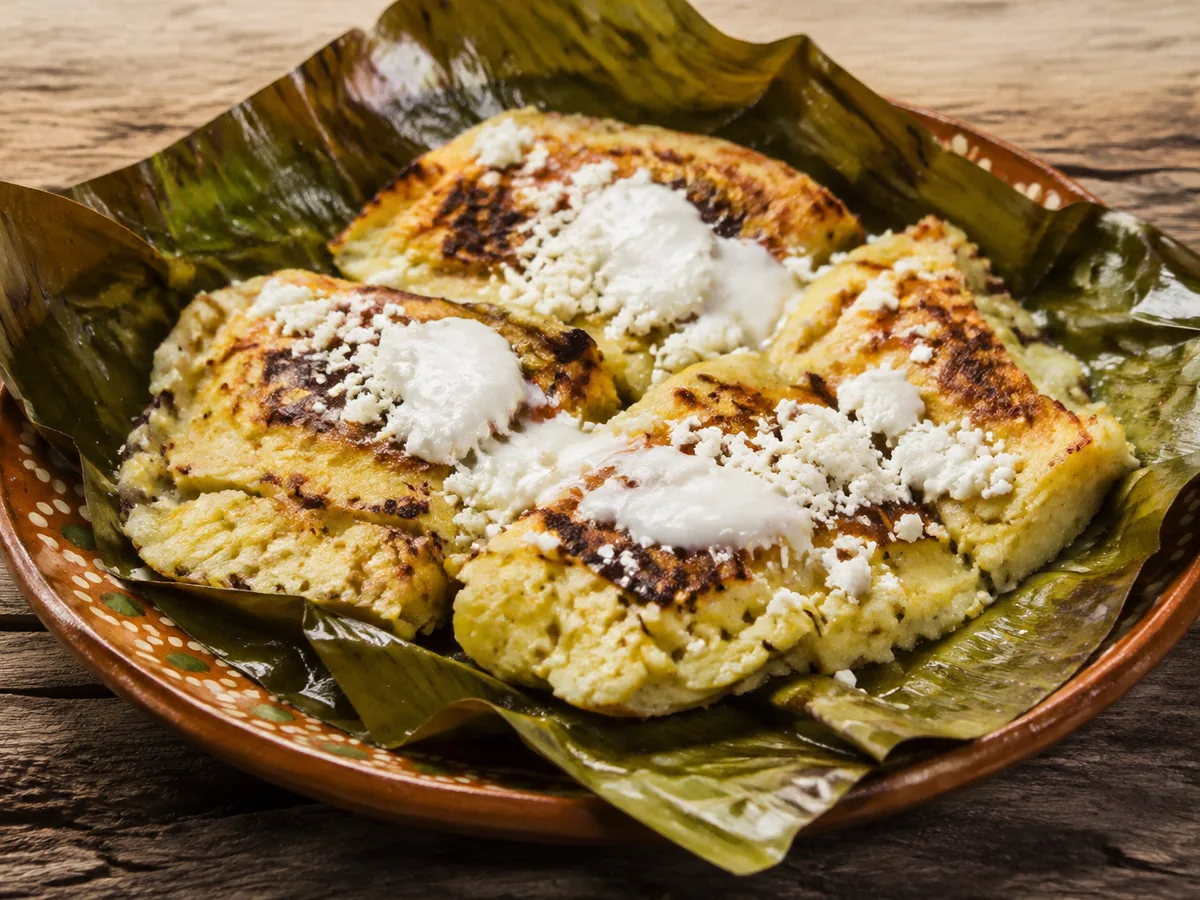
Along rural Salvadoran roadsides during the autumn harvest, the sweet smoke of riguas draws travellers to wooden stalls.
Unlike pupusas, made from dried nixtamalised corn flour, riguas are strictly young sweet corn cut fresh from the cob and ground raw with a little butter and salt into a coarse thick batter. It is spread directly onto fresh green banana leaves, folded into parcels, and toasted on a hot comal until the leaves char black and smoke.
Unwrapped steaming, the cake is folded over Salvadoran quesillo and dolloped with cold cultured crema.
The batter
- 1.2 kg6 cups kernelsFresh sweet yellow corn from 6 to 7 large ears, cobs scraped firmly for their milk
- 45 g3 TbspUnsalted European butter, melted and warm, or rendered lard
- 30 g2 TbspGranulated cane sugar, adjusted to how sweet the corn is
- 8 g1.5 tspFine sea salt
- 30 g2 TbspPrecooked white corn flour, or cornstarchonly if the corn runs watery
To wrap and fill
- 8 sheets8 sheetsFresh green banana leaves, cleaned, ribs trimmed, cut into 25 × 30 cm rectangles
- 300 g2.5 cupsSalvadoran quesillo, or queso Oaxaca or mozzarella, shredded
- 120 ml½ cupSalvadoran cultured sour cream, chilled
The leaf does the cooking
It conducts heat gradually and traps the corn's own escaping moisture as an individual steam chamber, so the starches gelatinise at 85 °C before the sugars can burn.
And then it smokes
As the underside chars against a 200 °C comal, the leaf's cuticular waxes and polyphenols pyrolyse and drive an earthy sweet smoke directly into the moist cake. That flavour cannot be got any other way.
Pulse, do not purée
Eight to ten pulses, until it is thick like oatmeal with visible corn grit. Blended to a liquid, the released water makes the cake gummy.
Young corn only
Riguas need sweet juicy *maíz tierno*. Starchy mature field corn gives a chalky cake with none of the sweetness.
Cheese goes on after
The rigua comes off the comal, the leaf is opened, and the residual heat alone melts the quesillo into strands as it is folded over.
Passive time, counted separately
The batter rests 5 minutes after grinding. That sits outside the times quoted above.
The five tastes on this plate
Salt is in the batter and in the briny melting quesillo. Fat is butter in the corn, melted cheese and cold cream on top. Acid is the lactic tang of the crema against the sweet corn. Heat is absent by design. Umami is caramelised corn sugar, charred leaf polyphenols and aged cheese curds.
Equipment
- Sharp knife and a wide bowl
- Food processor or blender
- 12 to 14 in cast-iron skillet or plancha
- Wide spatula
Traditionally a large iron or clay comal over wood embers. A 12-to-14 inch cast-iron skillet works in a modern kitchen — it needs to hold about 195 °C so the leaf chars steadily rather than in patches.
Method
Cut and scrape the corn10 min
Stand the shucked cobs upright in a bowl and slice downward to release the kernels.
Then scrape the stripped cobs firmly with the blunt spine of the knife to pull out all the sweet starchy corn milk.
Stand the shucked cobs upright in a bowl and slice downward to release the kernels.
Then scrape the stripped cobs firmly with the blunt spine of the knife to pull out all the sweet starchy corn milk.
Grind the batter10 min
Pulse the kernels, corn milk, melted butter, sugar and salt 8 to 10 times into a thick coarse batter with visible grit — like oatmeal, not a liquid.
If it runs, stir in 2 Tbsp of corn flour. Rest 5 minutes.
Pulse the kernels, corn milk, melted butter, sugar and salt 8 to 10 times into a thick coarse batter with visible grit — like oatmeal, not a liquid.
If it runs, stir in 2 Tbsp of corn flour. Rest 5 minutes.
Prepare the leaves5 min
Wipe the leaves with a damp towel and pass each briefly over a flame, about 3 seconds a side, until pliable and dark green.
Wipe the leaves with a damp towel and pass each briefly over a flame, about 3 seconds a side, until pliable and dark green.
Assemble the parcels10 min
Spoon 120 ml of batter onto one half of a leaf rectangle and spread it with the back of a spoon into an oval 15 cm long and 1 cm thick.
Fold the empty half of the leaf over to enclose it completely.
Spoon 120 ml of batter onto one half of a leaf rectangle and spread it with the back of a spoon into an oval 15 cm long and 1 cm thick.
Fold the empty half of the leaf over to enclose it completely.
Toast on the comal16 min
Heat the skillet to 195 °C and cook the parcels dry, two at a time.
4 to 5 minutes until the bottom leaf chars black and puffs, then flip and give the second side 3 to 4 minutes, until the cake feels firm through the leaf at 85 °C.
Heat skillet to 195 °C. Cook dry leaf parcels two at a time, 4–5 minutes until bottom leaf blackens and puffs. Flip; cook 3–4 minutes until the cake feels firm through the leaf and reaches 85 °C.
Fold with quesillo
Peel the charred top leaf open — the steam is hot — and mound shredded quesillo across one half of the cake.
Using the bottom leaf as a guide, fold the rigua over the cheese like a taco; the residual heat melts it into strands. Dollop cold crema over the top and serve.
Open the top leaf carefully: escaping steam is hot. Cover half the cake with shredded quesillo; use the bottom leaf to fold it over the cheese. Let residual heat melt cheese, add cold crema and serve.
Sensory cues of doneness
- Visual: a blackened blistered wrapper opening onto a pale-gold moist corn cake with toasted patches and melting white cheese.
- Auditory: energetic crackling and hissing as the water in the fresh leaf vaporises against the iron.
- Olfactory: charred banana leaf, roasting sweet corn, browned butter and melted quesillo.
Look for charred, blistered leaves enclosing moist pale-gold corn cakes with toasted patches and melted white cheese. Expect vigorous crackling as leaf moisture evaporates, with aromas of charred banana leaf, sweet corn, browned butter and quesillo.
Storing it
Reheat inside their charred leaves on a dry hot skillet, 2 minutes a side.
Troubleshooting
- A gummy cake.
The batter was blended smooth. Pulse briefly and keep the grit.
- Scorched sugars and a raw centre.
It was cooked on bare metal. The banana leaf is what moderates the heat.
- A chalky, unsweet cake.
Mature field corn was used. Riguas need young sweet maíz tierno.
Substitutions
One-to-one global substitutions, with the technique adjustment each one requires.
Ingredient substitutions
| Ingredient | Replace with | Culinary impact and technique adjustment |
|---|---|---|
| Fresh sweet corn | Thawed frozen sweet corn, thoroughly drained | One-to-one, with 2 Tbsp corn flour to absorb the extra moisture |
| Salvadoran quesillo | Queso Oaxaca, low-moisture mozzarella, or Monterey Jack | One-to-one |
| Banana leaves | Parchment paper | A mechanical wrapper only — the leaf smoke is lost entirely |
Scaling
Half, for 4 riguas
Halve everything. Cooking stays 4 minutes a side.
Double, for 16 riguas
Double everything across two cast-iron pans side by side.
What to serve it with
- Cold thick crema pura salvadoreña
- Fresh cuajada
- Hot black coffee, or atol de elote with cinnamon
Questions
Can I use frozen corn?
Yes. Thaw it, drain and dry it thoroughly, and add 2 Tbsp corn flour to make up for the freezing moisture.
What cheese goes inside?
Salvadoran quesillo or queso Oaxaca — both give the right melting stretch and salty tang.
Can they be reheated?
Yes, inside their charred leaves on a dry hot skillet, 2 minutes a side.