Empanadas de Plátano con Poleada
Not wheat turnovers at all — croquettes of boiled ripe plantain, mashed hot into a dough with no flour in it. The custard inside must be chilled firm before it is wrapped, because warm poleada turns watery in the fryer and bursts straight through the seam.
- Prep
- 35 min
- Cook
- 20 min
- Serves
- 12 large croquettes
- Difficulty
- Medium
Researched · Kitchen testing pending
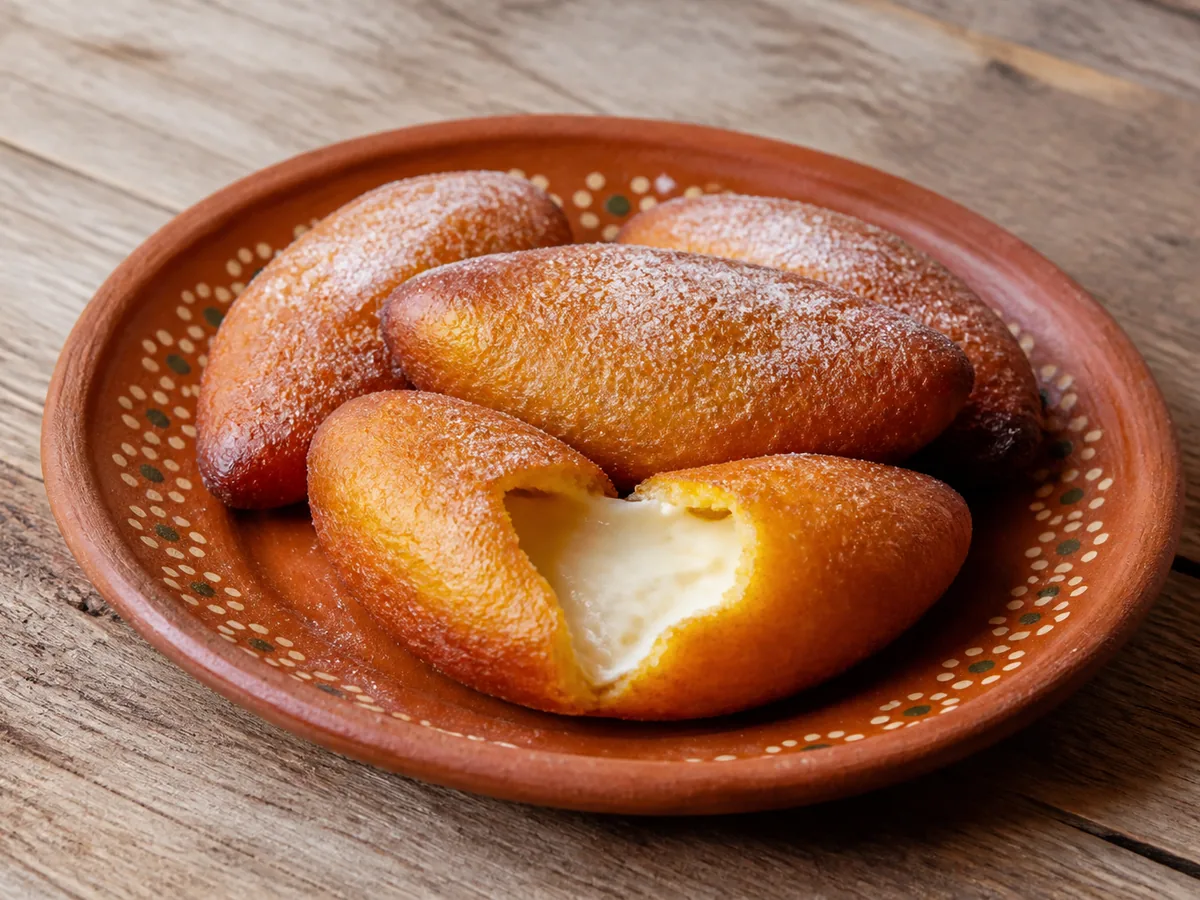
During the late-afternoon merienda across El Salvador, pastry carts fill the streets with empanadas de plátano.
These are not wheat turnovers. They are golden caramelised croquettes made from boiled ripe plantains, mashed while hot into a smooth pliable dough with no flour at all, and stuffed with poleada — a velvety custard of milk, cornstarch, egg yolk, vanilla and cinnamon.
Deep-fried until the plantain sugars blister into a brittle shell and rolled straight into granulated sugar, they give way at the first bite and the warm vanilla custard arrives.
The plantain dough
- 1.2 kg4 largeVery ripe plantains, skins heavily mottled black, cut crosswise into 5 cm chunks
- 1 L4.2 cupsCold water, for boiling
- 1 stick1 stickCeylon cinnamon, for the boiling water
- 2 g½ tspFine sea salt
The poleada
- 500 ml2.1 cupsWhole milk100 ml cold for the slurry, 400 ml into the pan
- 45 g⅓ cupCornstarch
- 75 g6 TbspGranulated cane sugar
- 2 large2 largeEgg yolks, at room temperature
- 1 stick1 stickCeylon cinnamon
- 5 ml1 tspPure vanilla extract
- 1 g¼ tspFine sea salt
To fry and finish
- 500 ml2.1 cupsHigh-smoke-point vegetable oil
- 80 g⅓ cupGranulated white sugar, for rolling
Black-mottled plantains, or nothing
Ripening amylases convert the long-chain starches into fructose and sucrose. Yellow under-ripe fruit still holds ungelatinised starch — it cracks, and it has none of the sweetness the shell depends on.
Mash while steaming
Hot mashing gelatinises the residual starches, which is the entire binding mechanism. There is no flour and no egg in this dough.
The custard must be cold and firm
Cornstarch gelatinises past 82 °C into a tight amylose gel, reinforced by coagulated yolk. Chilled it holds; warm it liquefies inside the croquette and blows the seam open.
175 to 180 °C
Hot enough to caramelise the surface fructose into a rigid shell that keeps oil out. Above 190 °C that sugar burns before the custard inside is even warm.
Roll in sugar immediately
Thirty seconds on paper towel, then straight into the sugar while the caramelised crust is still hot enough to hold the crystals.
Passive time, counted separately
The poleada chills 45 minutes until firm and the mashed plantain cools completely. Neither is active work.
The five tastes on this plate
Salt is a pinch in both the dough and the custard, sharpening the sweetness. Fat is whole milk, egg yolks and the frying oil. Acid is subtle — a little lactic tang from the milk. Heat is the warm woodiness of Ceylon cinnamon in both components. Umami is caramelised plantain sugar, yolk proteins and toasted dairy solids.
Equipment
- Saucepan and a whisk
- 4 qt pot, for the plantains
- Potato masher and a wide bowl
- 10 to 12 in cast-iron skillet with a deep-fry thermometer
- Slotted spoon
Traditionally a heavy cast-iron paila over coals. A 10-to-12 inch cast-iron skillet with a thermometer works in a modern kitchen — holding 175 °C is the whole difference between a caramelised shell and a burnt one.
Method
Cook the poleada10 min
Off the heat, whisk 100 ml cold milk with the cornstarch and egg yolks until completely smooth, then add the remaining 400 ml milk, the sugar, cinnamon stick, vanilla and salt.
Cook over medium, whisking constantly. At a simmer, 82 °C, it thickens suddenly into a dense glossy pudding — about 4 to 5 minutes. Discard the cinnamon, press cling film onto the surface and chill 45 minutes.
Off heat, whisk 100 ml cold milk, cornstarch and yolks smooth. Add remaining 400 ml milk, sugar, cinnamon, vanilla and salt. Whisk constantly over medium 4–5 minutes to 82 °C and thick, glossy pudding. Remove cinnamon, cover surface with film; chill 45 minutes until firm.
Boil and mash the plantains20 min
Boil the plantain chunks skins on with 1 L water, the cinnamon stick and ½ tsp salt for 15 minutes, until the skins split and the fruit is soft.
Drain and peel while hot, mash thoroughly, then knead by hand 3 minutes into a smooth pliable dough with no lumps. Cool completely.
Boil skin-on plantain with 1 L water, cinnamon and ½ tsp salt 15 minutes until skins split and fruit softens. Drain, peel and mash while hot; knead 3 minutes until smooth and pliable. Cool completely.
Shape and fill15 min
Oil your hands and divide the dough into 12 balls of about 70 g. Flatten one into an oval disc 8 mm thick.
Spoon 1.5 tablespoons of cold firm poleada into the centre, bring the edges over and pinch tightly shut, then roll smooth between your palms with no cracks.
Oil hands; divide dough into 12 balls of about 70 g. Flatten to 8 mm ovals; fill each with 1.5 tablespoons cold, firm poleada. Fold over, pinch tightly shut and roll smooth without cracks.
Fry20 min
Heat the 500 ml oil to 175–180 °C and lower in three or four at a time.
Fry 3 to 4 minutes a side, rolling them gently, until deep golden-amber with dark caramelised patches.
Heat the 500 ml oil to 175–180 °C and lower in three or four at a time.
Fry 3 to 4 minutes a side, rolling them gently, until deep golden-amber with dark caramelised patches.
Sugar and serve
Drain 30 seconds on paper towel, then roll immediately in granulated sugar while the crust is still hot enough to hold the crystals.
Serve warm.
Drain 30 seconds on paper towel, then roll immediately in granulated sugar while the crust is still hot enough to hold the crystals.
Serve warm.
Sensory cues of doneness
- Visual: a glistening golden-bronze oval with dark caramelised patches under sparkling sugar, oozing pale ivory custard when broken.
- Auditory: a delicate crackling crunch on the bite, and steady gentle bubbling in the oil.
- Olfactory: caramelised plantain, warm vanilla custard, sweet milk and roasted cinnamon.
Look for golden-bronze ovals with dark caramelised patches and adhering sugar, revealing ivory custard when opened. Maintain gentle oil bubbling; expect delicate crispness and aromas of caramelised plantain, vanilla, milk and cinnamon.
Storing it
Crispest within 30 minutes of frying. Reheat in a toaster oven at 180 °C for 5 minutes.
Troubleshooting
- Cracked, dry croquettes.
The plantains were under-ripe. The skins need to be heavily mottled black.
- Custard bursting into the oil.
It went in warm. Chill the poleada until genuinely firm.
- A burnt shell around a cold centre.
The oil was above 190 °C. Hold 175–180 °C.
Substitutions
One-to-one global substitutions, with the technique adjustment each one requires.
Ingredient substitutions
| Ingredient | Replace with | Culinary impact and technique adjustment |
|---|---|---|
| Ripe plantains | No substitute | Bananas are far too wet and will not hold a shape |
| Poleada | Sweetened refried black beans, or dulce de leche | One-to-one — both are traditional fillings in their own right |
| Cornstarch | Tapioca starch, or arrowroot | One-to-one for thickening the custard |
Scaling
Half, for 6 croquettes
Halve everything. Frying times are identical.
Double, for 24 croquettes
Double everything and fry in batches of four.
What to serve it with
- Café de olla with cinnamon and panela
- Empanadas de frijol, the sweetened bean version, served alongside
- Atol shuco, or rich spiced hot chocolate
Questions
Can they be filled with beans?
Yes — empanadas de frijol use sweetened refried black beans cooked down with sugar and cinnamon.
Can they be air-fried?
Yes. Spray with oil and air-fry at 180 °C for 12 minutes, turning halfway, then roll in sugar.
How long do they stay crisp?
About half an hour. Reheat in a toaster oven at 180 °C for 5 minutes.