Poutine
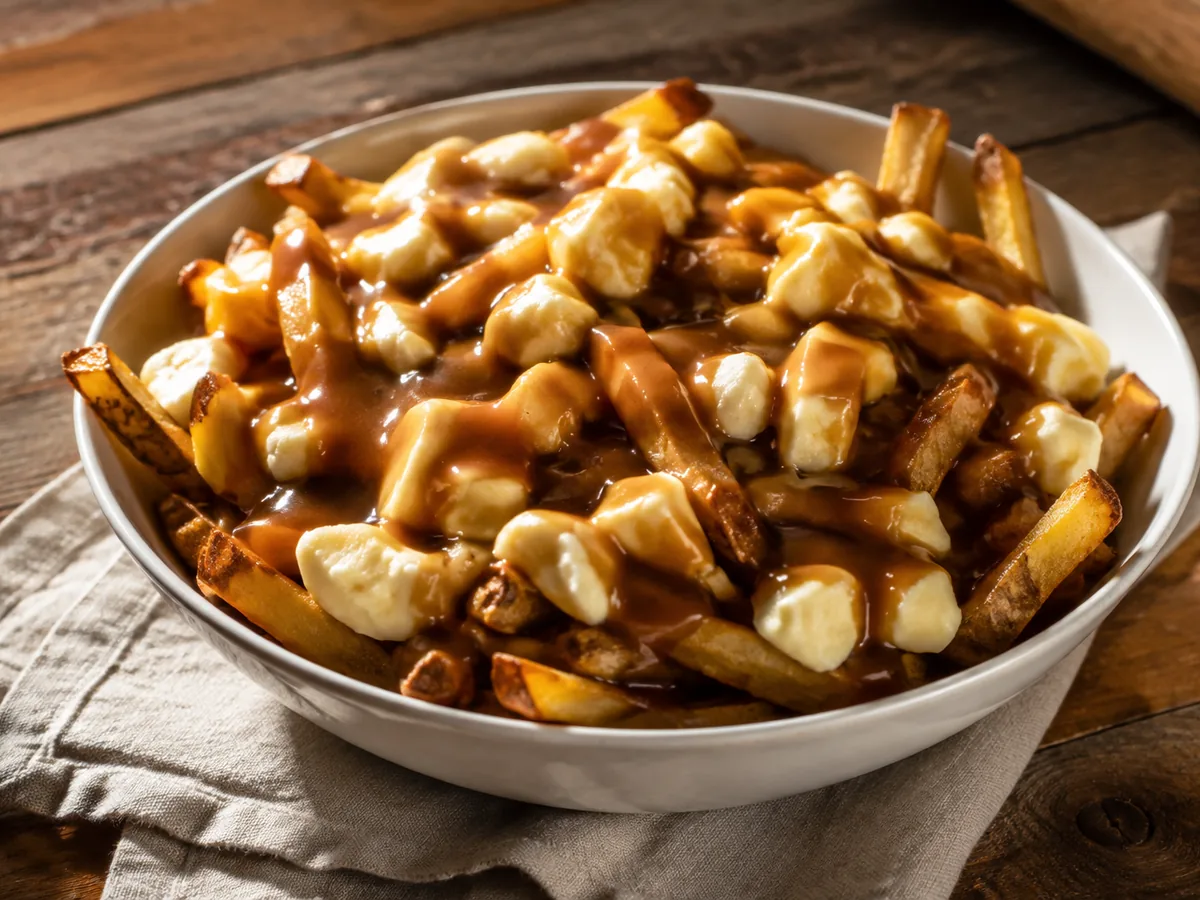
The Quebec diner icon done properly. Russets soaked, blanched at 160 °C and crisped at 190 °C, fresh cheddar curds kept at room temperature so they squeak, and a peppery sauce brune of beef and chicken stock ladled over at 90 °C so the curds soften at the edges without melting into soup.
- Prep
- 30 min
- Cook
- 25 min
- Serves
- 4
- Difficulty
- Medium
Researched · Kitchen testing pending
In the late 1950s, dairy-country diners between Warwick and Drummondville started tossing hot fries and fresh cheddar curds together in paper bags. The curds sweated and softened, a ladle of scalding brown gravy went over the top, and a messy, unctuous comfort food was born.
A proper poutine is strict about temperatures. The potatoes are aged russets, soaked and double-fried in tallow until brittle. The curds are fresh, never refrigerated, and at room temperature so they squeak while warming instead of melting into grease. The sauce brune is a pepper-forward blend of beef and poultry stock over a dark roux, ladled at 90 °C to warm the curds to a molten core.
Fries and curds
- 1.2 kg2.6 lbRusset Burbank potatoes, scrubbed and cut into 1 cm batons
- 350 g3 cupsFresh white cheddar cheese curds, at room temperature, never refrigerated
- 2 L8.5 cupsBeef tallow or peanut oil, for double frying
Sauce brune
- 45 g3 TbspUnsalted butter
- 30 g¼ cupPlain flour, for the roux
- 15 g1 Tbsp + 1 tspCornflour dissolved in 30 ml cold water
- 500 ml2.1 cupsUnsalted beef bone broth, hot
- 400 ml1.7 cupsChicken or veal bone broth, hot
- 15 g1 TbspTomato paste
- 15 ml1 TbspApple cider vinegar
- 15 ml1 TbspWorcestershire sauce
- 1 large1 largeShallot, minced fine
- 2 cloves2 clovesGarlic, minced to a paste
- 8 g1½ tspFine sea saltplus more for the fries
- 4 g1½ tspCoarsely cracked black pepperthe peppery bite is mandatory
Why two fries
Soaking the cut batons for an hour washes off surface starch so they do not scorch. The first fry at 160 °C cooks the inside to fluffy mash without browning. The second at 190 °C flashes the moisture out of the skin and leaves a rigid, blistered shell that stands up to gravy.
Why the curds squeak
Fresh curds hold an intact, elastic casein network at a pH around 5.3. Refrigeration crystallises calcium lactate and the squeak is gone. Kept at room temperature, 90 °C gravy warms them to about 50 °C, so the inside turns to gooey ribbons while the outside still squeaks.
Neither beef gravy nor chicken gravy
Sauce brune is a hybrid: dark beef stock and poultry stock over a hazelnut roux, sharpened with cider vinegar and a lot of black pepper.
The five tastes on this plate
Salt is coarse salt on the fries and the lactic salinity of the curds. Fat is tallow, the butter roux and whole-milk curds. Acid is cider vinegar and tomato paste against the gravy. Heat is cracked black pepper and a little garlic. Umami is roasted bone stock, tomato paste, Worcestershire and cheddar.
Equipment
- 6-quart enamelled cast-iron Dutch oven with a deep-fry thermometer
- 2-quart heavy saucepan and a whisk
- Wire spider skimmer and wire racks
- Four wide, shallow bowls
The diner version comes from a deep-fryer and a warming well. At home a Dutch oven with a clip-on thermometer gives you the two exact oil temperatures the fries depend on.
Method
Cut and soak the potatoes1 hr
Cut the potatoes lengthwise into 1 cm batons and drop them straight into cold running water, agitating to wash away the cloudy starch. Drain, refill with cold water, and soak for an hour. Drain, spread on clean towels in a single layer and pat completely dry.
Cut potatoes into 1 cm batons; rinse under cold running water, agitating away starch. Drain, refill cold and soak 1 hour. Drain and spread in one layer on towels; dry completely.
Simmer the sauce brune25 min
Melt the butter in the saucepan over medium heat and sweat the shallot and garlic 3 minutes. Whisk in the flour and cook 4 to 5 minutes, whisking constantly, until the roux is a deep hazelnut brown. Whisk in the tomato paste for a minute. Stream in the hot beef and chicken broths, whisking hard to keep it smooth. Add the vinegar, Worcestershire, pepper and salt, bring to a boil, then simmer on low 15 minutes.
Whisk in the cornflour slurry and simmer 3 minutes until glossy and thick enough to coat a spoon. Hold at 90 °C on the lowest heat.
Sweat shallot and garlic in butter over medium 3 minutes. Whisk in flour; cook 4–5 minutes to hazelnut brown, then tomato paste 1 minute. Whisk in hot broths, vinegar, Worcestershire, pepper and salt. Boil; simmer low 15 minutes. Add cornflour dissolved in 30 ml cold water; simmer 3 minutes until glossy and spoon-coating. Hold at 90 °C.
The first, blanching fry12 min
Heat the tallow in the Dutch oven to exactly 160 °C. Fry the dried batons in two batches for 5 to 6 minutes, until soft and cooked through but still pale. Lift out with the spider and drain in a single layer on racks. Cool at least 20 minutes, or freeze up to 2 hours for extra crunch.
Heat tallow to 160 °C. Fry dried potatoes in two batches, 5–6 minutes each, until cooked but pale. Drain in one layer on racks; cool at least 20 minutes, or freeze up to 2 hours.
The second, crisping fry8 min
Bring the oil to 190 °C. Return the blanched fries in batches and fry 3 to 4 minutes, tossing gently, until deep golden, blistered and rattling like dry sticks against the spoon. Tip into a wide bowl, salt at once, and go straight to assembly.
Bring the oil to 190 °C. Return the blanched fries in batches and fry 3 to 4 minutes, tossing gently, until deep golden, blistered and rattling like dry sticks against the spoon. Tip into a wide bowl, salt at once, and go straight to assembly.
Assemble2 min
Divide the hot fries among four bowls. Scatter the room-temperature curds over and between them, tucking curds into the gaps so they take the heat. Ladle the scalding sauce brune over everything, coating the fries and blanketing the curds. Rest 60 seconds so the curds soften at their edges, and serve with forks.
Divide hot fries among four bowls. Tuck room-temperature curds between and over them; coat everything with hot sauce brune. Rest 60 seconds to soften curd edges, then serve with forks.
Sensory cues of doneness
- Visual: golden fries piled with white curds under glossy mahogany gravy, the curds softened at the edges but not collapsed.
- Auditory: a loud, rigid rustle as the fries are tossed, and a rubbery squeak as teeth close on a warm curd.
- Olfactory: tallow-fried potato, peppery roasted beef gravy, cider vinegar and fresh lactic curds.
Check for golden fries and white curds with softened edges, still holding shape under glossy mahogany gravy. Expect crisp fries, squeaky curds and potato, peppery gravy, cider vinegar and dairy aromas.
Troubleshooting
- Cold, rubbery lumps of cheese that never soften.
The curds came from the fridge and dropped the gravy temperature. They must be fresh and held at room temperature.
- Soggy, oil-logged fries that collapse under the gravy.
They were fried once. Blanch at 160 °C and crisp at 190 °C; the double fry is not optional.
- Watery, bland gravy.
Weak canned broth. The sauce needs roasted beef and chicken bone stock over a dark roux, finished with cracked pepper and vinegar.
Substitutions
One-to-one swaps, with the technique change each one needs.
Ingredient substitutions
| Ingredient | Replace with | Culinary impact and technique adjustment |
|---|---|---|
| Fresh cheese curds | Whole-milk low-moisture mozzarella, cut into 2 cm chunks | Must be fresh and brought to room temperature before plating |
| Beef tallow | Peanut oil or high-oleic canola | One-to-one. Peanut oil crisps well; tallow gives the traditional richness |
| Apple cider vinegar | White wine vinegar or malt vinegar | One-to-one. Supplies the acid the gravy needs |
Scaling
Half, for 2
Halve everything. The gravy simmers in 12 minutes; keep the oil at the same two temperatures.
Double, for 8
Double the ingredients, simmer the gravy in a 4-quart pot, and fry the potatoes in four batches so the oil never drops.
What to serve it with
- A cold Montreal red ale or a crisp blonde such as Blanche de Chambly
- Garlic dill pickle spears, for acid between rich bites
- Mayonnaise or yellow mustard on the side, for dipping
Questions
Why do fresh curds squeak?
Intact, elastic casein strands vibrate against tooth enamel. Refrigeration breaks that network down and silences them.
Can I use mozzarella?
Shredded mozzarella melts into a stringy, oily soup. If real curds are impossible, cut fresh whole-milk block mozzarella into irregular 2 cm cubes and pat them dry.
What makes poutine sauce different from gravy?
It is a hybrid of dark beef stock and poultry broth, sharpened with black pepper and cider vinegar, rather than a plain beef or chicken gravy.