Feijoada
Black beans and salted, smoked, and fresh pork on one stove, simmered until the broth turns ink-dark. A Saturday, with rice, farofa, orange, and couve waiting.
- Prep
- 1 hr 30 min
- Cook
- 3 hr 30 min
- Serves
- 8–10 generous servings
- Difficulty
- Hard
Researched · Kitchen testing pending
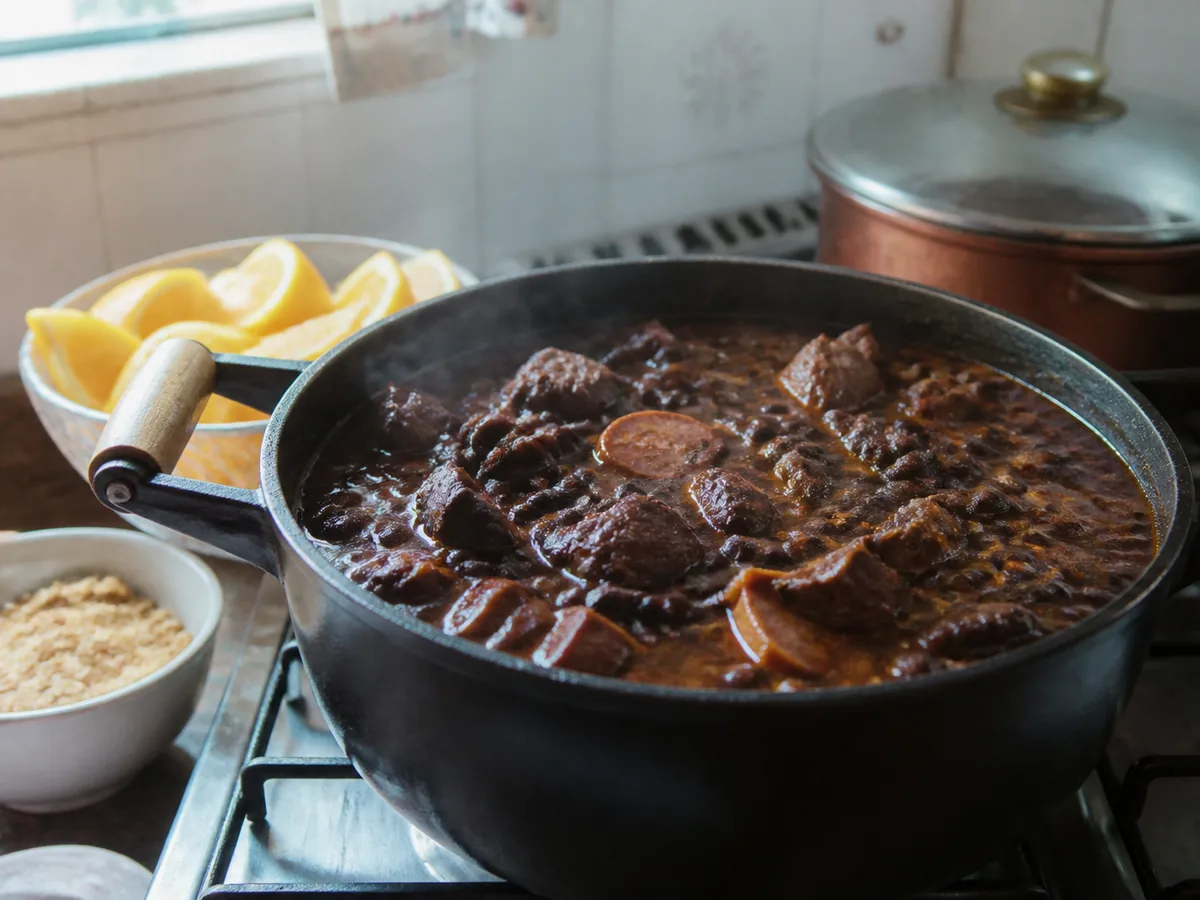
I start the beans Thursday night when I know Saturday lunch is going to be a full table. That overnight soak is not optional for me — under-soaked black beans stay chalky at the core even after a long simmer, and the broth never turns the deep purple-black I want.
This is the Saturday feijoada I make when I have room for pork cuts, sausage, and carne seca on the same stove, with rice, farofa, orange, and couve waiting on the side.
I ladle into wide bowls so rice, stew, farofa, couve, and orange all fit. The first spoonful should taste smoky, beany, and roundly salty, with the orange brightening the next bite.
When the pot went right, the table goes quiet for a minute. That is feedback I trust more than my tasting spoon.
Beans and broth base
- 1 kg2.2 lbDried black beans (feijão preto), sorted and rinsed
- 3.5 L3.7 qtCooking water, to startplus more as needed to keep the beans submerged. Soaking water is separate — cover by 8 cm
- 2 leaves2 leavesBay leaves
- 300 g1 largeOnionhalf left whole for the pot, half diced for the sofrito
- 10 cloves10 clovesGarlic6 smashed for the pot, 4 minced for the sofrito
- 1 tsp1 tspKosher salt, to startyou will adjust late — the cured meats add salt
Pork and beef cuts
- 400 g14 ozCarne seca (Brazilian dried salted beef)cut into 4 cm pieces after desalting
- 500 g1.1 lbSmoked pork ribs, cut between the bones
- 300 g10.5 ozLinguiça calabresa or similar smoked pork sausagesliced into 2 cm rounds
- 250 g9 ozPaio, or another smoked Brazilian sausageleft in large chunks
- 300 g10.5 ozFresh pork belly or thick bacon slab, in 3 cm cubes
Optional extremities — label them if you serve guests
- 200 g7 ozPork ear, cleaned and splitgelatin and body. Leave it out for a lighter pot without apology
- 250 g9 ozPork tail, cleaned and split
- 400 g14 ozPig's feet, cleaned and split2
The sofrito finish
- 2 tbsp2 tbspNeutral oil or lard
- 1 small1 smallTomato, seeded and dicedoptional — some houses skip it
- a handfula handfulFlat-leaf parsley, chopped
- ½ orange½ orangeOrange zestoptional, but I use it
For the table — do not skip
- 400–500 g2–2½ cupsLong-grain white rice, cooked plainsalted water, no stock — the stew is the flavour
- 200 g2 cupsFarinha de mandioca, for farofatoasted with butter and onion — see the serving notes
- 2–32–3Oranges, peeled and sliced into rounds
- 500 g1.1 lbCollard greens, stems removed, sliced into thin ribbons2 bunches, for couve mineira
The calendar
Soak Thursday night. Cook Friday evening or Saturday morning. Serve Saturday midday or early afternoon, when it tastes best. About 90 minutes of active work spread across the day, plus an overnight soak and a 2½ to 3½ hour simmer.
On the overnight soak
Not optional, for me. Under-soaked black beans stay chalky at the core even after a long simmer, and the broth never turns the deep purple-black I want. Soaked beans should plump, and the skin should slip under a fingernail. If your kitchen is above about 27 °C / 80 °F, soak in the fridge. Quick-soak if Saturday got away from you: boil 2 minutes, cover off the heat 1 hour, drain, proceed. Second-best texture.
On the carne seca
Cover the pieces with cold water and change it 3 or 4 times over 8 to 12 hours — or simmer 20 minutes, drain, and soak again in fresh cold water for an hour. Taste a tiny shred afterwards: it should be pleasantly salty, not punishing. Undesalted carne seca will wreck the pot, and you cannot un-salt it later. Once desalted it is no longer shelf-stable. Treat it like fresh meat for fridge timing.
On the optional extremities
Ear, tail, and feet give gelatin and body to a feijoada completa. They also get a separate 20-minute open boil first, drained and rinsed, which pulls off scum and some of the stronger smell. Leave them out and it is still feijoada. Say so on the card.
On the table, which is structural
Rice, farofa, orange, and couve are not garnish theatre. Orange acid and perfume cut pork fat. Farofa drinks broth and adds crunch. The greens are the only fresh thing on the plate. Farofa sketch: toast 2 tbsp butter or drippings, soften half a small onion, stir in 200 g farinha de mandioca until sandy-gold and fragrant, 4 to 6 minutes. Salt lightly.
Equipment
- A large non-reactive bowl for soaking beans, and a separate one for desalting the carne seca
- An 8 to 10 L heavy pot or Dutch oven — enamelled cast iron works well
- A skillet, for the sofrito and the couve
- A slotted spoon, ladle, and tasting spoon
- A cutting board dedicated to raw pork, washed hot afterwards
A 6 to 8 L pressure cooker is a labelled departure for a weekday or a single-burner kitchen — the timing is in the substitutions. It is not the headline method here.
Method
The night before — soak and desalt10 min active, 8–12 hours passive
Spread the black beans on a tray, pick out stones and shrivelled beans, and rinse under cold water until it runs clearer. Cover with cold water by at least 8 cm and leave 8 to 12 hours.
At the same time, start desalting the carne seca — cold water, changed 3 or 4 times.
Sort and rinse beans; cover with cold water by 8 cm and soak 8–12 hours, refrigerating if the kitchen exceeds 27 °C / 80 °F. Separately desalt carne seca in cold water, changing it 3–4 times; treat desalted meat as fresh for refrigeration.
Parboil the extremities, if you are using them25 min
Put the ear, tail, and feet in a separate pot, cover with cold water, bring to a boil, skim the foam, and simmer 20 minutes. Drain and rinse. Pat dry.
This first boil pulls off excess scum and some of the stronger smell.
Skip this entire step if you are not using those cuts.
If using ear, tail or feet, cover them with cold water in a separate pot. Bring to a boil uncovered, skim, then simmer 20 minutes. Drain, rinse and pat dry; otherwise skip this step.
Start the beans0:00
Drain the soaked beans. Into the heavy pot with 3.5 L of fresh water, the whole onion half, the smashed garlic, and the bay leaves.
Bring to a boil over high heat, then drop to a steady simmer. Skim the purple-grey foam for the first 10 minutes.
At this stage the liquid smells earthy and clean, not meaty yet.
Drain soaked beans and add to a heavy pot with 3.5 L fresh water, the whole onion half, smashed garlic and bay. Boil over high heat, reduce to a steady simmer and skim for 10 minutes; keep beans submerged.
Tougher meats first0:20 · then 1 hour
Add the desalted carne seca, the smoked ribs, and any parboiled ear, tail, or feet.
Keep a gentle simmer — small bubbles breaking, not a rolling boil that frays bean skins into mush. Partially covered. One hour.
The broth will darken from ink-wash grey toward deep brown-black. The ribs should start to pull slightly from the bone but not fall apart yet.
At 20 minutes, add desalted carne seca cut into 4 cm pieces, smoked ribs and any parboiled extremities. Simmer gently, partially covered, for 1 hour; avoid a rolling boil. Ribs should begin releasing from bones without falling apart.
Sausages and belly1:20 · then 45–75 min
Add the linguiça, paio, and pork belly cubes. Continue simmering 45 to 75 minutes more — a total bean simmer of roughly 2 to 2¾ hours, depending on how old the beans are.
Taste a bean: it should crush easily between tongue and palate with no chalky centre. The broth should coat a spoon lightly — gelatin from the extremities and collagen from the ribs thicken it naturally.
Add linguiça, paio and pork belly; simmer 45–75 minutes more. Beans should crush easily with no chalky centre, and the broth should lightly coat a spoon. Keep enough water in the pot to submerge the beans.
The sofrito finishabout 2:30
In a skillet, heat the oil or lard over medium until it shimmers, around 175 °C / 350 °F. Soften the diced onion 6 to 8 minutes until translucent and sweet-smelling, not browned hard. Minced garlic for 60 to 90 seconds — raw edge gone, not bitter. Optional tomato, 2 to 3 minutes, until it collapses.
Ladle two cups of bean broth into the skillet, scrape, and pour the whole sofrito back into the big pot. Stir.
Season with salt only now, tasting first — the cured meats may have you close already. Pepper, and the optional orange zest. Simmer 10 to 15 minutes uncovered so it marries and the surface looks glossy, not watery.
Heat oil or lard over medium to about 175 °C / 350 °F. Soften onion 6–8 minutes, garlic 60–90 seconds, then optional tomato 2–3 minutes. Deglaze with 2 cups bean broth and return to pot. Taste before salting; add pepper and optional zest, then simmer uncovered 10–15 minutes.
Rest before serving15–30 min
Kill the heat. Feijoada tastes rounder after a short rest; the fat rises and you can skim it for a cleaner bowl.
Fish out the bay leaves and the spent onion half. Keep the meats in large pieces for a platter, or chop some into the beans for mixed bowls — both are correct.
Turn off the heat and rest 15–30 minutes. Skim risen fat if desired; remove bay leaves and the onion half. Serve meats in large pieces on a platter or chop some into the beans.
Rice and couve, while the pot rests20 min
Rice: cook it plain, in salted water, no stock.
Couve mineira: heat 1 to 2 tbsp of oil or bacon drippings in a wide skillet over medium-high. When it is hot, add the ribboned collards with a pinch of salt and a minced garlic clove or two. Toss 3 to 5 minutes until the greens turn bright and then deep green — wilted, still with a slight chew.
They should smell garlicky and sweet-vegetal. Sulfurous means you overcooked them, or crowded a cold pan.
Cook rice in salted water. Toss collards with 1–2 tbsp hot oil or drippings, salt and 1–2 minced garlic cloves over medium-high, 3–5 minutes until wilted but chewy. For farofa, soften ½ small onion in 2 tbsp butter or drippings; toast 200 g farinha 4–6 minutes until golden, then salt lightly. Serve with orange slices.
Storing it
Cooling and keeping
Cool leftovers in shallow containers and refrigerate within 2 hours. Do not leave a full stockpot on the counter all afternoon in warm weather. Fridge 3 to 4 days, sealed. Freeze up to 3 months — beans freeze well. Thaw overnight in the fridge and reheat to a full simmer, steam rising, before serving again. Add a splash of water if it has set into a brick. Day two is often better: the salt balances and the broth tightens.
Raw pork, and the buffet
Separate board; wash hands and knives with hot soapy water. Optional extremities must be cleaned thoroughly before the first boil. If the pot sits out during a long lunch, hold it above 60 °C / 140 °F — a covered Dutch oven at 90 °C, or a slow cooker on warm. Stir, and add hot water if it thickens.
Troubleshooting
- Beans still hard after hours.
Old beans, hard water, acid added too early, or an under-soak. Keep simmering. A pinch of baking soda (⅛ tsp) can help stubborn beans — use it sparingly or the flavour turns soapy. Next time, soak longer and buy fresher beans.
- The broth is too salty.
Carne seca or sausage under-desalted, or salt added early. Dilute with unsalted cooked beans and water, and serve with unsalted rice and extra orange. Peeled raw potato chunks for 20 minutes are mild help at best.
- The broth is thin and grey.
Short cook, no collagen cuts, or too much water. Simmer uncovered to reduce, and mash a ladle of beans against the pot wall. Next time include a foot, or more ribs.
- The meats are dry.
Lean cuts simmered too hard for too long. Slice and moisten with broth. Next time keep a gentler simmer and add the sausages later.
- A greasy surface.
Belly and bacon fat with no skim. Chill briefly and lift the fat cap, or blot with a ladle. Farofa and orange on the plate cut the richness.
- Muddy flavour.
A scorched bottom, or bitter garlic. Do not scrape burnt bits into the stew. Next time stir more and add the garlic later, in the sofrito.
Substitutions
Traditional — the main path
Overnight soak; open-pot long simmer; a mix of carne seca, ribs, smoked sausages, and belly; optional ear, tail, and feet included and named; a sofrito of onion and garlic stirred in at the end; Saturday service with rice, farofa, orange, and couve.
Departures I use, and label
Skipping ear, tail, and feet — still feijoada, and say so on the card. Spanish chorizo or kielbasa when linguiça and paio are unavailable, with the salt adjusted down. No carne seca: extra ribs and sausage, and liquid smoke only if you must, and admit it.
Not a departure — a different dish
A vegetarian black-bean stew with paprika and mushrooms is its own thing. Do not call it feijoada.
Pressure cooker, labelled
Same ingredients, different clock, for a rented kitchen with one burner or a Saturday that got away from you. After soaking and desalting: combine drained beans, meats — extremities still get their separate 20-minute open boil first — aromatics, and water to cover by 3 cm. High pressure 35 to 45 minutes, natural release 15. Open, check the beans, then do the skillet sofrito and the 10-minute open simmer as above. Texture is slightly less layered, and beans go from perfect to blown in a narrow window, so err early and finish open. I do not present it as "the real way."
Scaling
Salt does not scale linearly when cured meats dominate. Taste late, every time.
Half and double
Half (4–5 people): halve the beans and meats, use a 5 L pot, start with about 1.75 L of water. Simmer times stay similar — beans do not cook faster because the pot is smaller; heat penetration through each bean is what matters. Double (16–20): two pots beat one overcrowded cauldron. Crowding drops the temperature and extends the time unpredictably. Season each pot separately at the end.
What to serve it with
Rice mounded on the plate first, feijoada ladled beside or over it.
- Farofa, sprinkled over the stew at the table
- Sliced orange on every plate — the acid is structural, not decoration
- Couve mineira, the garlicky collards
- Vinaigrette salsa of tomato, onion, and vinegar, on the table
- Cold beer, a caipirinha, or coffee afterwards
Smoke and orange fight most wines. Fried banana appears in some regions — I leave it off unless someone asks.
Questions
Can I use canned black beans?
In a rush: drain and rinse two large cans per 250 g dried equivalent, simmer the meats 45 to 60 minutes, and accept a thinner broth. I still prefer dried.
Do I have to use ear, tail, and feet?
No. They add gelatin in a completa. Label them optional and skip them when that is kinder to your table.
Why orange with a meat stew?
Fat needs acid and perfume. Orange is classic here; lime works; lemon is harsher.
Can I make it Saturday morning with no overnight soak?
Quick-soak: boil 2 minutes, cover off the heat 1 hour, drain, proceed. Second-best texture — and start desalting the carne seca on Friday regardless.
Is feijoada only for Saturday?
Saturday lunch is the ritual. The stew is fine on a Wednesday; the gathering is what Saturday means.
How do I keep it warm for a buffet?
A covered Dutch oven at 90 °C / 195 °F, or a slow cooker on warm. Stir, and add hot water if it thickens.
Is it gluten-free?
Beans, meat, and rice are naturally gluten-free. Check the sausage fillers for wheat, and confirm the farofa is pure manioc.