Medialunas
Small butter-laminated crescents, baked pale-gold and lacquered with hot syrup the moment they leave the oven. A factura for coffee, not a croissant.
- Prep
- 1 hr 30 min
- Cook
- 16 min
- Serves
- 12–16 medialunas
- Difficulty
- Hard
Kitchen-tested
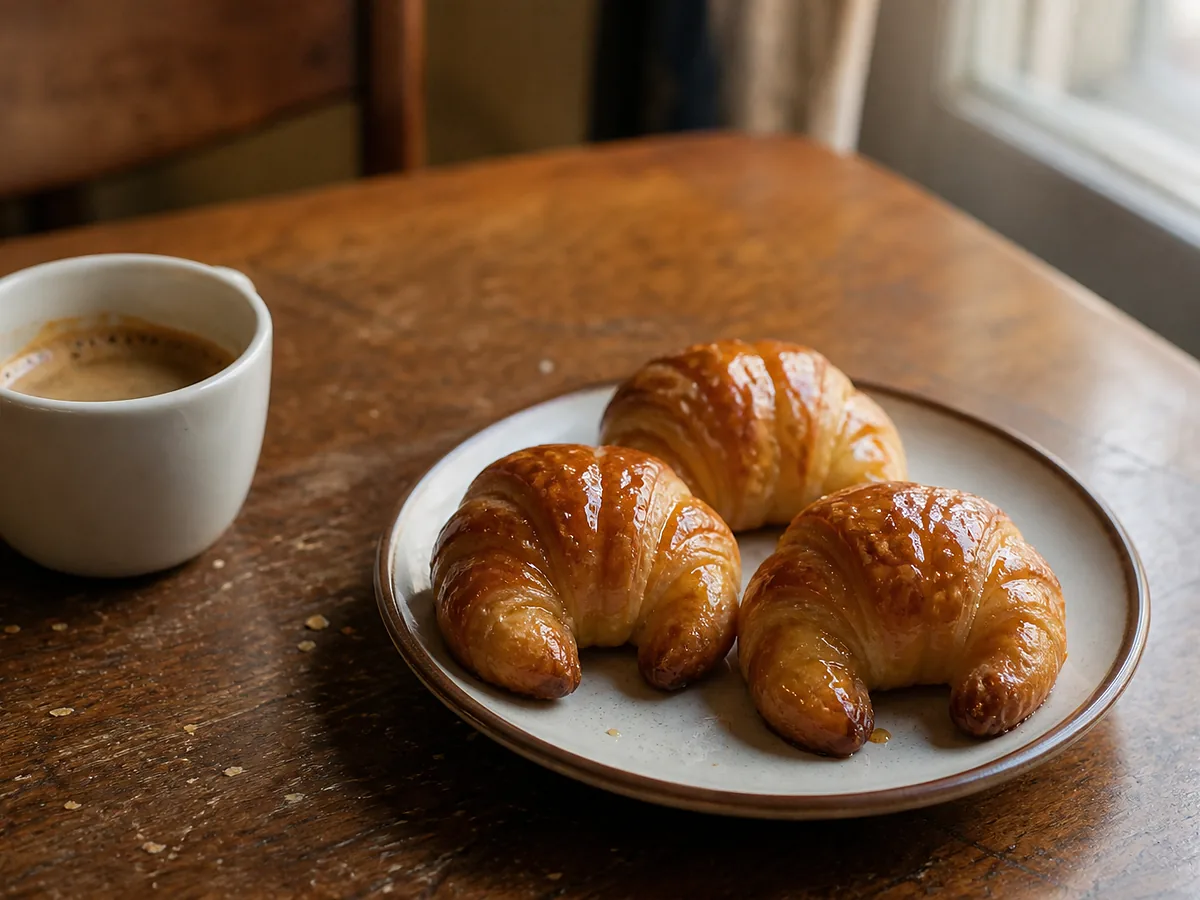
A medialuna de manteca is a factura: a small, sweet, butter-laminated crescent, baked pale-gold and lacquered with hot sugar syrup while it is still hot. It is not a French croissant. Croissants are leaner, puffier, darker, unsyruped, and treated as bread. Medialunas are pastry for coffee — breakfast, merienda, and whenever the jar of dulce is already open.
The rule people get wrong is baking them like croissants: too little sugar in the dough, no almíbar, too much oven colour, too much puff. The other way to ruin them is rushing the folds so the butter leaks onto the tray and you get fried bread. Two mistakes, same result: something that is not a medialuna.
There is a sibling. Medialunas de grasa are made with lard, less sweet, more savoury — a different pastry. I am not writing that one here.
The dough
- 500 g4 cupsHarina 000, or unbleached all-purpose flourspooned and levelled. Not high-protein bread flour
- 150 ml⅔ cupWhole milk, lukewarm35–38 °C / 95–100 °F
- 80 g⅓ cup plus 1 tbspGranulated white sugar
- 10 g3¼ tspInstant dry yeastor 25 g fresh yeast, dissolved in the milk
- 50 g1 eggEgg, at room temperature, beaten
- 40 g3 tbspUnsalted butter, softthis is the dough butter, not the lock-in
- 10 g1¾ tspFine salt
Lock-in butter
- 180 g12½ tbspUnsalted butter, cold but pliable82% fat if you can get it
Egg wash
- 50 g1 eggEgg, beaten with a pinch of salt
- 15 ml1 tbspWhole milk
Almíbar — the syrup
- 100 g½ cupGranulated white sugar
- 100 ml⅓ cup plus 1 tbspWater
- 2.5 ml½ tspVanilla extractoptional, off the heat
Yield and timing
12–16 medialunas. About 90 minutes of active work spread over two days. The overnight cold ferment is not optional: mix in the evening, then fold, shape, and bake the next day.
The numbers
Sugar in the dough at 80 g per 500 g flour is 16% baker's percent; lock-in butter at 180 g is 36% of the flour weight. Both are home-kitchen starting points for *de manteca*, not a plant formula. French croissant dough runs leaner on sugar and higher on lock-in butter — correct toward those numbers and you will bake croissants.
On the flour and the sugar
Harina 000 is the Argentine bag: moderate protein, tender crumb. US all-purpose is the closest stand-in. Bread flour at 12–13% protein makes a chewy medialuna that fights the syrup; if that is what you have, cut it with 20% cake flour or accept the chew. This is a sweet factura, not laminated bread. Sugar tenderises — it competes with flour for water, so gluten develops less — browns a little, and is why a medialuna tastes like itself before the syrup goes on. Cut it to croissant levels and the syrup has to do work the dough should have done.
On the two butters
Forty grams go into the dough so it is rich before you laminate. One hundred and eighty grams get locked in as a slab. They are not interchangeable. Dough butter should be soft. Lock-in butter should be cold but bend, about 13–16 °C / 55–60 °F — the same stiffness as the chilled dough. Harder, and it shatters into shards. Softer, and it smears and leaks. Either way: no layers. European-style butter around 82% fat behaves; US 80% butter carries more water and leaks more readily, though it still works if the temperature is right.
On the syrup
Equal weights sugar and water is the almíbar de brillo I use. Simmer until the sugar is gone and the liquid is clear, not until you have candy. Optional vanilla off the heat; orange peel or rum are variations. The requirement is hot syrup on hot pastry. Cold syrup sits on top. Hot syrup on a cooled medialuna does not soak in.
On the sibling you are not making
Medialunas de grasa are made with lard, less sweet, more savoury — a different pastry. Swapping lard into this dough does not give you de grasa. It gives you a confused de manteca.
Equipment
- A wide mixing bowl and a work surface you can flour
- A wooden rolling pin — not a wine bottle; you need even pressure
- A bench scraper, and a ruler or tape
- Plastic wrap or a clean bag for the overnight rest
- Two baking sheets and parchment
- A pastry brush
- A small saucepan for the syrup
Not needed, and actively harmful: a 220 °C / 425 °F croissant oven (dark, hollow, unsyruped bread); a pasta machine (butter smears); a food processor (overworks and warms the dough); a proofing box at 32 °C / 90 °F (butter melts, layers vanish). A room that is merely not cold is enough.
Method
Mix the dough15 min
With instant yeast: combine the flour, sugar, yeast, and salt, then add the lukewarm milk, beaten egg, and the 40 g of soft dough butter. With fresh yeast: dissolve it in the lukewarm milk first, then add that to the flour with everything else.
Mix until there is no dry flour. Knead 8–10 minutes until smooth and slightly tacky, not wet. If it tears instead of stretching, knead another minute. If it sticks badly, flour the bench lightly — extra flour dries the pastry.
Mix flour, sugar, instant yeast and salt; add milk at 35–38 °C / 95–100 °F, the beaten egg and 40 g soft dough butter. If using fresh yeast, dissolve it in the milk first. Knead 8–10 minutes until smooth and slightly tacky, adding another minute if it tears. Use minimal dusting flour.
Bulk, then the overnight cold ferment45 min, then 8–14 hours
Ball the dough, set it in a lightly oiled bowl, and cover it. Room temperature, 24–26 °C / 75–79 °F, until it has risen by about half — 40–60 minutes. Alive, not doubled into a balloon.
Punch it down gently, flatten to a rectangle about 2 cm thick, wrap it tight, and refrigerate overnight.
The fridge does three jobs: slows the yeast for flavour, firms the dough for the butter slab, and gives you a morning start instead of laminating when the butter is already too warm. Overnight is the method.
Cover in a lightly oiled bowl and rise at 24–26 °C / 75–79 °F for 40–60 minutes, until about half again its original size, not doubled. Deflate gently, flatten to a 2 cm-thick rectangle, wrap tightly and refrigerate 8–14 hours overnight.
Make the butter slab10 min, plus a short chill
Beat the 180 g of lock-in butter between parchment into a rectangle about 15 × 20 cm, even in thickness. It should bend without cracking.
Rock-hard: five minutes on the bench. Greasy, with fingerprints that stay: chill 10 minutes. Dough and butter should indent similarly under a finger.
Pound the separate 180 g lock-in butter between parchment to an even 15 × 20 cm slab. It must bend without cracking and feel as firm as the cold dough, roughly 13–16 °C / 55–60 °F. If brittle, leave out five minutes; if greasy, chill 10 minutes.
Lock in15 min
Dough straight from the fridge. On a lightly floured bench, roll it to about 30 × 22 cm, roughly twice the butter slab. Butter in the centre. Fold the flaps over so they meet, and pinch the seams. A closed packet, no windows.
Roll gently to about 20 × 45 cm, keeping the edges square. If butter breaks through, patch it with flour and chill 15 minutes. Forcing a leaky packet is how you fry them later.
Roll chilled dough on a lightly floured surface to about 30 × 22 cm. Center the butter, fold the flaps over to meet and pinch seams shut. Gently roll the sealed packet to 20 × 45 cm, keeping square edges. If butter breaks through, patch with flour and chill 15 minutes.
Three letter folds20 min work · 20–30 min chill between each
A letter fold: divide the long rectangle in thirds, fold the bottom third up and the top third down, square the edges, wrap, and refrigerate 20–30 minutes.
Repeat: roll to about 20 × 45 cm, letter fold, chill. Third time the same. Three folds is enough — you are not chasing croissant honeycomb, and extra folds on a warm bench smear butter and erase the work.
Rest 30–60 minutes in the fridge after the last fold, or overnight again if the day got away from you. Cold dough cuts clean.
Rolling warms butter into a paste; the fridge sets it so the next roll shears dough against butter instead of mixing them. That shear is the lamination. Skip the rest and you skip the pastry.
Fold the bottom third up and top third down like a letter. Square, wrap and chill 20–30 minutes. Repeat rolling to 20 × 45 cm, folding and chilling until you have made three folds total. After the last fold, chill 30–60 minutes, or overnight. Do not add extra folds or roll warm, leaking butter.
Shape20 min
Roll to about 30 × 40 cm and 4–5 mm thick. Trim a sliver off the edges so you have clean laminated faces. Cut triangles with a base of about 8–9 cm and a height of about 15 cm — you should get 12 to 16.
Roll each triangle from the base toward the tip, reasonably tight but not a death grip, and tuck the tip underneath so it does not unfurl.
Curve them only slightly. A plump crescent, not a French hook — Argentine medialunas sit fatter and less arched. Leave 4–5 cm between them; they grow.
Roll to about 30 × 40 cm and 4–5 mm thick. Trim edges and cut 12–16 triangles, about 8–9 cm at the base and 15 cm high. Roll from base to tip, tuck tips underneath and curve gently. Space 4–5 cm apart on trays.
Proof90–150 min
Cover loosely. Proof at 24–26 °C / 75–79 °F until swollen and jiggly when you bump the tray, with the layers at the ends opened a little. A finger dent should fill back slowly.
Too warm and the butter melts out — greasy puddles, proof already lost. Too cold and you wait three hours. Underproofed bakes tight and dense; overproofed collapses and leaks. Ready when they look ready.
Cover loosely and proof at 24–26 °C / 75–79 °F for 90–150 minutes, until swollen and jiggly with slightly open end layers. A finger dent should recover slowly. Avoid warm spots that melt the butter; cooler dough may take longer.
Heat the oven, make the syrup15 min
Oven to 190 °C / 375 °F conventional, or 175 °C / 350 °F convection, rack in the middle. Gold, not mahogany.
Syrup: sugar and water to a simmer, stirring until the sugar is gone, 2–3 minutes. Off the heat, vanilla if you are using it. Keep it hot — a bare simmer while they bake. It needs to be liquid and steaming when they come out.
Heat oven to 190 °C / 375 °F conventional or 175 °C / 350 °F fan, middle rack. Simmer the syrup sugar and water for 2–3 minutes, stirring until dissolved; add optional vanilla off heat. Keep the syrup hot for glazing the hot pastries.
Egg wash and bake13–16 min
Brush with the egg wash lightly — not in puddles, and not drowning the exposed layers at the ends. Those layers should stay visible.
Bake until the tops are a clear golden: toasted milk, not croissant. 13 minutes is a look; 16 is the usual top. Set, not doughy in the crease; bottoms gold, not white.
Still pale at 16 minutes? Give them two more, but do not raise the oven. High heat puffs them into croissant territory and dries the crumb the syrup is about to feed.
Mix the egg-wash egg, milk and pinch of salt. Brush lightly without flooding exposed layers. Bake 13–16 minutes until golden on top and underneath, with no doughy crease. If still pale at 16 minutes, give them two more; do not increase the temperature.
Syrup while hot2 min
Tray out, brush the syrup on immediately and generously. The crust should look wet, and then shine.
Hot pastry drinks hot syrup. That lacquer is not garnish — it is how a medialuna stays tender into the afternoon instead of staling like a lean croissant.
Move them to a rack after a couple of minutes so the bottoms do not steam soggy. Eat one warm, which is the point.
Immediately brush the hot pastries generously with hot syrup until glossy. After a couple of minutes, transfer to a rack so the bottoms do not steam. Serve warm.
Storing it
How long they last
Same day is best. Next morning they are still good; day three they are bread. Room temperature, covered, on the day you bake. Overnight in a tin is fine in a cool kitchen. Refrigeration dries laminated pastry — freeze rather than fridge.
Freezing
Freeze them baked and wrapped, up to a month. Reheat from frozen at 150 °C / 300 °F for 6–8 minutes, and brush on leftover syrup if you saved any. You can also freeze them unbaked after shaping, before the proof: freeze solid, bag, thaw in the fridge, then proof until jiggly and bake.
Ordinary enriched-dough sense
Milk, egg, butter. Do not leave egg-washed, half-proofed medialunas in a hot kitchen for half a day. If the proof has collapsed or smells strongly alcoholic, bake them off or throw them out. Toss leftover egg wash.
Troubleshooting
- Butter leaked all over the tray.
Lock-in butter too warm, a skipped rest, or too hot a proof — the layers mixed. Next batch: colder dough, colder bench, actual rests. You cannot put leaked butter back inside.
- No layers, just a sweet roll.
Same cause as leaking, or a food processor, or lock-in butter added in pieces like pie dough. Lamination is a packet and then folds, not rubbed-in fat.
- Dense, tight, pale.
Underproofed, or the yeast was dead — milk too hot, or old yeast. They should jiggle before the oven. Raw in the crease is oven time; dense is yeast and time. Do not confuse them.
- Huge, hollow, dark, unsyruped.
You baked a croissant. Too hot an oven, too little sugar, no almíbar. Stay at 190 °C / 375 °F, keep the sugar, brush the syrup.
- They unfurled in the oven.
The tip was not tucked under, or they were underproofed and oven spring unwound them. Tuck the tip, proof until swollen.
- Syrup sat on top like varnish and stayed sticky.
The syrup was cold, or the pastry had already cooled, or you cooked it to candy. 1:1, simmered until clear, hot on hot.
- Dry by evening.
No syrup, too hot an oven, or bread flour. The almíbar is the staling insurance.
Substitutions
Swaps, and the verdict on each
| Swap | Verdict |
|---|---|
| Harina 000 / US all-purpose | Traditional, and the correct stand-in |
| Bread flour | Known departure. Chewier. Cut with cake flour if you must |
| Instant yeast, 10 g | What this recipe is written for |
| Fresh yeast, 25 g | Traditional panadería yeast. Dissolve it in the milk |
| Whole milk in the dough | Traditional |
| 80 g sugar in the dough | Starting point |
| Croissant-level sugar (~50 g) | Known departure. You are heading toward croissant |
| 40 g dough butter + 180 g lock-in | Starting point |
| All the butter in the dough, no lamination | Not a medialuna. That is a sweet roll |
| US 80% butter for lock-in | Usable. Watch the temperature; it leaks more easily |
| Lard in place of butter | Not a substitute. That is the de grasa sibling, a different pastry |
| Egg wash then syrup | Traditional for de manteca — shine plus colour |
| No syrup | Known departure. They stale faster and taste like under-sweet croissant |
Scaling
Keep the rests whatever the size. Proof time will not double — watch the jiggle.
| Row label | Half (~8) | Base (12–16) | Double (24–32) |
|---|---|---|---|
| Flour | 250 g | 500 g | 1 kg |
| Milk | 75 ml | 150 ml | 300 ml |
| Sugar (dough) | 40 g | 80 g | 160 g |
| Instant yeast | 5 g | 10 g | 20 g |
| Egg (dough) | 25 g | 50 g | 100 g |
| Dough butter | 20 g | 40 g | 80 g |
| Salt | 5 g | 10 g | 20 g |
| Lock-in butter | 90 g | 180 g | 360 g |
| Syrup sugar + water | 50 g + 50 ml | 100 g + 100 ml | 200 g + 200 ml |
Doubling
A double batch takes longer to roll, so split the packet after the last fold: work one half and keep the other in the fridge.
What to serve it with
Café con leche. That is the pairing — a glass or a cup, morning or 5 p.m.
- Café con leche
- Dulce de leche, split the medialuna and spread it — clásico, not repostero
- Nothing at all, still warm
A plain medialuna, still warm, is a complete object. Ham and cheese belongs more to de grasa; on de manteca the syrup makes it odd.
Questions
Are these croissants?
No. Same family of laminated dough, different pastry: more sugar, egg, and milk, a tighter smaller shape, a paler bake, and a hot syrup. Croissant technique used blindly produces croissants.
Butter or lard?
This recipe is de manteca — butter. De grasa is lard, less sweet, a sibling, not a swap.
Do I have to wait overnight?
Yes. You can compress the cold rest to 4 hours if the dough is fully chilled and firm, and the result is a little less flavourful and harder to roll. Overnight is the method I trust.
Why did the butter leak?
Temperature. Butter warmer than the dough, a proof above about 27 °C / 80 °F, or folds without rests. There is no patch for a tray of melted butter.
Can I skip the syrup?
You can, and they will not be the pastry this page is for. They stale faster and taste drier. The syrup is part of the crumb, not a glaze for photographs.
What oven temperature?
190 °C / 375 °F conventional, 175 °C / 350 °F convection, until golden, 13–16 minutes. Not 220 °C. If they colour too fast, drop 10 degrees and give them a minute more.
How many folds?
Three letter folds after lock-in. Enough for a medialuna. More folds on a home bench usually means more smearing, not more pastry.