Cracked Conch
The plate every Bahamian orders first when they come home. Cleaned conch sliced into cutlets and beaten thin until it gives up its chew, seasoned with lime, salt and a pinch of goat pepper, dredged in flour, dipped in egg and evaporated milk, coated in crumbs and fried at 180 °C in small batches until crisp and gold. Lime wedges and a cool pink sauce beside it.
- Prep
- 30 min
- Cook
- 15 min
- Serves
- 4
- Difficulty
- Medium
Researched · Kitchen testing pending
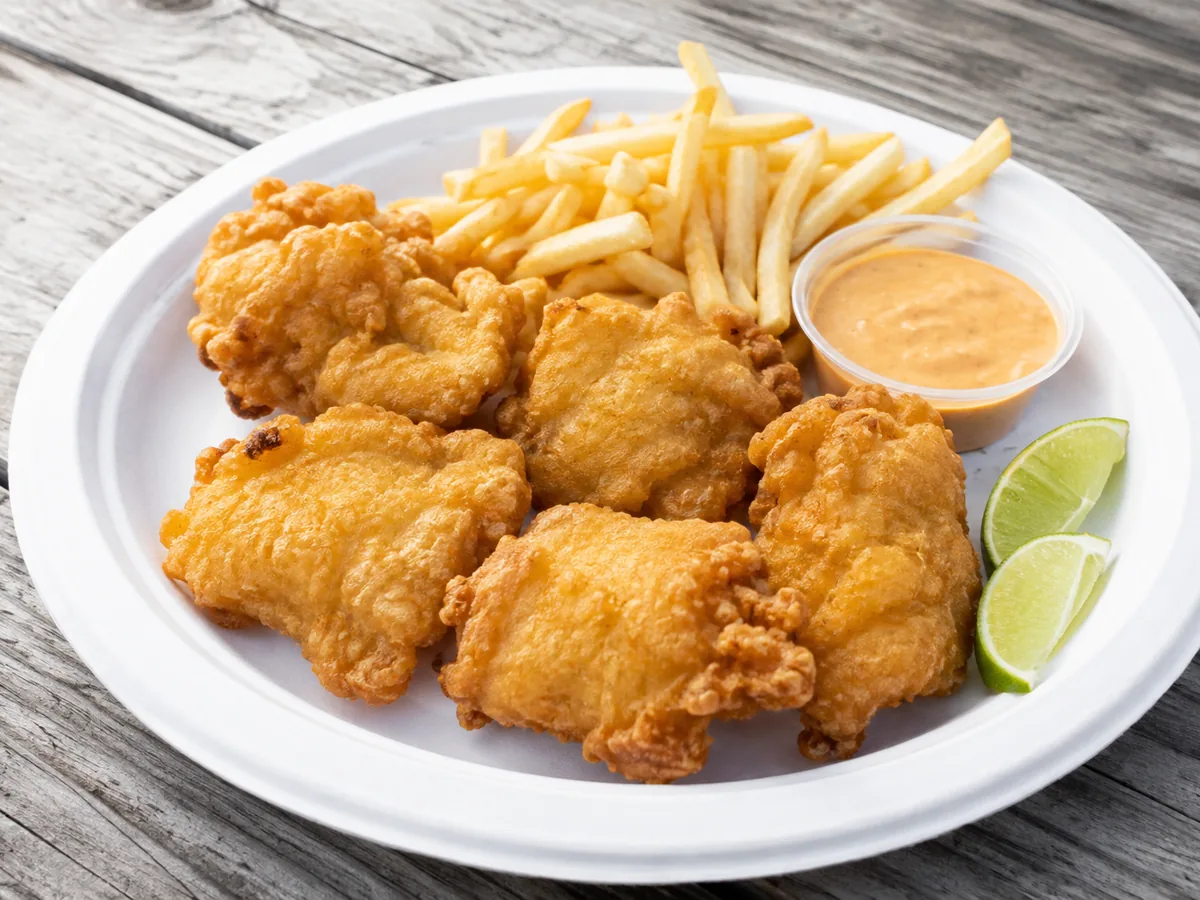
At the Fish Fry on Arawak Cay and at every roadside shack from Bimini to Inagua, cracked conch is the order. The queen conch is the national shellfish of the Bahamas, and this is its most loved form: pounded thin, breaded and fried until crisp, with lime and a pink dipping sauce.
The cracking is the technique. Conch is tough by nature, and a mallet, a sheet of plastic and a few patient minutes are what turn it into something that fries tender in two.
Conch
- 700 g1½ lbCleaned conch meat
- 22Limes, 1 juiced and 1 in wedges
- 6 g1 tspFine salt
- ½½Goat pepper, seeded and minced very finea Bahamian habanero; start with less
Coating
- 250 g2 cupsAll-purpose flour
- 22Eggs
- 120 ml½ cupEvaporated milk
- 150 g1½ cupsFine dry breadcrumbs
- 750 ml3 cupsNeutral frying oil
Dipping sauce
- 120 g½ cupMayonnaise
- 30 g2 TbspKetchup
- 15 ml1 TbspLime juice
- to tasteto tasteGoat pepper sauce
Cracking
Conch is a muscle that has spent its life hauling a shell across the sea floor, and it is as tough as that sounds. Pounding it thin, the cracking, breaks the fibres so it fries tender in a couple of minutes. Beat it to about 5 mm, evenly, without tearing.
Goat pepper
The Bahamian name for the small, fierce, fruity habanero-type chile. Half of one, minced fine, seasons the conch without burning; a whole one is a serious statement.
The five tastes on this plate
Salt is in the seasoning and the crumb. Fat is the frying oil and the mayonnaise sauce. Acid is lime, twice. Heat is goat pepper, in the meat and in the sauce. Umami is the conch itself, sweet and briny.
Equipment
- Meat mallet or the flat of a heavy cleaver
- Three shallow bowls, for the coating
- 4 to 5-quart heavy pot with a deep-fry thermometer
- Tongs and a rack lined with paper
- Instant-read thermometer
A heavy mallet with a flat face beats conch evenly; a textured face tears it. Wrap the conch in plastic before pounding to keep the kitchen dry.
Method
Crack the conch12 min
Slice the conch across into cutlets about 1 cm thick. Lay each between sheets of plastic and pound with the mallet until an even 5 mm thick, working from the centre outwards.
Slice conch crosswise into 1 cm cutlets. Place each between plastic sheets and pound from the centre outward to an even 5 mm thickness without tearing.
Season10 min
Toss the cutlets with the juice of one lime, the salt and the minced goat pepper. Rest 10 minutes.
Toss the cutlets with the juice of 1 lime, salt and finely minced goat pepper, starting cautiously with the pepper. Rest for 10 minutes.
Make the sauce3 min
Stir the mayonnaise, ketchup, lime juice and goat pepper sauce together. Chill.
Mix mayonnaise, ketchup, lime juice and goat pepper sauce until smooth. Chill the dipping sauce while you prepare and fry the cutlets.
Coat8 min
Set out the flour, the eggs beaten with the evaporated milk, and the crumbs in three bowls. Dredge each cutlet in flour, shake off the excess, dip in the egg and press into the crumbs to coat both sides.
Prepare three bowls: flour; eggs beaten with evaporated milk; breadcrumbs. Coat each cutlet in flour, shake off excess, dip in egg mixture and press both sides into crumbs.
Fry12 min
Heat the oil to 180 °C. Fry 3 pieces at a time, 2 minutes a side, until deep gold and crisp; the conch inside reads 63 °C. Drain on the rack and let the oil recover between batches.
Heat oil to 180 °C. Fry 3 cutlets at a time for 2 minutes per side until deeply golden, crisp and 63 °C inside. Drain on a rack; allow oil to recover between batches.
Serve
Hot, with lime wedges, the sauce, and fries or peas n' rice beside.
Serve the conch hot with lime wedges and chilled dipping sauce, with fries or peas n’ rice alongside.
Sensory cues of doneness
- Visual: a craggy gold crust; the conch inside white and tender when cut.
- Auditory: a brisk sizzle that quietens as the crust sets; a crunch at the bite.
- Olfactory: hot oil and toasted crumb, then lime and the sea.
Look for a rough golden crust and white, tender conch inside. The initial brisk sizzle should soften as the crust sets, and the coating should crunch when bitten.
Storing it
Cracked conch is for the moment it leaves the oil. Cleaned raw conch keeps a day refrigerated at 4 °C or colder, and freezes for 3 months; pound it while half-thawed.
Troubleshooting
- Rubbery conch.
Not pounded thin enough, or fried too long. Five millimetres, and two minutes a side.
- Crumbs fell off.
The conch was wet when floured, or the oil was cool. Pat dry, and wait for 180 °C.
- Greasy crust.
Too many pieces at once. Three at a time, and let the oil recover.
Substitutions
One-to-one swaps, with the technique change each one needs.
Ingredient substitutions
| Ingredient | Replace with | Culinary impact and technique adjustment |
|---|---|---|
| Conch | Abalone, or squid steaks pounded the same way | Both are tender in 90 seconds a side; do not overcook |
| Breadcrumbs | A thin batter of flour, cornstarch and cold soda water | Lighter and more like the fry-shack version |
| Evaporated milk | Whole milk | Slightly thinner egg wash; the crumb sticks a little less |
Scaling
Half
Two portions in the same oil; fry in two batches.
Double
Crack all the conch first and keep it cold. Fry in steady batches of three so the oil holds 180 °C.
What to serve it with
- French fries or peas n' rice
- Coleslaw
- A cold Kalik, or a sky juice
Questions
Where do I buy conch?
Caribbean fishmongers sell cleaned frozen conch; it is the standard form outside the islands. Thaw in the fridge overnight.
Why is it called cracked?
For the cracking, the pounding that tenderises the meat before it is fried.
Can I bake it?
The crumb will not crisp the same way. A very hot oven, 230 °C, on a rack, 12 minutes, is the nearest.