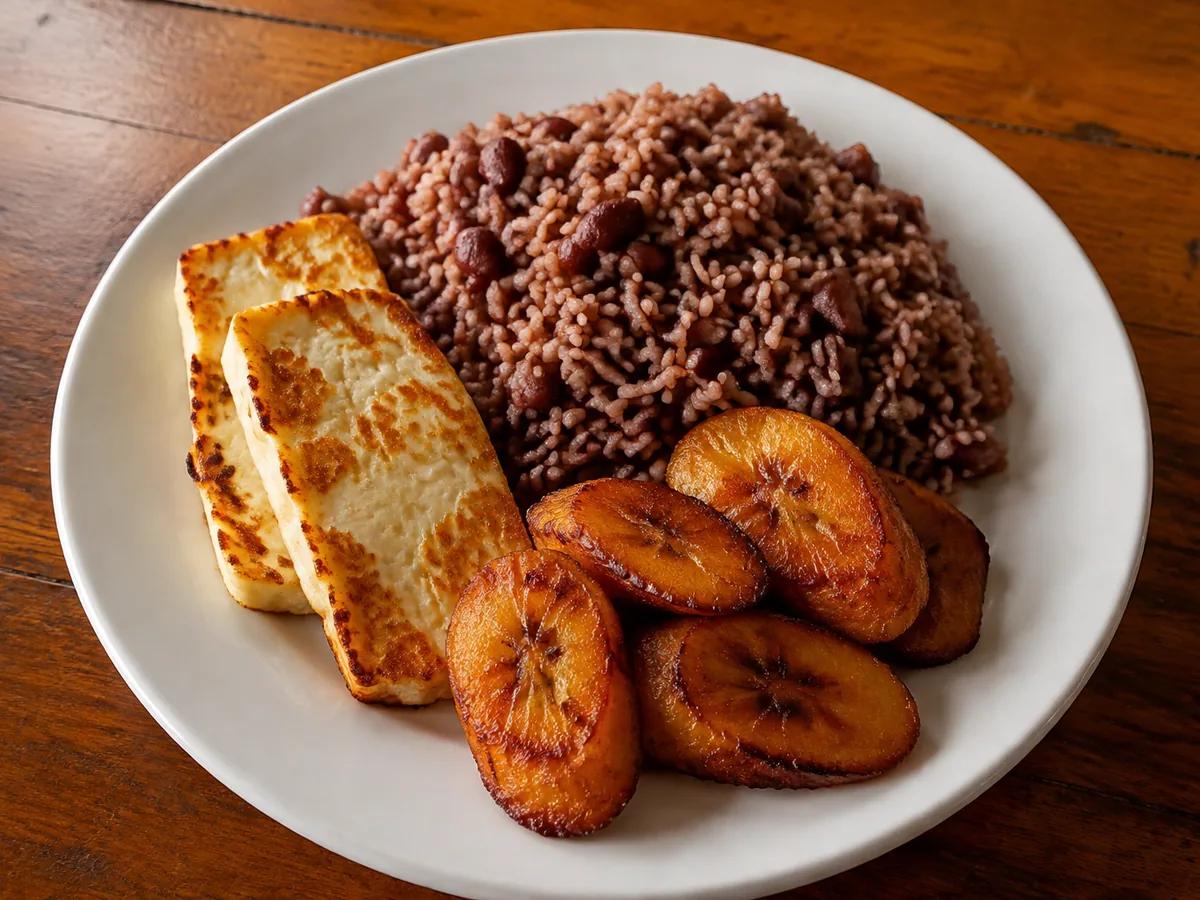
Gallo Pinto con Queso Frito y Maduros
Red beans, not black, and no bottled sauce anywhere. The anthocyanins in red silk bean liquor dye the grains deep crimson while twelve hours of chilling has already recrystallised the amylose — so the rice takes the colour without ever turning gummy.
- Prep
- 15 min
- Cook
- 20 min
- Serves
- 4 hearty portions
- Difficulty
- Easy
Researched · Kitchen testing pending
Morning in Managua starts with the smell of sizzling pork lard and wood smoke.
Unlike the Costa Rican gallo pinto made with black beans and bottled Lizano, the Nicaraguan version revolves around small red silk beans — thin-skinned, and giving a deep garnet-crimson cooking broth. Day-old white rice is fried hard in hot lard with minced onion and sweet green chiltoma, and the bean broth boils down and stains the grains deep mahogany while leaving them loose and separate.
It comes with thick slabs of salty white cheese fried crisp on the outside, and caramelised ripe plantains.
The rice and beans
- 400 g2.5 cupsCooked long-grain white rice, chilled at 4 °C for 12 hours or more
- 300 g1.5 cupsCooked Nicaraguan red silk beans, drained
- 100 mlscant ½ cupRich red bean liquor, reserved from the beans
The pan
- 45 ml3 TbspRendered pure pork lard, or neutral vegetable oil
- 150 g1 mediumWhite onion, peeled and cut into fine 3 mm brunoise
- 1 medium1 mediumSweet green chiltoma pepper, or green bell pepper, seeded and minced fine
- 3 cloves3 clovesFresh garlic, peeled and minced to a paste
- 6 g1 tspFine sea salt, adjusted to how the bean broth is seasoned
- 2 g½ tspFreshly ground black pepper
The cheese and plantains
- 400 g14 ozQueso blanco para freír, cut into 4 thick 100 g slabs about 1.5 cm thick
- 2 large2 largeRipe black-mottled plantains, sliced diagonally into 1.5 cm tajadas
- 120 ml8 TbspVegetable oil, for frying the cheese and then the plantains
Red silk beans, not black
Frijoles rojos de seda have thin tender skins and give a deep garnet-crimson broth. That broth is what separates the Nicaraguan version from the Costa Rican one, which uses black beans and bottled Lizano.
Twelve hours cold, minimum
Chilling realigns the linear amylose chains into tight crystalline structures. Cold retrograded grains hitting smoking lard get sheathed in fat instead of gelling together.
Strictly 100 ml of liquor
Enough to stain and season, little enough to evaporate off. Cups of bean water boil the rice instead of frying it.
Mash two tablespoons of beans
Pressed against the pan floor they release starch into the liquid, which helps the colour cling to every grain.
Hot oil for the cheese
Cold cheese into warm oil melts into a greasy puddle. At 180 °C a crust forms instantly and holds the slab together.
Passive time, counted separately
The rice chills 12 hours beforehand. That sits outside the times quoted above.
The five tastes on this plate
Salt is the seasoned bean liquor and the briny seared cheese. Fat is lard on every grain and the frying oil. Acid is mellow, brought at the table with pickled onions or vinegary cabbage. Heat is white onion, sweet chiltoma, garlic and black pepper. Umami is concentrated red bean starch, lard fond and toasted cheese curds.
Equipment
- 12 in cast-iron or carbon-steel skillet
- Second skillet, for the cheese and plantains
- Wide wooden spatula
- Paper towel
Traditionally a heavy cast-iron paila or aluminium caldero over wood embers. A 12-inch cast-iron skillet works in a modern kitchen — the thermal mass is what stops cold rice dropping the pan into a wet steam.
Method
Sweat the aromatics7 min
Melt the lard over medium until shimmering and sauté the onion and chiltoma 5 to 6 minutes until soft, translucent and fragrant, without browning.
Add the garlic for 1 minute.
Use cooked rice refrigerated at least 12 hours beforehand. Heat lard over medium until shimmering; soften onion and chiltoma 5–6 minutes without browning, then add garlic for 1 minute.
Deglaze with the beans3 min
Add the beans and the 100 ml reserved liquor, bring to a boil, and simmer 2 to 3 minutes, mashing 2 tablespoons of beans against the pan floor.
Add cooked red silk beans and exactly 100 ml reserved bean liquor. Bring to boiling, then simmer 2–3 minutes, mashing 2 tablespoons of beans against the pan bottom.
Fold in the cold rice8 min
Break up the clumps in the cold rice with your fingers and tip it all in.
Over high heat, fold continuously with a wide spatula 6 to 8 minutes as the grains drink the red broth.
Break up cold rice clumps with your fingers and add all the rice. Fold continuously with a wide spatula over high heat for 6–8 minutes as the grains absorb the red broth.
Evaporate and toast5 min
Spread the rice across the pan floor and leave undisturbed 60 seconds to toast lightly.
Toss vigorously 3 to 4 minutes more until every trace of free moisture has gone and the grains are loose, dry and glistening. Season and pull off the heat.
Spread rice over the pan bottom and leave untouched 60 seconds to toast. Toss for another 3–4 minutes until no free moisture remains and grains are separate and glossy. Season and remove from heat.
Fry the queso frito6 min
Heat 60 ml oil in a second skillet to 180 °C and pat the cheese slabs completely dry.
Fry 2 to 3 minutes a side until deeply golden and blistered outside while the inside stays warm and firm. Drain.
Heat 60 ml oil in a second skillet to 180 °C. Pat cheese slabs completely dry, fry 2–3 minutes per side until deeply golden and blistered with warm, firm centres, then drain.
Maduros, then plate8 min
In the same oil over medium, fry the plantain slices 3 to 4 minutes a side until mahogany-gold and caramelised.
Mound the hot gallo pinto on warm plates and flank it with a slab of queso frito and two tajadas.
In the same oil over medium, fry plantain slices 3–4 minutes per side until caramelized mahogany-gold. Serve hot gallo pinto on warm plates with a cheese slab and two tajadas.
Sensory cues of doneness
- Visual: grains stained deep red-mahogany separating cleanly with a fork, a crisp golden-bronze crust on the cheese, dark caramelised plantain edges.
- Auditory: a sharp crackle as the cold rice lands, then steady hissing that quietens as the bean water goes.
- Olfactory: rendered pork lard, toasted rice, sautéed chiltoma, garlic and browned cheese curds.
Check that red-mahogany rice grains separate cleanly, cheese has a crisp bronze crust and plantains have dark caramelized edges. The sizzling should quiet as bean liquid evaporates, leaving aromas of toasted rice, lard, chiltoma, garlic and cheese.
Storing it
Leftovers reheat beautifully in a hot skillet with a teaspoon of lard, fried until crisp on the bottom.
Troubleshooting
- Sticky, gummy porridge.
Warm fresh rice was used. It needs 12 hours cold so the starches retrograde.
- Boiled rather than fried rice.
Too much bean broth. Strictly 100 ml, then evaporate it off.
- The cheese melts into a puddle.
The oil was not hot enough. It must be at 180 °C so a crust forms on contact.
Substitutions
One-to-one global substitutions, with the technique adjustment each one requires.
Ingredient substitutions
| Ingredient | Replace with | Culinary impact and technique adjustment |
|---|---|---|
| Frijoles rojos de seda | Small Central American red beans, or red kidney beans | Small red beans match the silky texture; kidney skins are thicker |
| Pork lard | Unsalted European butter, or high-smoke vegetable oil | One-to-one. Butter adds dairy aroma, oil stays neutral |
| Queso concha negra | Halloumi, or queso blanco para freír | One-to-one, provided it has a high enough melting point to sear |
Scaling
Half, for 2 portions
Halve everything in a 10-inch skillet. The whole fry runs about 12 minutes.
Double, for 8 portions
Double everything across two 12-inch skillets — 800 g of cold rice in one pan drops the heat and the grains clump.
What to serve it with
- Salted Nicaraguan crema ácida, dolloped over the rice or the plantains
- Thick warm handmade white corn tortillas
- Shredded cabbage and tomato salad in white cane vinegar
- Cacao con leche, or black Matagalpa coffee
Questions
Can I use black beans?
You can, but Nicaraguan gallo pinto is defined by frijoles rojos de seda — they give the sweet earthy flavour and the red-mahogany colour.
What cheese substitutes for queso concha negra?
Queso blanco para freír, halloumi, or firm queso panela. Halloumi browns with the same crisp crust and salty chew.
Do leftovers reheat?
Very well — in a hot skillet with a little lard, fried crisp on the bottom.