Pâté Haïtien
French lamination with Caribbean soul — not the turmeric shortcrust of the British Caribbean, but real pâte feuilletée folded into over a hundred layers. A splash of vinegar weakens the disulfide bonds so the dough rolls without snapping back, and breadcrumbs trap the filling's juices so they never reach the pastry.
- Prep
- 1 hr
- Cook
- 25 min
- Serves
- 12 large pâtés, or 24 cocktail size
- Difficulty
- Hard
Researched · Kitchen testing pending
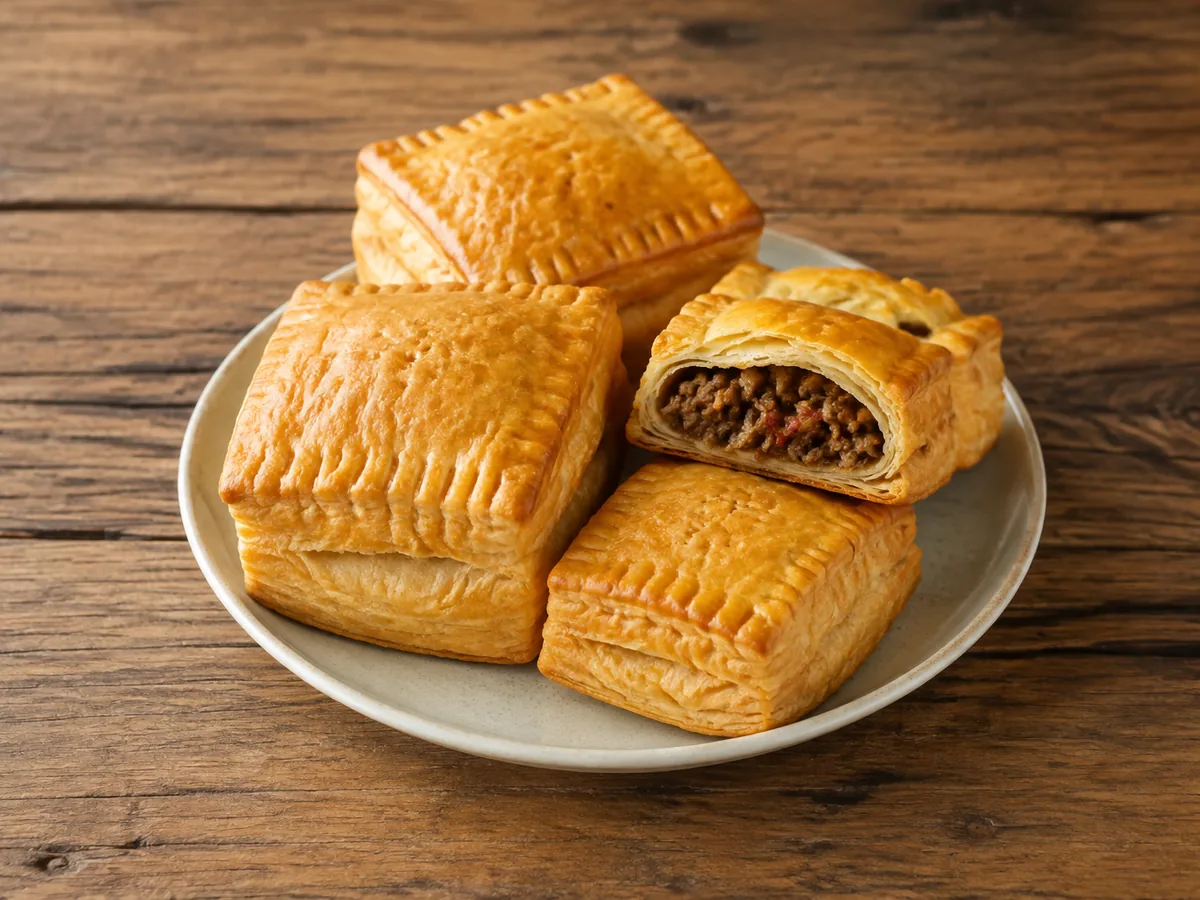
Morning bakeries from Pétion-Ville to Cap-Haïtien smell of melting butter and toasted pastry. Pâté Haïtien is the French colonial baking legacy transformed by Caribbean cooking.
Unlike British Caribbean patties with their yellow turmeric shortcrust, an authentic Haitian pâté uses classic pâte feuilletée, laminated with chilled butter and shortening, rolled and folded through three turns until hundreds of gossamer layers have formed.
Inside sits a concentrated filling of spiced ground beef, chicken or salted cod braised down with épice, garlic, shallot, wild thyme and a hint of Scotch bonnet. Baked hot, the pastry puffs into shattering buttery layers that crumble at the first bite.
The détrempe
- 500 g4 cupsAll-purpose wheat flour, about 11% protein, sifted
- 10 g2 tspFine sea salt
- 15 g1 TbspGranulated cane sugar
- 240 ml1 cupIce-cold filtered water
- 15 ml1 TbspWhite cane vinegar, or lemon juicethe gluten relaxer
- 100 g7 TbspVegetable shortening or leaf lard, chilled and cubed
The lamination
- 200 g14 TbspUnsalted European butter, 82% butterfat, chilled hard and pounded into a flat 15 × 15 cm square
The filling
- 500 g1.1 lbLean ground beef chuck (85/15)
- 30 ml2 TbspNeutral vegetable oil or butter
- 60 ml4 TbspHaitian green épice
- 1 medium1 mediumYellow onion or shallot, minced into fine 3 mm brunoise
- 4 cloves4 clovesFresh garlic, minced to a paste
- 15 g1 TbspTomato paste
- 4 whole4 wholeWhole cloves, finely ground
- 4 sprigs4 sprigsFresh thyme, leaves stripped
- ½ whole½ wholeScotch bonnet pepper, seeded and minced microscopically fine
- 8 g1.5 tspFine sea salt
- 2 g½ tspFreshly ground black pepper
- 60 ml¼ cupRich beef stock, or water
- 30 g⅓ cupFine plain breadcrumbsthe moisture binder
To glaze
- 1 large1 largeEgg, beaten with 15 ml whole milk
Vinegar relaxes the gluten
Lowering the dough pH weakens the disulfide bonds between glutenin and gliadin, which makes the détrempe supple enough to roll out without fighting back through three turns of lamination.
Breadcrumbs are structural
They gelatinise in the pan juices and trap the moisture. Without them the filling's liquid boils out in the oven and dissolves the delicate bottom layers of pastry.
Cold filling, cold butter
Warm filling melts the butter layers inside raw dough and the whole thing bakes greasy and dense. It has to go in refrigerator-cold.
Egg wash the top only
Let it run down the cut edges and it glues the laminated layers shut, and the pastry cannot rise. Brush the surface, nothing more.
200 °C, not lower
Below 190 °C the butter melts and runs out before the steam has a chance to push the sheets apart. Hot and fast is what makes lamination work.
Passive time, counted separately
The filling chills completely, the détrempe rests 30 minutes, and the laminated block chills twice for 45 minutes. None of that is active work.
The five tastes on this plate
Salt is in both the laminated pastry and the spiced beef. Fat is cold European butter and shortening building the layers, plus the chuck fat in the filling. Acid is vinegar in the dough and cooked tomato paste in the meat. Heat is minced Scotch bonnet, ground clove, garlic and black pepper. Umami is browned beef fond, reduced tomato paste and toasted butter pastry.
Equipment
- Skillet, for the filling
- Large bowl and a rolling pin
- Parchment paper, for pounding the butter
- Sharp pizza wheel
- Two rimmed half-sheet pans
- Pastry brush and a wire rack
Traditionally wood-fired deck ovens on iron sheets. Heavy rimmed half-sheet pans lined with parchment work in a modern kitchen — bake on the middle-lower rack so the base pastry crisps all the way through.
Method
Cook the filling20 min
Sauté the onion, garlic and épice in the oil 4 minutes, add the beef and cook 6 minutes broken into small morsels.
Stir in the tomato paste, ground cloves, thyme, minced Scotch bonnet, black pepper and 8 g salt, pour in the 60 ml stock, and simmer 5 minutes until nearly dry. Stir in the breadcrumbs until thick and cohesive, and chill completely.
Sauté onion, garlic and épice in oil 4 minutes; add beef and crumble while cooking 6 minutes. Add tomato paste, cloves, thyme, Scotch bonnet, pepper, 8 g salt and 60 ml stock. Simmer 5 minutes until nearly dry; bind with breadcrumbs and refrigerate until completely cold.
Make the détrempe12 min
Whisk the flour, sugar and 10 g salt, then rub in the 100 g cold shortening to pea-sized crumbs.
Whisk the ice water with the vinegar, drizzle it in while tossing with a fork, and knead 2 minutes into a cohesive square. Wrap and chill 30 minutes.
Mix flour, sugar and 10 g salt; rub in 100 g cold shortening to pea-sized crumbs. Combine ice water and vinegar; drizzle in while tossing with a fork. Knead 2 minutes into a square, wrap and chill 30 minutes.
Laminate — three turns25 min
Pound the 200 g butter between parchment into a flat 15 × 15 cm square. Roll the dough to 25 × 25 cm, set the butter in diagonally, and fold the corners over like an envelope, pinching the seams shut.
Roll to 20 × 45 cm and fold in thirds (turn 1). Rotate 90°, roll, fold again (turn 2). Chill 45 minutes. Roll and fold once more (turn 3) and chill 45 minutes.
Flatten 200 g cold butter to 15 × 15 cm. Roll dough to 25 × 25 cm; enclose butter diagonally and seal. Roll to 20 × 45 cm, fold in thirds; rotate 90° and repeat. Chill 45 minutes; roll and fold a third time, then chill another 45 minutes.
Roll and cut10 min
Heat the oven to 200 °C and line two sheet pans.
Roll the laminated block into a large rectangle 4 mm thick, trim the rough edges with a pizza wheel, and cut 12 rectangles of about 10 × 15 cm.
Heat oven to 200 °C and line two trays. Roll cold laminated dough 4 mm thick, trim rough edges and cut 12 rectangles approximately 10 × 15 cm.
Fill and seal15 min
Brush the borders with water and put 2 generous tablespoons of cold filling on one half of each rectangle.
Fold over, press the borders firmly to expel trapped air, crimp with fork tines, and prick two vent holes in the top. Space them 4 cm apart on the sheets.
Wet borders and place 2 generous tablespoons refrigerator-cold filling on half of each rectangle. Fold over, expel trapped air and press borders firmly; crimp with a fork. Pierce two top vents and space pastries 4 cm apart.
Glaze and bake25 min
Brush the tops only with egg wash, keeping it off the cut edges.
Bake at 200 °C 22 to 25 minutes until puffed high into distinct layers and deep golden-amber. Rest 5 minutes on a wire rack.
Brush tops only with egg beaten with 15 ml milk; keep cut edges clean. Bake at 200 °C for 22–25 minutes until deeply golden-amber with distinct risen layers. Rest on a rack 5 minutes.
Sensory cues of doneness
- Visual: golden-amber turnovers with high stratified laminated edges and a glossy egg sheen, with nothing leaking.
- Auditory: a loud delicate crackle as the layers shatter under a knife.
- Olfactory: browned butter pastry, toasted wheat, garlic-scallion épice, clove and seared beef.
Check for glossy golden-amber tops, tall separate pastry layers and no leaking filling. The layers should crackle delicately under a knife and smell of browned butter, spices and beef.
Troubleshooting
- Greasy, dense pastry.
The filling was warm when it went in and melted the butter layers. It must be refrigerator-cold.
- The pastry will not rise.
Egg wash ran down the cut edges and glued the layers, or the oven was below 190 °C.
- A soggy bottom.
The breadcrumbs were left out and the filling's juices soaked through.
Substitutions
One-to-one global substitutions, with the technique adjustment each one requires.
Ingredient substitutions
| Ingredient | Replace with | Culinary impact and technique adjustment |
|---|---|---|
| Home-laminated pastry | High-grade all-butter frozen puff pastry | Thaw in the fridge, cut into rectangles, and fill as directed |
| Ground beef | Shredded chicken, or flaked salt cod | One-to-one — pâté poulet and pâté morue are equally classic |
| Scotch bonnet | Habanero | One-to-one, seeded and minced microscopically fine |
Scaling
Half, for 6 pâtés
Halve everything. The bake stays 22 to 25 minutes at 200 °C.
Double, for 24 pâtés
Double everything and bake in two batches, so the oven recovers its temperature between trays.
What to serve it with
- Pikliz
- A cold Kola Couronne
- Strong black Haitian drip coffee
Questions
What fillings are traditional?
Spiced ground beef, shredded chicken and flaked salted cod — pâté bœuf, pâté poulet and pâté morue are the three bakery classics.
Can I use bought puff pastry?
Yes. Good all-butter frozen sheets substitute well — thaw in the fridge, cut, and fill as directed.
Why prick vent holes?
So steam from the filling escapes upward instead of forcing the crimped seam open.