Fry Jacks
The breakfast bread of Belize, a puffed and blistered triangle of fried dough. Flour, baking powder and salt with a little shortening rubbed in, brought together with warm water, rested twenty minutes, rolled thin, cut into triangles with a short slit through each centre, and fried at 180 °C until they balloon and turn gold. Eaten hot with beans, eggs or jam.
- Prep
- 25 min
- Cook
- 15 min
- Serves
- 12 fry jacks
- Difficulty
- Easy
Researched · Kitchen testing pending
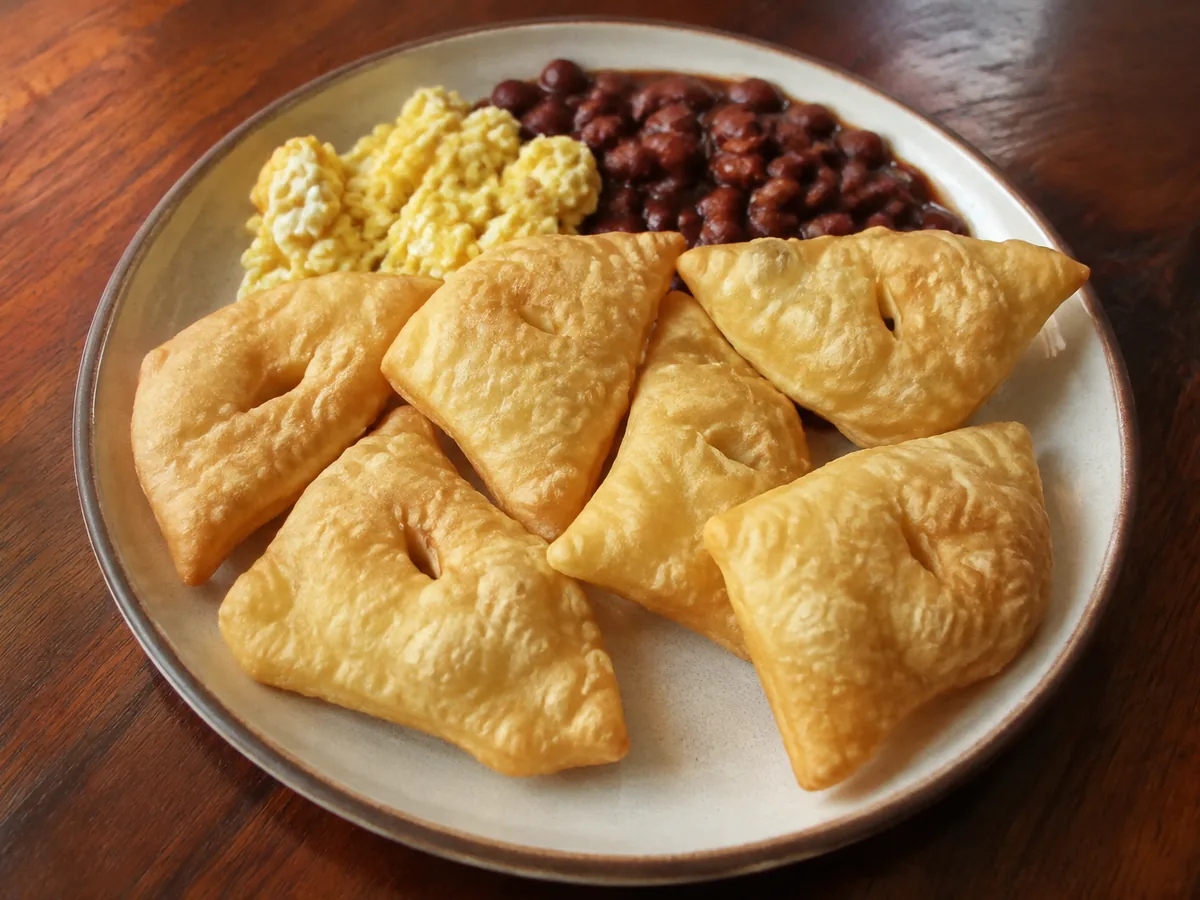
Every Belizean breakfast counter, from the market stalls of San Ignacio to the hotels on Ambergris Caye, starts the day with fry jacks. They are the simplest thing on this list and the one that travels least: a flour dough, rolled thin, cut into triangles and dropped into hot oil, where it inflates into a hollow, blistered pillow.
They are eaten torn open and filled. Stewed beans and scrambled eggs are the standard, cheese and refried beans a close second, and a jack with butter and jam is the sweet version children ask for.
- 500 g4 cupsAll-purpose flour
- 15 g1 TbspBaking powder
- 8 g1½ tspFine salt
- 30 g2 TbspShortening or butter, cold
- 300 ml1¼ cupsWarm waterabout 40 °C, plus a spoonful if the dough is dry
- 1 L4 cupsNeutral frying oil
Why they puff
A thin sheet of dough hits 180 °C oil and the water in it turns to steam faster than it can escape, so the sheet inflates like a pillow. The slit in the middle lets some of that steam out, which is what keeps the jack from bursting and gives it the classic pinched look.
Shortening or butter
Shortening makes a crisper, flakier jack and is what most Belizean kitchens use. Butter tastes better and browns a shade faster.
The five tastes on this plate
Salt is in the dough. Fat is the shortening and the oil. Acid comes from what goes beside it, a squeeze of lime on eggs or a spoon of pickled onion. Heat is habanero sauce. Umami is stewed beans and cheese.
Equipment
- Large mixing bowl
- Rolling pin
- 4 to 5-quart heavy pot with a deep-fry thermometer
- Slotted spoon and a rack lined with paper
A heavy pot holds the oil at temperature between batches. A thin one drops 20 degrees the moment the dough goes in, and the jacks soak up oil instead of puffing.
Method
Make the dough5 min
Whisk the flour, baking powder and salt in the bowl. Rub in the shortening with your fingertips until no lumps remain. Pour in the warm water gradually, mixing with a fork, then your hand, until a soft, slightly tacky dough forms.
Mix flour, baking powder and salt; rub in shortening until lump-free. Gradually mix in warm water, about 40 °C, with a fork, then by hand, to make soft, slightly tacky dough. Add a spoonful more water if dry.
Knead and rest22 min
Knead on a lightly floured surface 2 minutes, just until smooth. Cover with a damp cloth and rest 20 minutes so the gluten relaxes and the dough rolls without springing back.
Knead on a lightly floured surface 2 minutes, just until smooth. Cover with a damp cloth and rest 20 minutes so the gluten relaxes and the dough rolls without springing back.
Roll and cut8 min
Divide the dough into 3 balls. Roll each into a round about 5 mm thick and 22 cm across. Cut each round into 4 triangles, and cut a short slit, about 2 cm, through the centre of each triangle.
Divide the dough into 3 balls. Roll each into a round about 5 mm thick and 22 cm across. Cut each round into 4 triangles, and cut a short slit, about 2 cm, through the centre of each triangle.
Heat the oil6 min
Pour the oil into the pot to a depth of at least 5 cm and heat it to 180 °C. Test with a scrap of dough: it should rise and sizzle at once.
Pour the oil into the pot to a depth of at least 5 cm and heat it to 180 °C. Test with a scrap of dough: it should rise and sizzle at once.
Fry12 min
Slide in 2 or 3 triangles at a time. They sink, then rise and puff within 20 seconds. Fry 1 to 1½ minutes until the underside is gold, turn once, and fry another minute. Lift out with the slotted spoon and drain on the rack. Let the oil come back to 180 °C between batches.
Fry 2–3 triangles at a time; they should puff within 20 seconds. Cook 1–1½ minutes until golden underneath, turn once and fry another minute. Lift with a slotted spoon; drain on a rack. Return oil to 180 °C between batches.
Serve
Hot, within minutes, with stewed beans, scrambled eggs and cheese, or split open with butter and jam.
Hot, within minutes, with stewed beans, scrambled eggs and cheese, or split open with butter and jam.
Sensory cues of doneness
- Visual: a blistered, pale-gold pillow with darker gold ridges; the inside a hollow lined with soft dough.
- Auditory: a lively hiss as the dough goes in that quietens as the outside sets.
- Olfactory: hot oil and toasted flour, faintly sweet.
Look for a blistered, pale gold pillow with darker gold ridges and a hollow inside lined with soft dough. Listen for a lively hiss as the dough goes in that quietens as the outside sets; smell hot oil and toasted, faintly sweet flour.
Storing it
Fry jacks are for the morning they are made; they soften within the hour. The dough can be made the night before, wrapped and refrigerated, and rolled straight from the fridge.
Troubleshooting
- They did not puff.
The oil was under 170 °C, or the dough was rolled too thick. Check the thermometer and roll to 5 mm.
- Greasy and heavy.
Oil too cool, or too many in the pot at once. Two or three at a time, and let the oil recover between batches.
- They burst and splattered.
No slit, or a slit too small. A 2 cm cut through the centre before frying.
Substitutions
One-to-one swaps, with the technique change each one needs.
Ingredient substitutions
| Ingredient | Replace with | Culinary impact and technique adjustment |
|---|---|---|
| Shortening | Cold butter, lard or coconut oil | Butter browns faster; watch the last 30 seconds |
| Warm water | Warm milk, or half milk and half water | A softer, richer jack that browns more |
| All-purpose flour | Bread flour | Chewier and puffs higher; rest the dough 30 minutes |
Scaling
Half
Six jacks from one 22 cm round cut into 6 wedges; the same oil.
Double
Roll in 6 balls and fry in steady batches of 3 so the oil holds 180 °C. Keep the cut triangles under a cloth so they do not dry.
What to serve it with
- Stewed black beans and scrambled eggs
- Belizean or Dutch-style cheese, sliced
- Guava jam or honey, and a coffee
Questions
Can I bake them?
Not to the same result; the puff comes from hot oil. A dry pan gives a flat bread closer to a johnny cake.
Why the slit?
It vents steam so the jack inflates evenly without bursting, and it is how you tell a Belizean fry jack from any other fried dough.
Can the dough be made ahead?
Yes, up to a day, wrapped in the fridge. Let it sit 10 minutes before rolling.