Belizean Tamales
The banana-leaf tamale of the Mestizo north. Chicken thighs stewed with recado rojo, onion and sweet pepper, shredded, their gravy thickened with masa into the col. Lard beaten light and worked with masa harina and stock into a spreadable dough, spread on softened leaves, filled, folded and tied, then steamed ninety minutes until the leaf peels clean.
- Prep
- 1 hr 30 min
- Cook
- 2 hr
- Serves
- 16 tamales
- Difficulty
- Hard
Researched · Kitchen testing pending
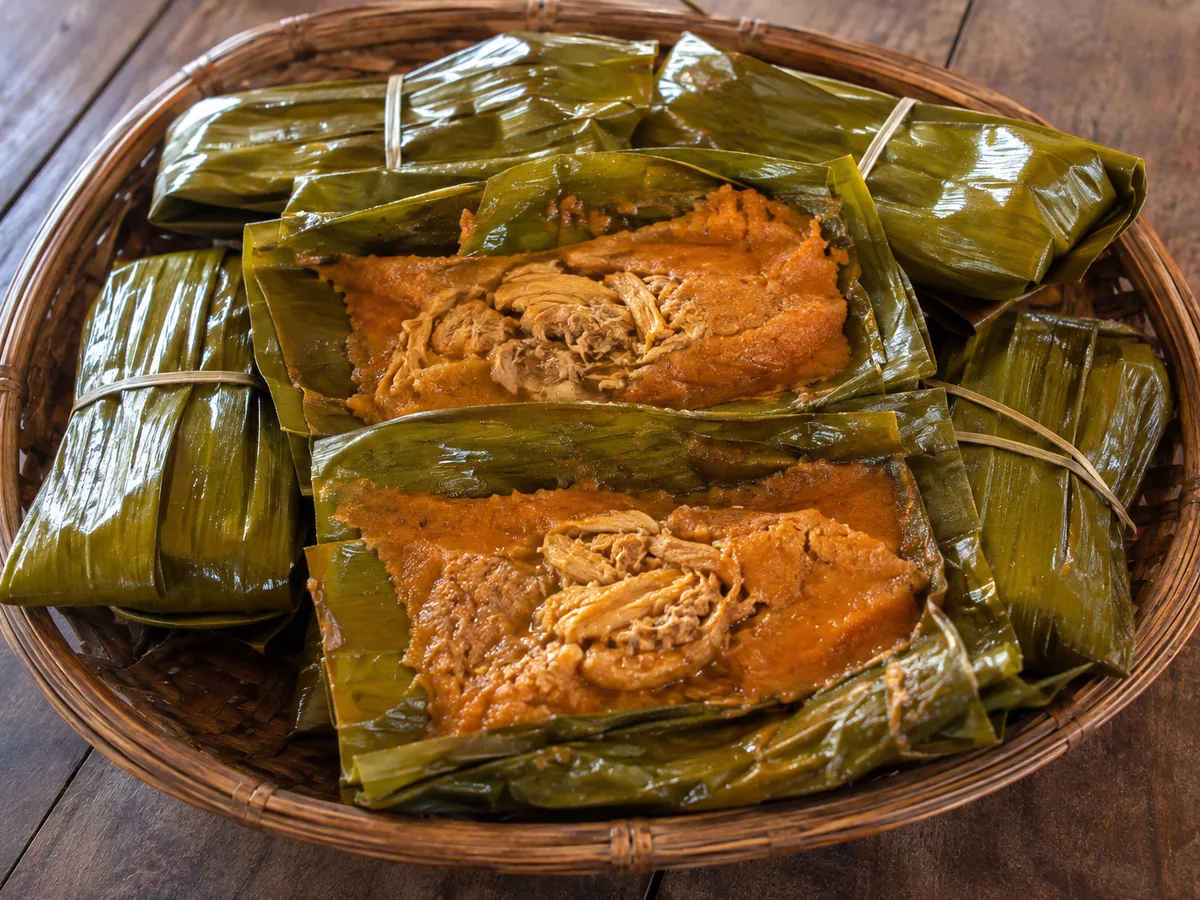
In Corozal, Orange Walk and the villages of the Cayo, tamales are wrapped in banana leaf, coloured orange with recado rojo, and steamed in tall pots on Saturday for Sunday. The masa is beaten with lard until it is light enough to spread, the chicken is stewed in recado and shredded, and its gravy is thickened into the col, a spoon of which goes into every parcel.
Ninety minutes of steam later, the leaf peels back from a firm, fragrant block of corn with a juicy centre. They are sold from coolers at the roadside and from kitchen doors, and a good tamale maker is known across the district.
Chicken and col
- 1.2 kg2⅔ lbBoneless chicken thighs
- 60 g¼ cupRecado rojo paste
- 2 medium2 mediumOnions, chopped
- 22Sweet peppers, chopped
- 500 ml2 cupsWater
- 6 g1 tspFine salt
- 30 g¼ cupMasa harina, to thicken the gravy
Masa
- 180 g¾ cupLard, at room temperature
- 750 g6 cupsMasa harina
- 1.1 L4½ cupsChicken stock, warm
- 30 g2 TbspRecado rojo paste
- 12 g2 tspFine salt
Wrapping
- 4 large4 largeBanana leavesenough for 16 pieces of 30 by 25 cm
- 11Kitchen string, cut in 16 lengths
Banana leaf, not corn husk
Belizean tamales are wrapped in banana leaf, which keeps the masa moist and gives it a green, tea-like scent that husks never do. The leaf must be passed over a flame first: raw, it cracks along the ribs the moment it is folded.
The col
The stewing gravy, thickened with a spoon of masa into something between a sauce and a custard. A spoon of col goes into every tamale with the chicken, and it is what makes the centre juicy.
The five tastes on this plate
Salt is in the masa and the chicken. Fat is the lard. Acid is the recado's vinegar and the tomato salsa beside. Heat is habanero sauce. Umami is the stewed chicken and its col.
Equipment
- Large pot, for the chicken
- Stand mixer with a paddle, or a large bowl and a wooden spoon
- A tall steamer pot with a rack, or a stockpot with a trivet
- Tongs
The steamer must hold the tamales above the water, not in it. A colander set over a few centimetres of water in a stockpot works.
Method
Prepare the leaves15 min
Cut the banana leaves into 16 pieces about 30 by 25 cm, removing the centre rib. Pass each piece over a gas flame or a hot dry pan for a few seconds a side until it turns glossy and pliable. Wipe with a damp cloth.
Cut the banana leaves into 16 pieces about 30 by 25 cm, removing the centre rib. Pass each piece over a gas flame or a hot dry pan for a few seconds a side until it turns glossy and pliable. Wipe with a damp cloth.
Stew the chicken40 min
Put the chicken in the pot with the 60 g recado, onions, peppers, water and salt. Bring to a simmer, cover, and cook 35 minutes until the thighs are tender. Lift out the chicken and shred it. Whisk the 30 g masa harina into the gravy and simmer 5 minutes until it thickens to a loose custard: this is the col.
Simmer chicken with 60 g recado, onions, peppers, water and salt, covered, 35 minutes until tender. Remove and shred chicken. Whisk 30 g masa harina into the gravy; simmer 5 minutes to a loose custard (col).
Make the masa15 min
Beat the lard in the mixer 3 minutes until light and white. Dissolve the 30 g recado and the salt in the warm stock. Add the masa harina to the lard in three additions, alternating with the stock, and beat to a soft, spreadable dough the texture of thick hummus. Add a splash more stock if it is stiff.
Beat lard 3 minutes until light and white. Dissolve 30 g recado and salt in warm stock. Beat masa harina into lard in three additions, alternating with stock, until soft and spreadable like thick hummus; loosen with extra stock if stiff.
Fill and fold30 min
Lay a leaf shiny side up. Spread 100 g of masa in a rectangle 12 by 15 cm in the centre. Put 40 g of shredded chicken and a tablespoon of col down the middle. Fold the long sides over so the masa encloses the filling, fold the ends under, and tie with string. Repeat for 16.
Place a leaf shiny-side up. Spread 100 g masa into a 12 × 15 cm rectangle; add 40 g chicken and 1 tablespoon col. Fold long sides to enclose filling, tuck ends underneath and tie. Make 16.
Steam1 hr 30 min
Stand the tamales upright, folds down, on the steamer rack over boiling water. Cover and steam 90 minutes, topping up with boiling water every 30 minutes. A tamale is done when the leaf peels away cleanly and the masa is firm and springy.
Stand the tamales upright, folds down, on the steamer rack over boiling water. Cover and steam 90 minutes, topping up with boiling water every 30 minutes. A tamale is done when the leaf peels away cleanly and the masa is firm and springy.
Rest and serve10 min
Rest 10 minutes out of the steamer so the masa sets. Unwrap at the table.
Rest 10 minutes out of the steamer so the masa sets. Unwrap at the table.
Sensory cues of doneness
- Visual: masa the colour of a mango, firm-edged, releasing from the leaf without sticking.
- Auditory: a steady rattle of boiling water below, never silence, which means it has run dry.
- Olfactory: warm banana leaf, corn and annatto.
Look for mango-coloured, firm-edged masa that releases from the leaf without sticking. Listen for a steady rattle of boiling water below (silence means it has run dry); smell warm banana leaf, corn and annatto.
Storing it
Keep wrapped, refrigerated, up to 4 days; re-steam 20 minutes to 74 °C inside. They freeze wrapped for 3 months and re-steam from frozen in 40 minutes.
Troubleshooting
- Masa stuck to the leaf and crumbled.
Under-steamed. Give it 15 minutes more and rest before unwrapping.
- Dense, dry masa.
Not enough lard beaten in, or too little stock. Beat the lard until white and aim for a dough that spreads easily.
- Leaves split while folding.
They were not softened. A few seconds over a flame until glossy.
Substitutions
One-to-one swaps, with the technique change each one needs.
Ingredient substitutions
| Ingredient | Replace with | Culinary impact and technique adjustment |
|---|---|---|
| Banana leaves | Corn husks, soaked 30 minutes, two per tamale | Drier and smaller; use 70 g masa each and make 20 |
| Lard | Vegetable shortening, or 150 ml neutral oil | Lighter flavour; oil gives a denser masa |
| Chicken thighs | Pork shoulder in 3 cm cubes, stewed 1 hour | The other classic filling; shred the same way |
Scaling
Half
Eight tamales; the steaming time does not change.
Double
Beat the masa in two batches; steam in two pots or in two rounds.
What to serve it with
- Tomato and habanero salsa, or plain sliced tomato
- Sliced onion in sour orange juice
- Coffee, or a cup of cocoa tea
Questions
Why does the masa need so much stock?
Masa harina is dried and needs roughly one and a half times its weight in liquid to become a spreadable dough. A stiff dough steams into a dry tamale.
Can I steam them lying flat?
Yes, in layers, if the pot is wide. Upright is easier to keep out of the water.
Are these the same as bollos?
Close cousins. Bollos are smaller and often plainer; the recado-red chicken tamale in banana leaf is the Sunday and Christmas one.