Belizean Boil Up
The Kriol one-pot of the river villages, everything boiled in one water and sauced at the end. Salted pigtail soaked overnight and simmered until it yields, then cassava, sweet potato and green banana added by their cooking times, eggs in their shells and flat boil cakes last. Snapper fried apart, and a bright tomato and onion sauce spooned over the whole plate.
- Prep
- 40 min
- Cook
- 1 hr 15 min
- Serves
- 6
- Difficulty
- Medium
Researched · Kitchen testing pending
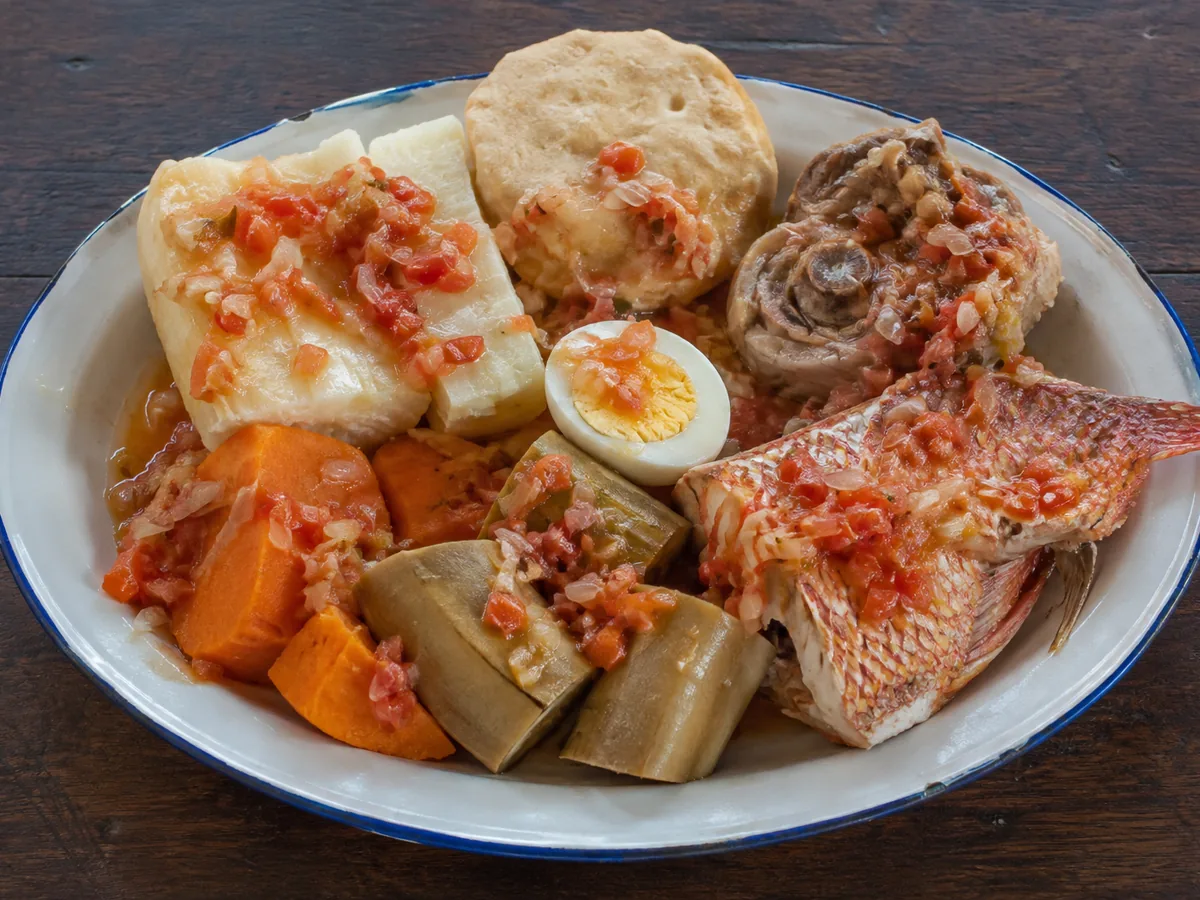
Boil up is the Kriol answer to a full larder and one fire. Along the Belize River, and on Saturdays in Belize City, a pot goes on with salted pigtail and water, and over the next hour the ground food goes in by cooking time: cassava first, then sweet potato, green bananas, eggs still in their shells, and finally the boil cakes, flat rounds of johnny cake dough that cook in the broth.
The fish is fried separately so it stays whole, and the plate is finished with a tomato and onion sauce spooned over everything. It is plain, filling food, and in Belize it is served with real affection.
The pot
- 500 g1 lb 2 ozSalted pigtail, cut in 5 cm pieces
- 4 L16 cupsWater, plus more for soaking
- 500 g1 lb 2 ozCassava, peeled, core removed, in 5 cm chunks
- 500 g1 lb 2 ozSweet potato, peeled, in 5 cm chunks
- 44Green bananas, peeled and halved
- 44Eggs, in the shell
Boil cakes
- 500 g4 cupsAll-purpose flour
- 8 g2 tspBaking powder
- 5 g1 tspFine salt
- 300 ml1¼ cupsWater
Fish and sauce
- 500 g1 lb 2 ozSnapper fillets, skin on, in 6 pieces
- 11Lime, juiced
- 45 ml3 TbspNeutral oil30 ml for the fish, 15 ml for the sauce
- 500 g1 lb 2 ozTomatoes, chopped
- 1 medium1 mediumOnion, sliced
- 6 g1 tspFine salt
- 2 g½ tspBlack pepper
Salted pigtail
Cured in brine and sold in buckets at Caribbean markets. It seasons the whole pot, which is why nothing else in the water gets salt. An overnight soak with two changes of water takes it from inedible to merely well seasoned.
Ground food
The Belizean name for the roots and green bananas that fill a boil up. They go in by cooking time, cassava first because it is the slowest, so that everything is tender at once.
The five tastes on this plate
Salt is the pigtail. Fat is the pork and the fish's frying oil. Acid is the tomato and the lime on the fish. Heat is black pepper and habanero sauce at the table. Umami is the long-boiled pork and the fried fish.
Equipment
- 8 to 10-quart stockpot
- Frying pan, for the fish
- Small saucepan, for the sauce
- Instant-read thermometer
One big pot is the point. The only other pans are for the fish, which would fall apart in the water, and the sauce.
Method
Soak the pigtail12 hr
Cover the pigtail with cold water and refrigerate overnight, changing the water twice. Drain.
Cover the pigtail with cold water and refrigerate overnight, changing the water twice. Drain.
Simmer the pork45 min
Put the pigtail in the stockpot with the 4 litres of water, bring to a boil, skim, and simmer 45 minutes until the skin is tender and the meat loosens from the bone. Taste the water: it should be seasoned, not salty. Dilute with a cup of fresh water if it is.
Bring pigtail and 4 litres water to a boil; skim. Simmer 45 minutes until skin is tender and meat loosens from bone. Taste; dilute with a cup of fresh water if salty. Do not add salt to the pot.
Make the boil cakes10 min
While the pork simmers, mix the flour, baking powder and salt, add the water and knead 1 minute to a firm dough. Divide into 6 and pat each into a flat round 10 cm across and 2 cm thick.
While the pork simmers, mix the flour, baking powder and salt, add the water and knead 1 minute to a firm dough. Divide into 6 and pat each into a flat round 10 cm across and 2 cm thick.
Add the ground food30 min
Add the cassava to the pot and cook 10 minutes. Add the sweet potato, the green bananas and the eggs in their shells and cook 10 minutes more. Slide in the boil cakes and simmer 12 minutes until they are cooked through and a knife goes cleanly into every root.
Cook cassava in the pot 10 minutes. Add sweet potato, green bananas and shell-on eggs; cook 10 minutes. Add boil cakes; simmer 12 minutes until cooked through and a knife enters every root easily.
Fry the fish8 min
Season the snapper with the lime juice, a pinch of salt and pepper. Heat 30 ml oil in the frying pan over medium-high and fry the fish skin side down 4 minutes, then 2 to 3 minutes on the flesh side, until opaque and 63 °C at the centre.
Season snapper with lime, a pinch of salt and pepper. Heat 30 ml oil over medium-high; fry skin-down 4 minutes, then flesh-side 2–3 minutes, until opaque and 63 °C at the centre.
The sauce10 min
Heat the remaining 15 ml oil in the saucepan, soften the onion 4 minutes, add the tomatoes, salt and pepper and cook 6 minutes to a loose, bright sauce.
Heat the remaining 15 ml oil in the saucepan, soften the onion 4 minutes, add the tomatoes, salt and pepper and cook 6 minutes to a loose, bright sauce.
Serve
Drain the pot. Peel the eggs and halve them. Give each plate cassava, sweet potato, banana, a boil cake, a piece of pigtail, half an egg and a piece of fish, and spoon the tomato sauce generously over all of it.
Drain the pot. Peel the eggs and halve them. Give each plate cassava, sweet potato, banana, a boil cake, a piece of pigtail, half an egg and a piece of fish, and spoon the tomato sauce generously over all of it.
Sensory cues of doneness
- Visual: cassava snowy and splitting, sweet potato orange and soft, banana pale green-grey and firm; the sauce red and glossy over everything.
- Auditory: a steady simmer, and the snapper skin crackling in the pan.
- Olfactory: pork broth, then fried fish and sweet cooked tomato.
Check that cassava is white and splitting, sweet potato soft, and banana firm. Keep a steady simmer; fish skin should crackle. Finish with glossy red sauce and aromas of pork broth, fried fish and cooked tomato.
Storing it
Keeps 2 days refrigerated, the roots and pork in a little of the cooking water. Reheat in that water to a simmer; the boil cakes soften on reheating and are best fresh. The fish is for the day.
Troubleshooting
- Everything tastes of salt.
The pigtail was under-soaked. Overnight with two water changes, and taste the pot before adding the roots.
- Boil cakes gummy.
Dough too wet, or added too early. A firm dough, and the last 12 minutes only.
- Cassava still hard.
Cut too large, or the fibrous core was left in. Five centimetre chunks, core out, and in first.
Substitutions
One-to-one swaps, with the technique change each one needs.
Ingredient substitutions
| Ingredient | Replace with | Culinary impact and technique adjustment |
|---|---|---|
| Salted pigtail | Smoked ham hock, or salt beef | Hock needs no soaking; salt beef needs the same overnight |
| Cassava | Yam, taro or extra sweet potato | Yam takes as long as cassava; the others go in later |
| Snapper | Any firm white fish, or salt cod soaked and flaked | Salt cod is the older way; skip the extra salt |
Scaling
Half
A 5-quart pot with 2 litres of water; the same timings.
Double
A 16-quart pot, or two pots. Fry the fish in batches so the pan stays hot.
What to serve it with
- Habanero sauce on the table
- Sliced avocado
- A cold lime juice or Belikin
Questions
Why boil the eggs in the same pot?
One pot is the tradition and the eggs take on the pork broth's seasoning through the shell. Ten minutes gives a firm yolk.
Is the fish always fried?
Fried or steamed with the pot's lid on top for the last minutes. Fried is the Belize City way and gives the plate its crunch.
What is a boil cake?
A flat flour dumpling, the same dough as a johnny cake, boiled in the pot rather than baked or fried.